DISCLAIMER
These are my impressions only, based on (some) research, my observations and my discussions with (some) Northern Irelanders during my recent visit to Belfast.
I never thought we’d visit here. I’d always been put off by the violence and the unsettled nature of the place. Particularly Belfast. I even strongly advised (= told) some of my children not to visit.
But, things have changed, and not only for tourists like us, but also, and more importantly, for the locals themselves.
Not that everyone is happy about the current arrangements though, which we soon learnt.
While we waited to board our plane to Belfast a few days ago, we got talking (actually it was more ‘listening ‘) to three brothers from Derry. One of them was louder than the others and very outspoken about his beliefs – let’s call him Paul, the quieter one was in fact called John, and the third one I’m going to assume his name was Patrick. (Some readers will know why I’ve chosen the two made-up names).
All of them were pretty ‘turped up’, even sharing a beer in line while we waited to board the plane. Yes, we were lined up waiting to show our tickets.
And it was not Londonderry they were from; it was Derry.
The loud one (Paul) continued to tell us of their (implying many Northern Irelanders) despise of the current arrangements, particularly the link to the Monarchy and the UK.
The Northern Ireland accent is very strong, but Mick and I could understand most of what he was saying. We could definitely understand one word he used repeatedly – “f#####g”.
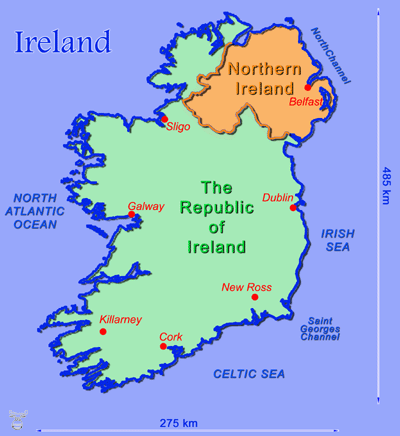
Mick and I knew something of the history of this area, but the more we heard and saw, the more we realised we knew ‘diddly squat’.
For example – we both knew of The Battle Of The Boyne – but I certainly didn’t know it was celebrated as a public holiday each 12th July in Northern Ireland.
Not that everyone openly celebrates it though.
This date is recognised as the victory of the Protestant King William of Orange over the Catholic French King James II in 1688.
So, on the 12 July, about half of the population of Northern Ireland hold parades, light bonfires, fly the Union Flag, and celebrate being a ‘loyalist’ or a ‘unionist’.
But not if the 12th falls on a Sunday. The parades are then held on Monday.
The other half exit the country or stay indoors (so we were told).

We saw this yesterday where some Orangemen / Loyalists / Unionists were demonstrating about the Union Flag not being flown every day at Belfast City Hall.
The message on the lower flag from a group called the Loyal People’s Protest says…
“A message to the Alliance and Sinn Féin
We haven’t went (sic) away you know!!
No surrender. “
One observation Mick made, and I agreed with him, was that in Northern Ireland the use of euphemisms has been taken to a new level.
The Troubles – used to describe thirty years of vicious violence and needless loss of lives.
Parades – used to describe what usually turn out to be ‘protests’.
Unionists – want to be united / remain united with the United Kingdom; May also be called Royalists or Loyalists – people who love and support the Monarchy and who are happy to be part of the United Kingdom. (These are usually the Protestants and might be referred to as “The Orange”, after William of Orange).
Nationalists – want to be united too (so it is s bit confusing), but not as part of the UK, rather united with The Republic of Ireland. The term is used to describe people who prefer the Irish identity. They might promote Gaelic language, and they don’t want to have a border between Ireland. (These are usually the Catholics and might be referred to as “The Green”).

The fact that the current Lord Mayor of Belfast is a woman – isn’t so unusual, she’s the fifth woman to hold this role. She is from the Sinn Féin Party (the largest Nationalist Party).
We read that in 1997, the Lord Mayor of Belfast was a Catholic – the first one to hold that office. That surprised us because Belfast is predominately a Catholic population, but politically it has been ruled by Unionists.
As we drove up to the Giants Causeway – we noticed some villages were flying the Union Flag, while in other villages there were no flags. We were told that was because certain towns were predominantly either unionists or nationalists.
We also learnt that schools in Northern Ireland are segregated. There are Catholic Schools and Controlled Schools (which are open to all faiths or none, and were predominantly Protestant). Some parents are trying to establish a third system of integrated schools.
This is a complex place, but we had a fabulous time and would definitely encourage others to visit. Tourism is a new and important industry here.
A note of warning though – and there is a pun intended here.
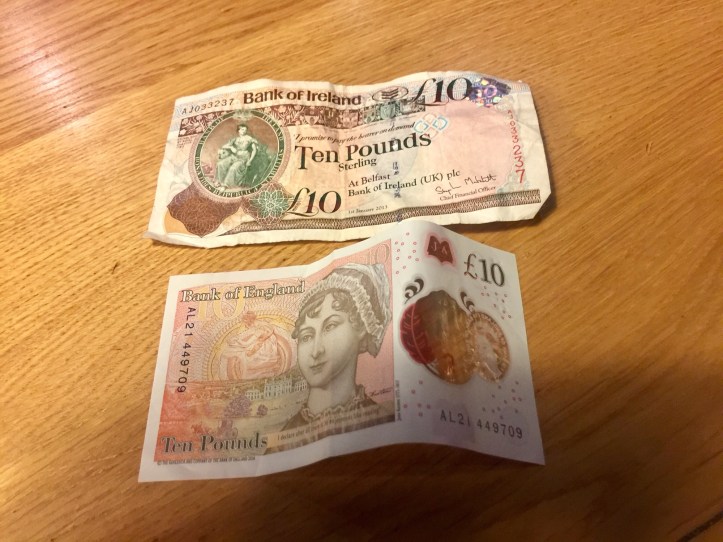
Be careful with the ‘paper’ money (notes).
The first time I paid for something I was given a £10 note in my change – the top note in this photo with the Bank of Ireland name clearly visible. The note in the lower half of the photo is the Bank of England note.
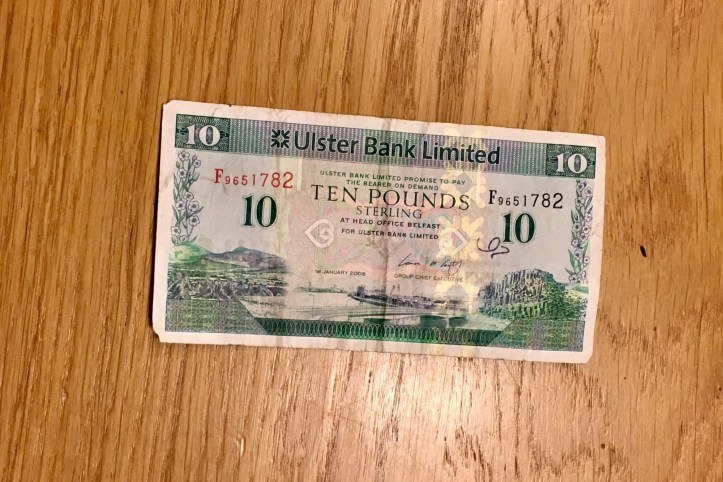
Then I got a different note from the Ulster Bank.
Our son had warned us about this before we came, so we were on the lookout. As these notes are not considered legal tender in other parts of the United Kingdom.
These notes are legal currency but technically not legal tender. I really don’t get that but I did make sure I spent them all before we flew back to England.
 Jane and Mick's Holiday Adventures