In fact, it can get you two hours travelling on a bus in and around the prefecture (similar to capital) of the Pyrénées-Orientale. (Perpignan).
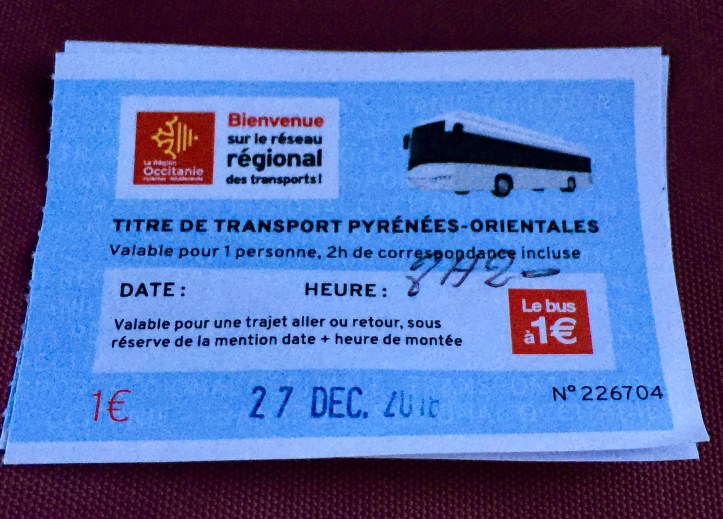
The other day we decided to catch the bus to Perpignan to re-acquaint ourselves with the car park around the railway station. We have friends arriving from Australia very soon, and we do not want to get lost 2 minutes after we collect them (I’ll be driving on that occasion). They are flying into Barcelona and then catching a train to Perpignan. Besides being exhausted, I don’t want to get them too anxious about my navigating skills.

Can you spot Mick waiting inside the bus shelter? It is 8.15am and the bus is due in 5 minutes. Before it does arrive, two more passengers appear, one loaded with suitcases and a huge shopping bag filled to the brim, the other obviously very well known because she was cheek-kissed by every passenger that got on the bus in the next half hour and she cheek kissed the driver.
It was a mild morning, about 6ºC, but standing outside was quite fresh.
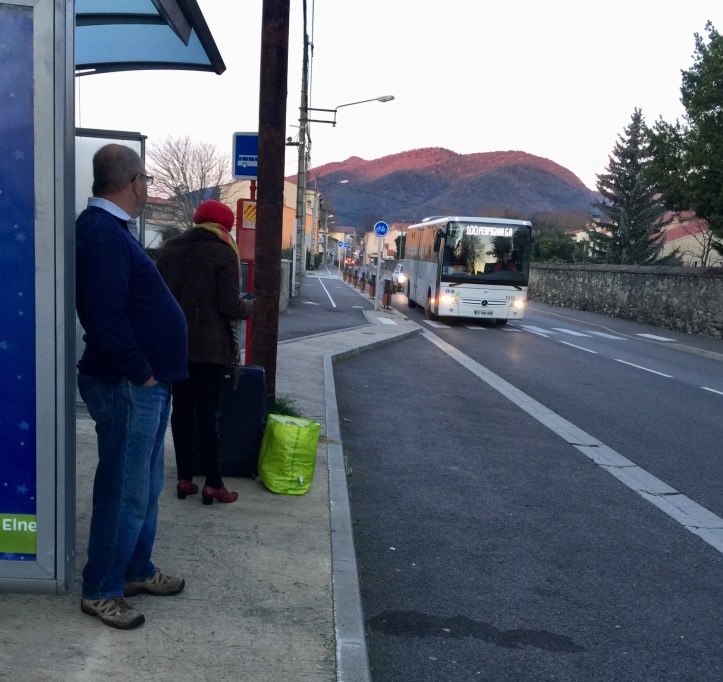
The bus between Quillan and Perpignan is Bus 100.
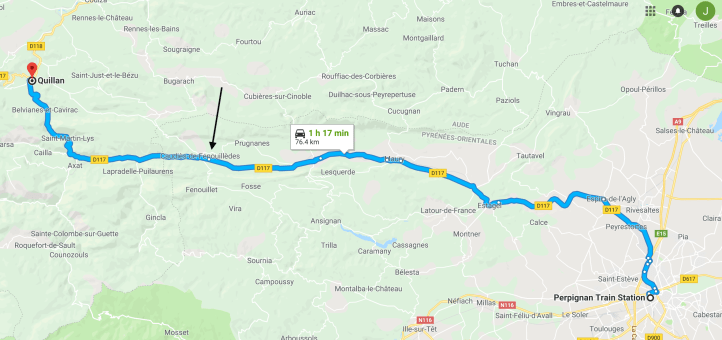
The arrow shows our village – Caudiès de Fenouilledes. It takes about 70 minutes from our stop to get to the bus depot (Gare Routière) in Perpignan, This is longer than if you were to drive there directly as the trip involves some important stops that aren’t really on the way e.g. the Hospital and a private health clinic.
We spent a few hours in Perpignan, not really our favourite French city by any stretch, but we did achieve our goal.
Mick and I feel quite at home in this part of France, which was part of Spain up until 1659. It is also known as Northern Catalonia. Signs for villages are usually written in both French and Catalan, and quite often there are French flags and Catalan flags flown on private homes.
The appearance of the people, the men in particular, show strong Spanish influences; dark hair and deepest dark eyes, with quite slim builds. The dialect here is different to the French spoken in Paris (for example). Which doesn’t help me as I try to practice my French with the locals.
This part of France is quite poor. When we were first here I recall our host describing why she loved the area and had lived here for so many years. She used the term ‘peasant’ to describe a large chunk of the local population. I know she did not mean this in a derogative way, but had used the term as it would have been used in 15th Century France – where the word “païsant” meant one from the pays, or countryside.
You might be interested in some other things you can buy in this area for €1:
- 3 baguettes (in a supermarket)
- 1 provincial baguette (in a boulangerie)
- 4 croissants (in a supermarket)
- 1.2 croissants (in a boulangerie)
- 1 can of beer (in a supermarket)
Other things you can buy in this area for between €1 – €2:
- a coffee (€1.40)
- a bottle of red wine (€1.80 – in some [large] supermarkets and yes it is the cheapest you can buy).
Mick is super happy when he finds some of those red wines still on the shelf, but quite often they are sold out.
You can also catch (some) trains from Perpignan for €1!! For example to Montpelier.
The only catch is you have to book early. I am not sure how early yet, but it is possible.
We may have to try this cheap travel option out if we get a letter back from the Office of Immigration and Integration calling us for an interview about our visa applications.
If we do get that letter, I am in big trouble with Mick!
 Jane and Mick's Holiday Adventures