I still get confused about how France is organised into Regions, Departments and Communes. And I have been her now for almost 4 months.
As background to this post, Mick and I are staying in a traditional stone farmhouse that was built between 1798 and 1800 in an area called Les Combrailles, in the Puy-de Dôme Department of the L’Auvergne Region. This area is famous for its locals’ involvement in World War II as part of the French Resistance.


This sign and derelict building are just across from the house we are staying in. The sign signifies an important location of action taken by the local French Resistance on 16 May 1944.
This sign triggered our interest to find out more, because we have seen quite a few of these signs on the roads we are travelling, and on the walks we take with the dogs. Our hosts had also mentioned something about their house having been involved in this ‘action’.
Saint Gervais d’Auvergne, depending on which road you take, is either 11 Km or 19Km from here. There is a museum in the town that documents the French Resistance in Les Combrailles. So Mick and I headed there this morning. It is a free museum that consists of a very well organised collection of memorabilia from WWII.


The displays document the establishment and actions of several maquis in Les Combrailles, known as Zone 13.
From 1942 and especially in 1943, volunteers joined the Underground and eventually they were placed into a maquis – a rural guerrilla group of fighters. Initially, they consisted of men and women who were trying to escape conscription into Vichy France’s Compulsory Works Service (Service du travail obligatoire – STO) where they had to provide labour for the Germans.


The fear of capture and deportation into Germany provided motivation to serve and work as part of the French Resistance. The maquis relied very much on the support of the local community they were based in. They aided in the escape of downed Allied airmen, Jews and others pursued by the Vichy and Germans.

The hills and forests in this area helped the members of the Resistance to hide and to organise ‘ambushes’ against the enemy, who in many cases were fellow Frenchmen working under the Vichy Government. In late 1943, the GMR (Mobile Reserve Group) acted under the Vichy Government, and with the agreement of the Germans, against the maquis. The GMRs were not locals and some historians believe they showed little hesitation to act against the French Resistance fighters.
As we were reading and learning about this, we spotted a photo and some information about a site that looked very familiar to us. It showed the corner of the house we are staying in and the derelict building across the road.
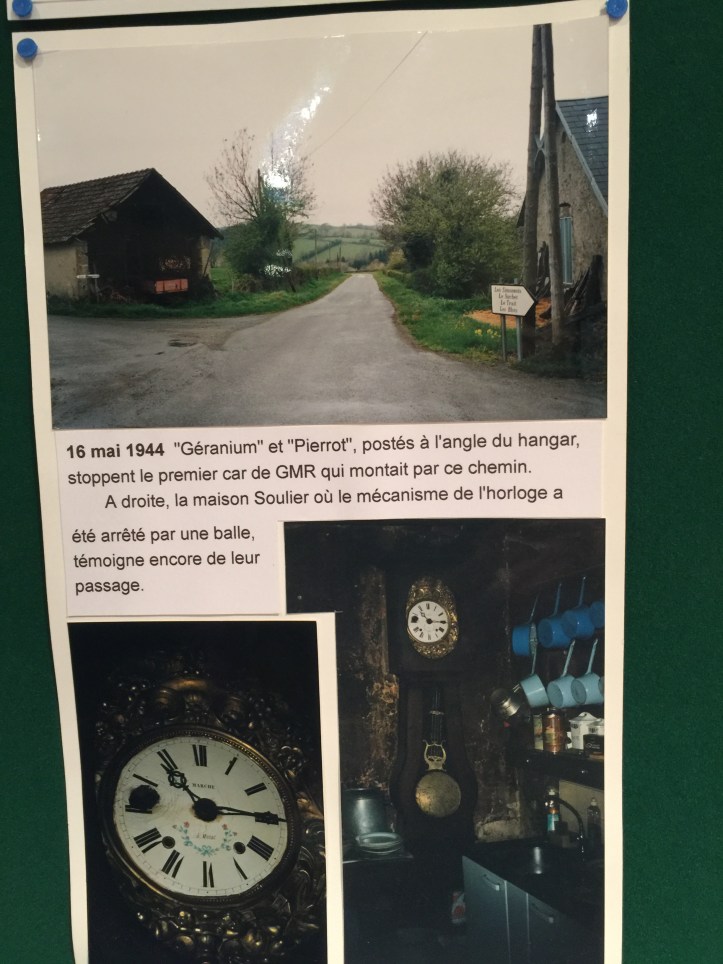
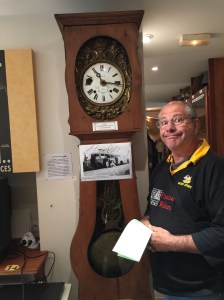
On the 16 May, two members (nicknamed Géranium and Pierrot) of the local Ayat-sur-Sioule Maquis – attacked the first Mobile Reserve Group (GMR) vehicle as it tried to make its way up the road towards the Ayat-sur-Sioule Maquis. Géranium and Pierrot used machine guns and grenades in the attack. Géranium was wounded and taken as prisoner. The poster also described that the house across from the site, to the right, the home of a family called Soulier, (and now owned by our hosts) was looted, and the grandfather clock was damaged by a bullet (at the number 9 on the clock) and has been stopped ever since, indicating the time of the attack.
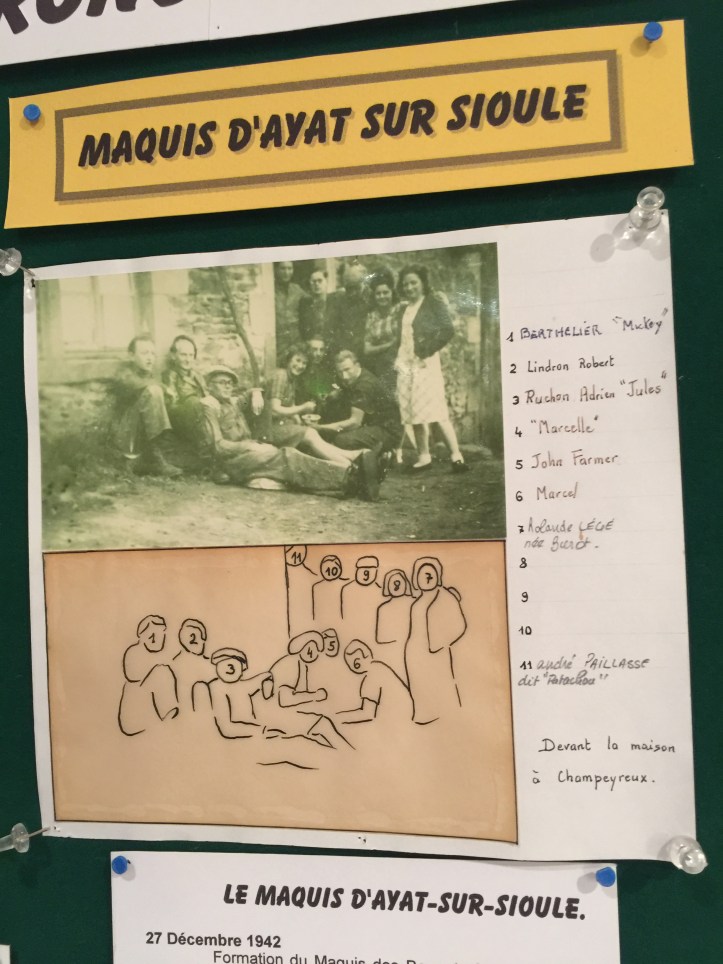
I thought it was interesting that not everyone in the picture was able to be named, until I understood that these people were not local people, but the locals in the area helped them out significantly with information and food and shelter. The Ayat-sur-Sioule Maquis was established around 1942 with men and women coming mostly from Montluçon.
Mick noted that the French Resistance fighter and the German soldier were provided with very different levels of equipment.


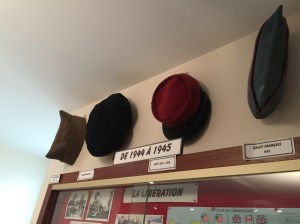
Mick also keenly spotted the berets and headwear that were worn during this period by some of Resistance fighters. His knowledge of this period of history far surpassed mine as he had read the book “La Vie en Bleu” during our stay in Fenouillet.
Most of the items on show had been provided by local people and compiled by interested community members. It was very well done.
 This poster was used during the ‘occupation’, during the time of rationing (les restrictions quotidiennes). It is advising the reader to economise, to cut the bread into thin slices and to use the crusts for soup.
It is obvious that the local people of Les Combrailles are very proud of their countrymen and women.
 Jane and Mick's Holiday Adventures