The first thing I must say is that I am no expert on this subject. What I have written here in this post is based on my observations as we drive through the many small communities in the Auvergne, and a little bit of online research.
France became involved in WWI because it was an ally of Russia’s. When Germany declared war on Russia in August 1914, Germany knew it would be easier to attack France than Russia, so France became Germany’s main target. And this cost France dearly.
Of course we have seen war memorials in our own country, and many as well in different parts of Europe, but they are a bit different here.
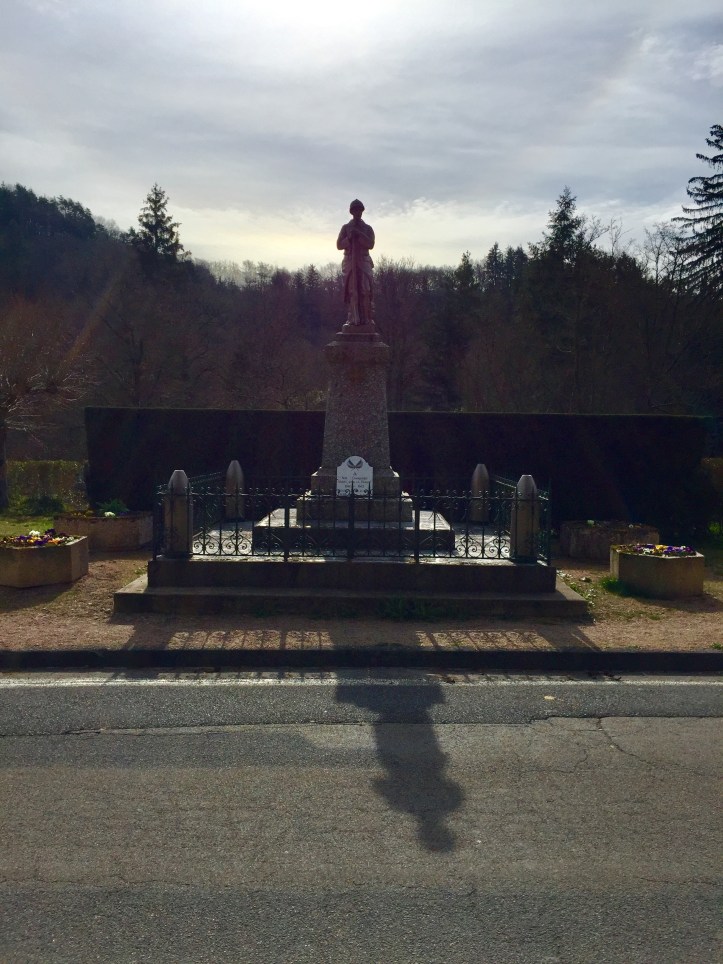
This World War I monument is beside the main route through Châteauneuf-les-Bains, 7 kilometres from where we are staying. This small village, with fewer than 300 inhabitants, is famous as a spa town, where people come to cure their rheumatism. Apparently, in summer months the place is very busy indeed.


But not so busy in early April. The river (Sioule) is filled with trout and is a popular spot for fishermen as well, but again in the summer months.
The plaque at the bottom of the WWI memorial showed the names of the local men who died in World War II.
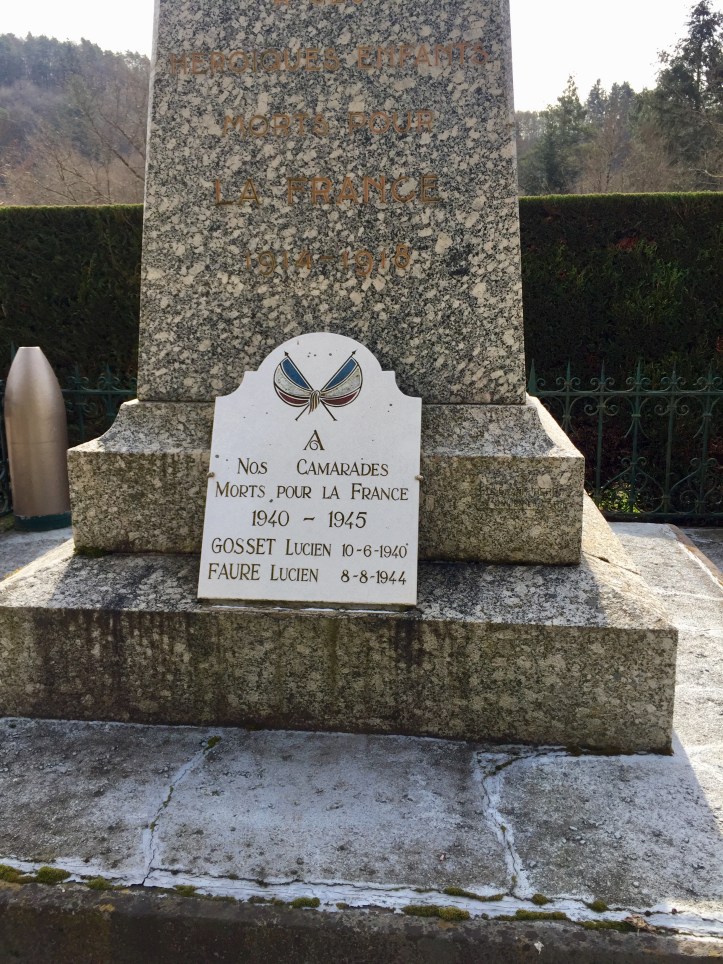
That interested me. We saw this time and again – the WWI monuments were also places to remember the local men who died in the Second World War. A little research on my part, as I did not study history at school beyond second year, helped make this clearer for me.
France lost hundreds of thousands of (mostly) men in WWI, leaving the small communities (like Châteuneuf-les Bains) with fewer men to work the land and with large numbers of widows and orphans. In fact, approximately 1.3 million lives were lost in WW1 (about 4.3% of the total population) compared with approximately 570,00 in WWII. In the WWI conflict, more than half of France’s casualties were lost in the first 18 months.
In the years following WWI, those left behind were determined to remember those who lost their lives for their country. France in particular erected around 176,000 memorials between the 1920s and 1930s. According to some historians, there was almost an ‘obsession’ to construct war memorials that celebrated both heroism and loss. And with 176,000 here in France, no wonder we have seen so many, and in very small communities as well.
The French communities chose simple monuments and placed them in central places in the villages or communes, deliberately trying to avoid political and religious imagery.
But this was not always possible.
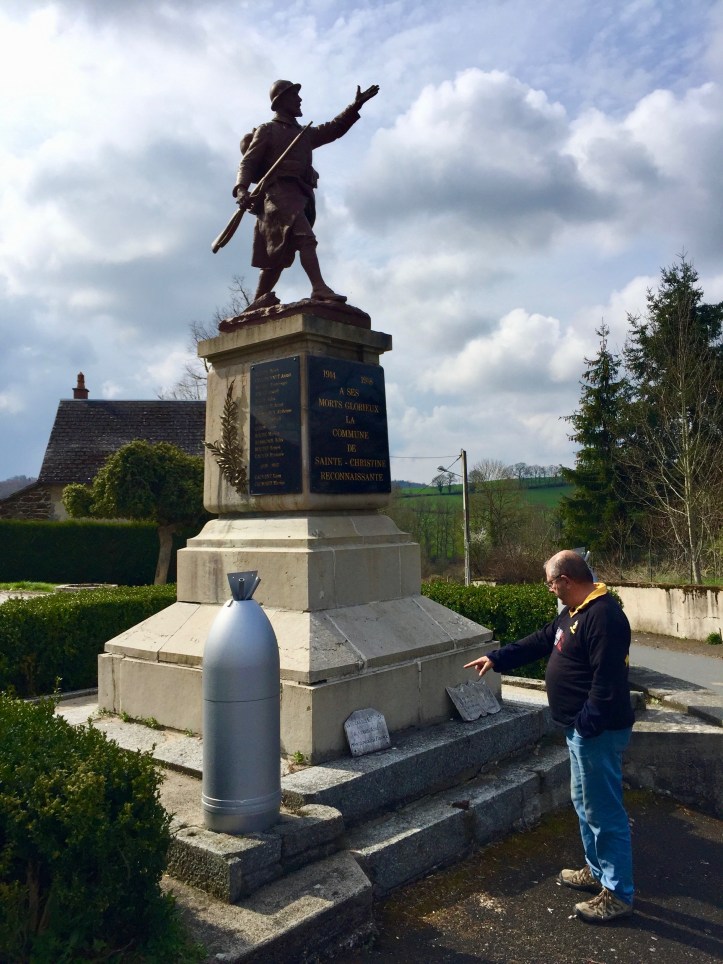
This one is located in the small commune of Saint Christine (about 5 kilometres from where we are staying) and the only non-residential building we saw here was the church, and this monument stands directly in front of the church and lists 24 names of men lost in WWI and 2 names of men lost in WWII.


This is the church in Saint Christine and you can see in the lower right hand corner of the photo the tip of one of the ‘shells’ used to mark the four edges of the memorial.
This is a common feature of the memorials here in the Auvergne – the use of the shells. We have not noticed that before, and I have been unable to find out why.
I was able to find out that a law was passed in 1919 that provided a subsidy for the construction of these local monuments. The money was distributed in proportion to the number of locals who had died. Despite this, most of the funding for the monuments came from private individuals and from fundraising.
These monuments are an important feature in each of the towns we have visited here in France. I find them a very poignant reminder of the lives lost and the lives destroyed by and through war. Sadly, few lessons seemed to have been learnt from this carnage and others since.
 Jane and Mick's Holiday Adventures
[…] mentioned before (in a post last month) that in every French town or village we have visited there is a WWI memorial; around 176,000 […]