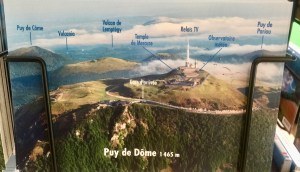
 Ok – this is a postcard of the Puy de Dôme – but Mick and I have been looking at this hill (dome), in the far off distance, for the last six weeks (from our last house sitting spot), and I really wanted to visit it. As we are spending two nights in Clermont-Ferrand, 10km from the dome, today was really the only chance we would get. This postcard image states that the Puy de Dôme is 1465m in height (quite a bit smaller than Australia’s highest peak – Mt Kosciuszko at 2228m, but still impressive).
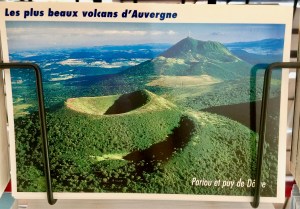 The Puy de Dôme is actually a lava dome in the range of mountains called the Chaîne des Puys (40km of a chain of 80 dormant volcanoes) in the Massif Central. It is the highest peak in the chain of volcanoes, and the youngest – which last erupted just over 7700 years ago – so I didn’t feel worried at all.
Luckily we did not have to walk to the top – although lots of people do. It is one of the most popular tourist attractions in the Auvergne – attracting more than 500,000 people each year because of the great views and also because of the great thermals produced in the area.


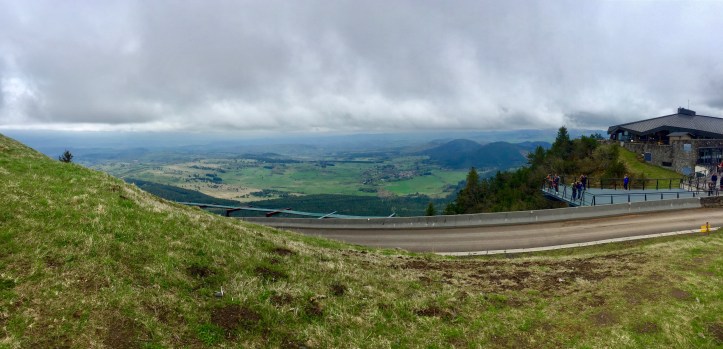
We were able to travel in style – leaving from this very modern terminal on a ‘rack railway’. The trip took 20 minutes each way.
The view was spectacular, despite the weather not being absolutely perfect.
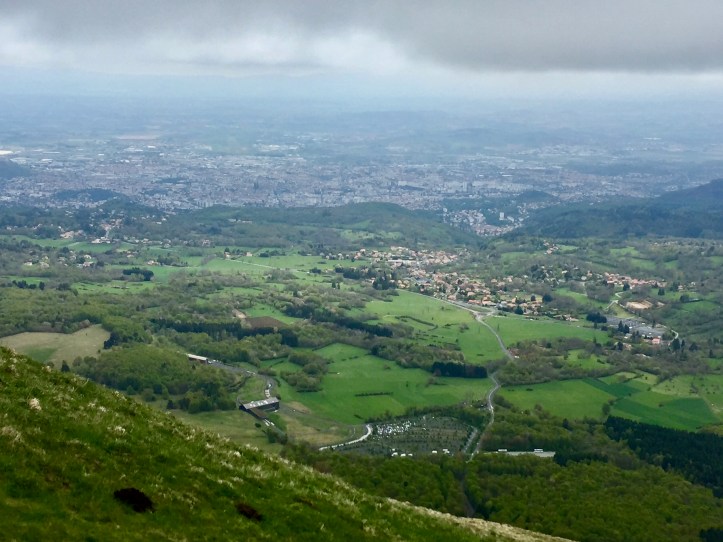
The next shot shows Clermont-Ferrand below us.
What Mick and I couldn’t see from our house sitting location, and what we didn’t know until we arrived there today, was that at the top of this dome there are some very ancient ruins, dating back to 140AD.


Up these stairs we found the remains of a huge Roman-Gaul temple, and at 3600 square metres the temple would have been one of the largest religious temples in the Western Roman Empire. The remains were only discovered fairly recently (in the late 19th Century), and have undergone some restoration work very recently (in the last 5 years or so), which looks very, very modern. But the argument was that the restoration was necessary in order to prevent further decay of the structure by the elements. As well, there was a very interesting museum showing some of the archaeological finds discovered on the site and explaining why the temple was built in this spot.
Excavators and archaeologists have concluded that the temple was dedicated to Mercury, the god of trade and the protector of travellers, as a bronze plaque stating that fact was found during excavations, which was pretty helpful.
The temple’s location, positioned perfectly to provide a great view of the major Roman road linking Lyon and Saintes, meant there would have been plenty of travellers to watch over, and hence many worshippers to give thanks for their safety.
There are excellent facilities located at the peak to serve all the visitors that come each day. We enjoyed a great snack lunch overlooking the valley from the building in the middle of this photo.
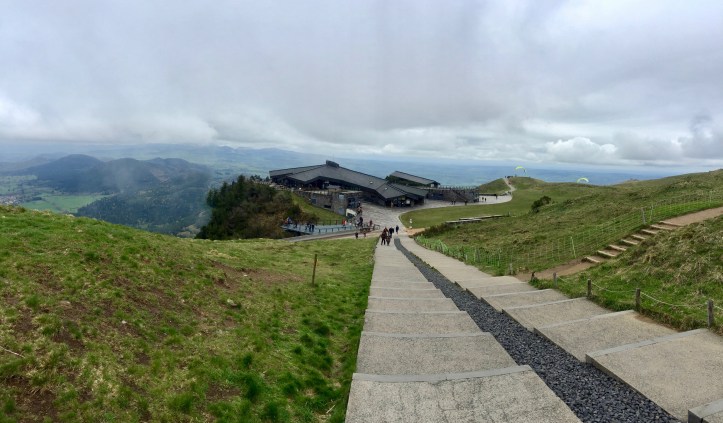
The great thermals I mentioned earlier have made the location a very popular site for paragliding, and there were no shortage of brave jumpers today.


You may have to look closely to find them, but we would have seen dozens of them during our time on the hill. And, during our lunch, these two came very close to where we were sitting.
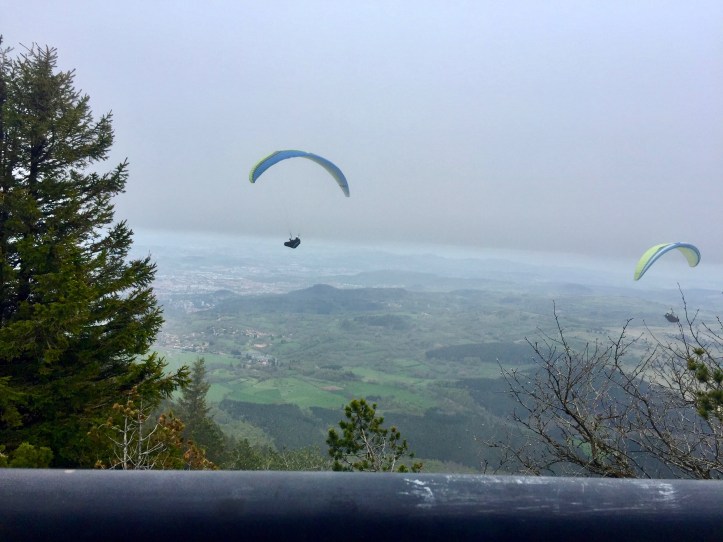
It looked amazing, but Mick and I agreed that it was not for us.
Tomorrow we catch a Flix Bus to Paris, where we will spend one night, before catching a second bus to Nancy. Mick is very excited about our upcoming three-day stay in Nancy. Can you guess why??
 Jane and Mick's Holiday Adventures