Located 12 kilometres from our current house sitting location in Mandray, this is our nearest large town. It has around 20,000 inhabitants but looks and feels bigger as there are quite a few large supermarket chains and outlet stores here.
Not the most picturesque town we’ve seen, but it has a few surprises.
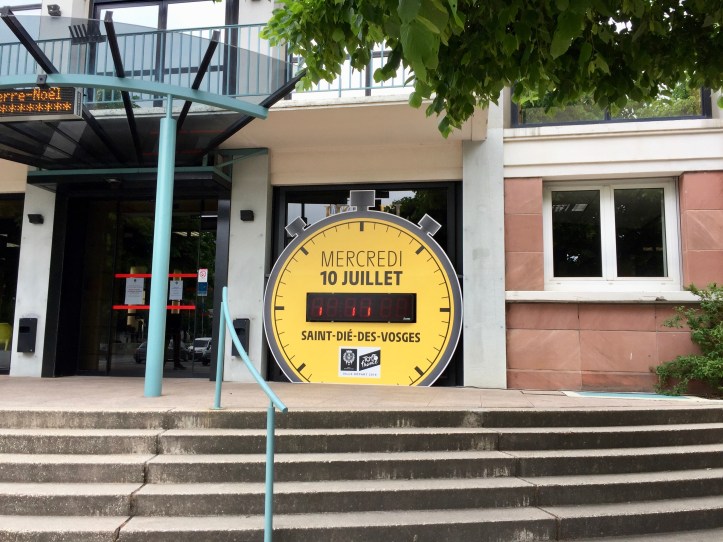
The town is very excited as it is getting ready for the upcoming Tour de France. Stage 5 of the race will start in Saint-Dié on 10th July. That leg of the race is described as ‘hilly’ and the 169km will have the riders end in Colmar. (We are heading to Colmar next month as it is supposed to be a very cute town. But definitely not on bikes!!)
That large clock was located on the steps of the local Mairie – council chambers. There was a digital clock flashing a countdown in days and hours until the start of the race, but it was flashing at such a rate my photo did not capture it.
There are colourful bikes on every roundabout and in shop fronts and even on the water. This is the Meurthe River which runs through the town. It played a very significant role in the town’s early industries of spinning, weaving and cotton bleaching, to name a few.

Besides the usual cathedrals and churches which are listed as significant tourist sites in the town (as in every town and small village), the next most famous, and fairly recent, monument is this tower – Tour de la Liberté – or Tower of Freedom.


It looks a bit like a spaceship to me, however the designers hoped it looked like a big white bird. Apparently, the were inspired by Jonathan Livingston’s movie “Seagull”.
The steel tower was manufactured in the Vosges (the Department in which we are staying), and was initially erected in Paris to commemorate the bicentennial of the French Revolution. The following year it was installed in Saint-Dié, opposite the Marie. We climbed to the top to get some views and were pleased the heavens did not open up while we were up there. We did get a great overview of the town and could pick out some other famous landmarks, namely the Church of Saint Martin (on the left) and Saint-Dié Cathedral.


Another “claim-to-fame” for Saint-Dié is that it was the birth place of Jules Ferry.
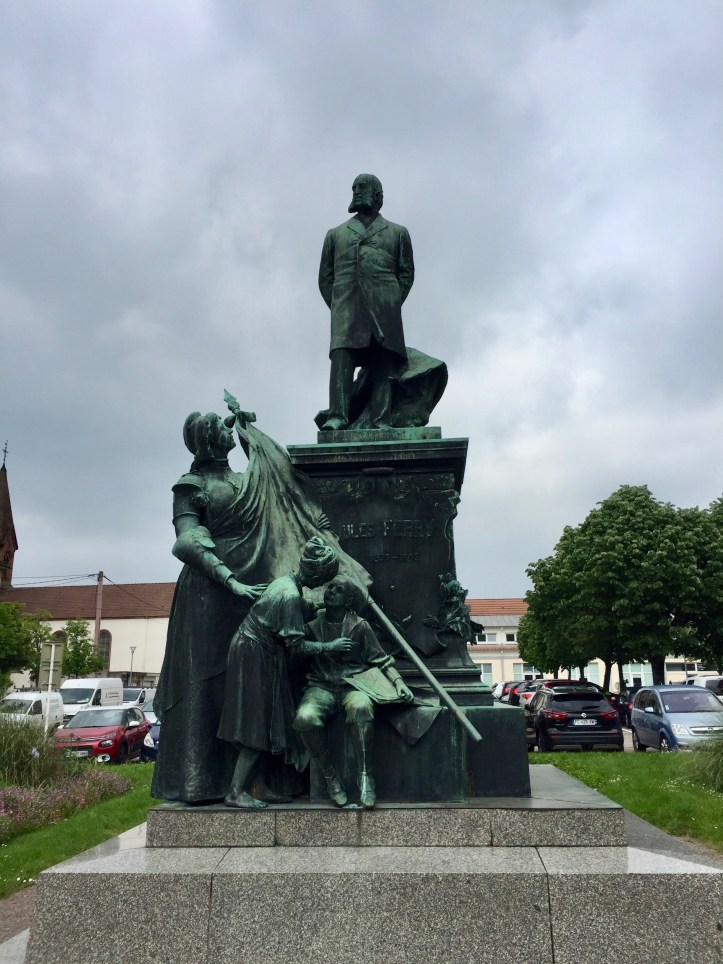
This statue stands proudly not too far from Place de Jules Ferry.
The names Jules Ferry is one Mick and I recognise, not really because we know who he was, but because in just about every town we’ve been to in France, and every French town map Mick has examined there is always a Rue de Jules Ferry. It is almost as common as Rue 8 Mai 1945.
But in Saint-Dié we find out Jules Ferry was born here in 1832, and that he is recognised as a great French politician who served during the early phase of what is now called the Third Republic (which was adopted after the Franco-Prussian War).
He was a lawyer as well as a politician and he died in 1893. When I searched for some information on the internet I found that he was recognised for his promotion of France’s colonial expansion and of laicism – of which I had never heard.
Laïcité, literally “secularity”, is a French concept of secularism. It discourages religious involvement in government affairs, especially religious influence in the determination of state policies; it also forbids government involvement in religious affairs, and especially prohibits government influence in the determination of religion.
After reading this definition, I could appreciate the impact of Jules Ferry’s support back in the late 19th Century for laicism, as Mick and my observations of France are that this is very much the case today.
Our walk along the Meurthe brought us to a large monument in memory of the many local people who lost their lives in World War I. Too many names to be listed.
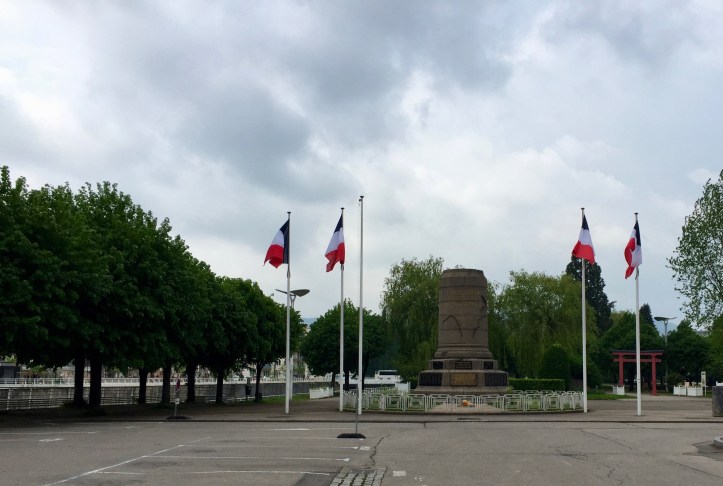
We have learnt that this area, now known as the Grand Est (previoulsy Lorraine), played a significant and costly role in WWI, mostly because of its geographical proximity to Germany, and because it not only shares a border with Germany, but it shares borders with Belgium and Luxembourg. It is the only Region in France that shares its borders with three other countries. This feature of course has made the area a ‘prime target’ in struggles for power. As a result of these struggles, the borders have changed many times over hundreds and hundreds of years. This gives the area its very unique characteristics which Mick and I are planning to explore over the next three weeks.
We have been loaned this car by the owners of the cats and we will slowly make our way around the area exploring what’s on offer – but possibly only within 60 or 70 km away.
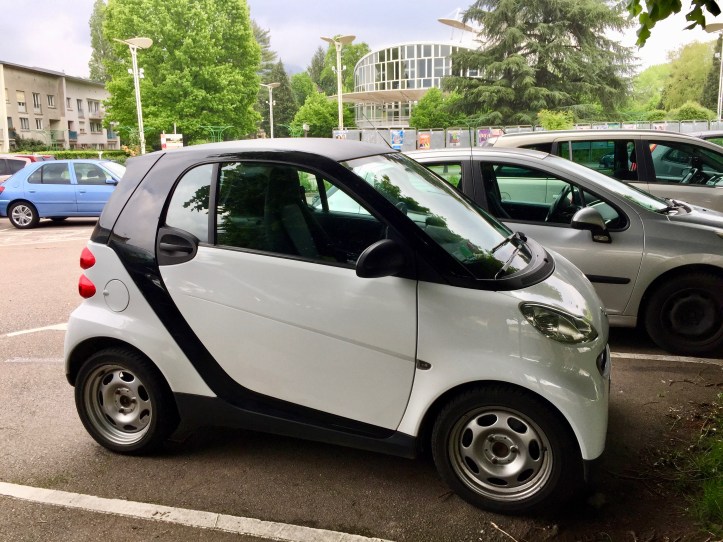
It is very easy to drive, except there is no power steering. There is only forward, reverse or neutral, and once inside, you forget there is not much to the car.
Our first (longer) excursion will be along the Routes de Vins.
No surprises there!
 Jane and Mick's Holiday Adventures