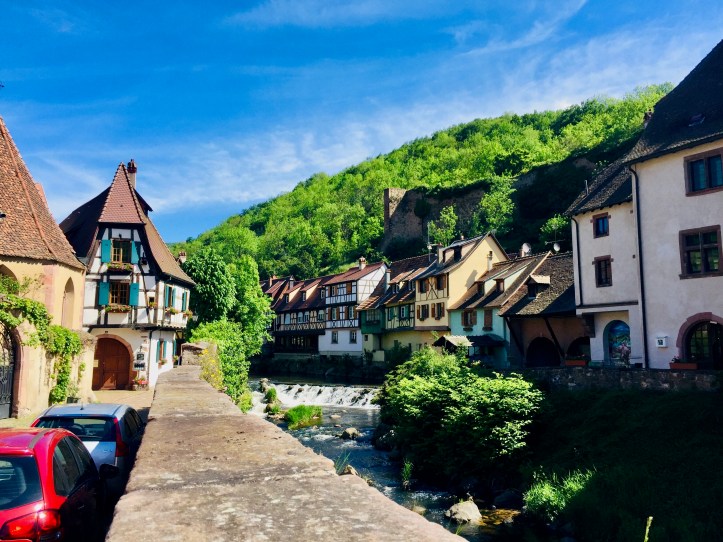
It was only a 45 minute drive to this French village. And we will be back.
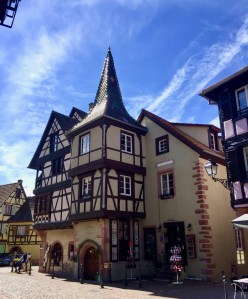 It was such a pleasure walking around the streets of Kaysersberg-Vignoble (only called that by the way since 2016, before that, it was just Kaysersberg) and looking at all the beautifully coloured buildings. They reminded us so much of villages we’d visited when we travelled the Romantic Road in Germany in 2012.
We have been waiting for some sunshine before we were prepared to venture up the mountains to visit the wine growing region of Alsace. Those same mountains by the way that the Tour de France competitors will have to ride up on 10th July on their way to Colmar. But, those participants will also get a few ‘free’ rides as they descend those same mountains – I bet they go at least as fast as we did in the little Smart Car.


Every street had us craning our necks – each building was maintained to a very high standard. We recognised a bus load of ‘oldies’, about our age, but other than that, there were very few tourists. But, we’ve read it can get very busy. So it was a real treat to be able to wander freely.


German culture was very evident here, not only in the finish of the buildings, but also in the produce and local cuisine. These two photos show the same place with a giant gingerbread man. There were lots of shops selling gingerbread and Gulgelhulfs (a yeast-baked cake baked in a Bundt pan.) We resisted the temptation – this time at least.
It is not a surprise that this village, and others we drove around very close to it, have a German feel, as this part of France was annexed by Germany between the Franco-Prussian War and WWI – a period of 48 years.


It was an interesting drive as we climbed up the mountains, leaving behind the relatively dull villages and communes close to where we are staying at the moment. They are characterised by fairly large barn-like houses on large blocks which seem to straggle along a road – not making any village pattern with squares etc. Some of the communes go on for kilometres with houses either side of the road and that’s all. As we started our descent towards Kaysersberg the layout of villages changed noticeably to the more formal cluster of houses, small businesses and roads, with a central church and a square. But, the buildings were so very different.
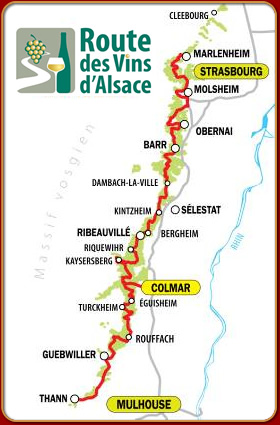 Mick was excited because once over the hill, finally he spotted some vineyards. Lots of them. Climbing up, or down, the hills depending on your perspective. And that’s one of the reasons we had come. Kaysersberg is apparently one of the finest wine growing areas in Alsace.
Mostly white wines are produced in Alsace, including the very well known (in Europe at least) Crémant d’Alsace – a sparkling wine produced using the same techniques as those used in the making of champagne, and Mick’s new favourite bubbles, Blanquette de Limoux. As readers know, my preference is for red wine but I have been known to enjoy a glass of white wine during the middle of the day. So, of course we had to try it.
We found a new grape variety in this area too – Sylvaner. Neither of us had heard of it before, or tasted it of course. Described as a lively wine, we both found it tasted delicious.
 We stopped at this cave in Kaysersberg, attracted initially by the name of the wine producer – Jean Dietrich. As one of our good school mates, and a groomsmen at our wedding, shares the same surname.
We took that as an omen.
The wines were very nice, especially the Sylvaner and the Crémant, and not too expensive either at €5.90 and €7.90 respectively.
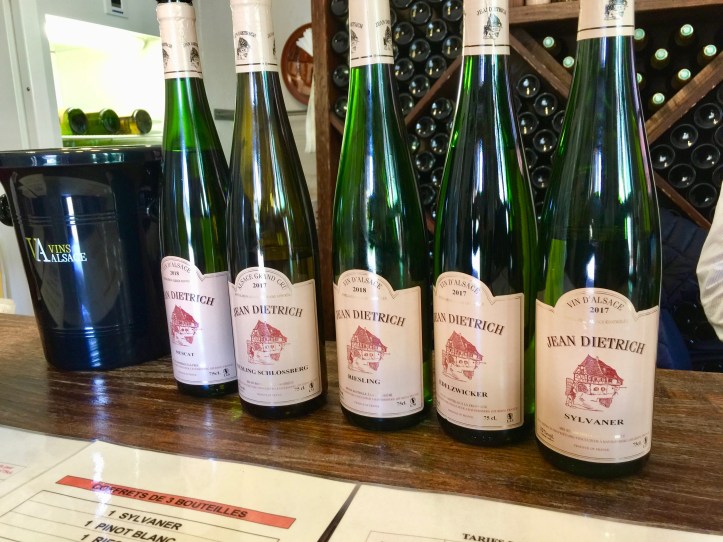
Although we tasted quite a few wines, you’ll be pleased to read that we only left with three bottles.
But we will be back!
 Jane and Mick's Holiday Adventures
All good stuff, Jane. Suzanne and I were in Alsace-Lorraine in the 80s, staying in a village called Eguisheim, near Colmar.
Sadly, I don’t think we will get there – just looked it up on the map. It looks gorgeous.
Just looked at the map again … I think we must go there!!