Only 10km from Kaysersberg, Turckheim is yet another quaint village along the Routes de Vins d’Alsace. Mick and I wanted to visit here, not so much to taste more wine, although we did that as well, but to visit a museum about WWII that involved this area close to Colmar. But more about that later in this post.
Turckheim has two features that sets it apart from other neighbouring villages.
 Firstly, it has an intact medieval wall with three doors or portes. This is me standing in front of one of them. Later in this post there is another one of them with Mick.
There was no access for visitors to be able to walk around the wall, but everything looked very well preserved.
The second distinguishing feature, and one we did not see, is the Night Crier.
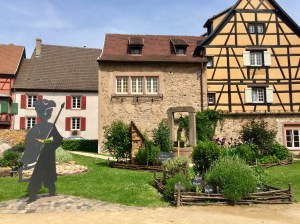 Each evening at 10pm (that’s why we did not see it!) a man dressed in black, carrying a lamp, walks around the village, along the same route that takes him about an hour. As he strolls, he sings. Tourists can join the parade if they like. The closest we got was this cut-out image of the Crier, which stands in the garden in the central square of the village.
Another feature we noticed on our first stop was this.

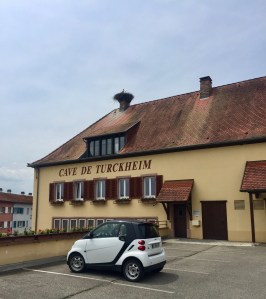 I’ve tried to zoom in to show the stork and its baby in a huge nest, which was situated on top of the area’s most famous winery – Cave de Turckheim.
We spotted another nest in the central part of the village as well. At the moment, there are five nests in Turckheim, which is good news for the storks. Storks were very common around here hundred of years ago, but numbers have dwindled.
Like the other villages we have visited along this Route de Vins, there are lots of beautiful homes and businesses. With tourism becoming a very good money-spinner for these villages, it is important to keep everything looking its best.


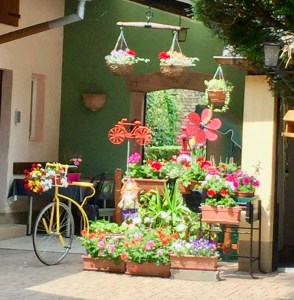 This garden won my pick for “Best on Show”. A lot of effort had gone into making this courtyard entrance to this home very welcoming.
During our visit today there was another tour group. A smaller one this time made up of a mix of Germans and Americans. They were here to visit the same museum we visited. (Mick and I later thought what an add combination to be visiting the museum together.) Other than that, there were very few people there. We have been lucky to visit these places before the tourist season begins in full.


This is one of the other portes to the village, the main one that leads into the town centre.
The photo of the magnificent ‘treats’ on display at this chocolatier were worthy of a photo as well. No harm in looking.
All of the beauty that exists in this town today, and in this area, hides a very difficult past.
In a previous post I mentioned why this part of France looks and feels a lot like some parts of Germany Mick and I have visited.
Following WWI, Germany ceded Alsace to France under the Treaty of Versailles. France believed that the Alsatians were Frenchmen who had been liberated from German rule. Policies were immediately introduced to replace the use of German with French in Alsace. But, not all French laws were applied at this time, as France did not want to upset the Alsatians too much. For example, the 1905 law requiring the separation between Church and State was not applied in Alsace at this time.
Then in 1940, during WWII, Alsace-Lorraine was occupied by Germany and was made part of Greater German Reich. We learnt that 130,000 young men from Alsace and Lorraine were conscripted against their will during this time. Most of these men died on the eastern front where they had been sent to fight Russia. This conscription clearly breached the Hague Convention.
Hague Regulations (1899)Article 44 of the 1899 Hague Regulations provides: “Any compulsion of the population of occupied territory to take part in military operations against its own country is prohibited.”

The museum Mick and I visited in Turckheim explained the history of how the area around Colmar – knowns as the Colmar Pocket – was eventually freed from the Germans during the final year of WWII. Turckheim is only 7 km from Colmar.
From November 1944 until February 1945, during the coldest winter in many years, a terrible battle occurred in the Colmar Pocket against the Germans by French and American soldiers. The ‘pocket’ was formed when American soldiers successfully pushed the Germans back across the Rhine, and therefore back into German territory, leaving only the area around Colmar occupied by Germans. You can read more about this if you’re interested on this website.
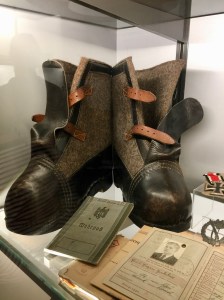 These ‘over shoes’ were worn by some of the luckier soldiers during this period, to help keep their feet from frost bight. But we also saw sandals that were worn by others. The sandals had nails in the soles to help prevent slipping in the ice and snow.
Some of the French soldiers were from French Africa. Several times during the tour we heard that the dark skin of these men did not suit these freezing conditions, and that there was a deliberate strategy by France to ‘whiten’ the soldiers; by replacing the French-Africans with French soldier.
It was an interesting museum and clearly showed how important the support of the American soldiers, with their vastly superior weaponry, was in regaining French territory and helping bring WWII to an end.
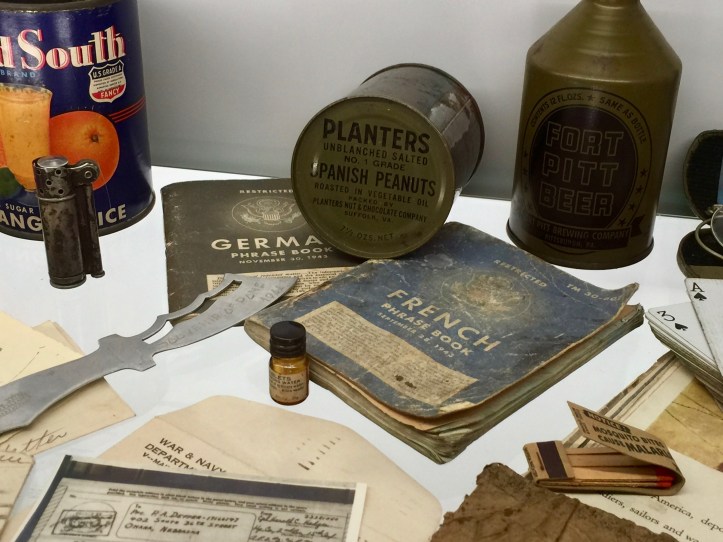
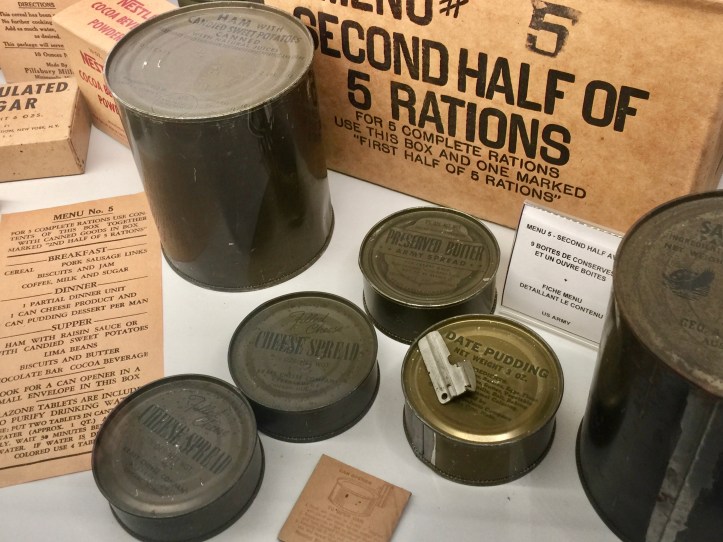
Some of the artefacts on display.
 Jane and Mick's Holiday Adventures
[…] that, 390,000 French civilians died during that period. In this area in particular, the Vosges, (as mentioned in a previous post) the war was played out very […]