I was wrong in a previous post when I said I thought the Sunday art markets were in the district known as Antigone. I found that out today when we went to the doctors, and later visited the real Antigone. And what a difference. This part of Montpellier is very new.
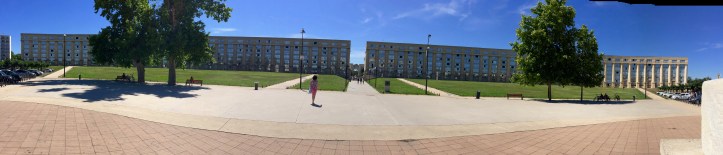 This is a pan shot of the Place d’Europe in the Antigone precinct.
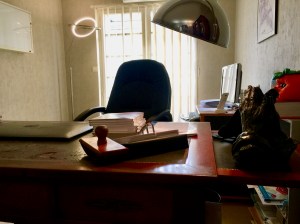
But, before we visited Antigone Mick had to go to a doctor to get a script. Nothing to worry about – as we always knew he’d need to do this at some stage during our 12 months away. Our current hosts recommended a doctor they go to. Surprisingly, it only cost €25.
I took this photo of the surgery while Dr Delpech was finalising his previous visit.
There was no receptionist. To make an appointment you must phone between certain hours – which Mick did. So, when we arrived, there was no receptionist, only other patients waiting for his or her appointment. And typically French, anyone who came in said “Bonjour Monsieur-Madams” and as they left they said “Au revoir“. Such a polite culture, and such an easy way to run a practice – very few overheads. Plus Dr Delpech did look pleased that we did not need a receipt and we paid him in cash.
Once finished with the doctor, we made our way to our real destination of Antigone. We passed another pretty clever mural – Montpellier has quite a few of these.
 The Antigone precinct was started in 1977, and most of the buildings are the designs of a Spanish architect – Ricardo Bofill.


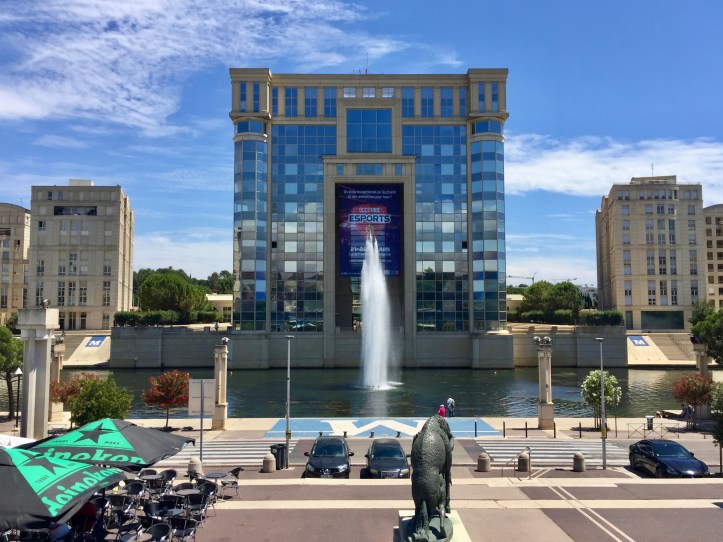 The Antigone precinct is located between the old centre and the River Lez.
 There were concrete foot bridges across the river. Possibly too dangerous for Australian standards. But ironically, there was an Australian Bar overlooking this exact spot. Apparently you can get a cheap Fosters beer there – but we decided to give that a miss.
I’ve grabbed this excerpt from Wikipedia which helps explain a little about this area.
The Antigone project, on a 36 hectares plot, has been one of the largest single developments completed in France and attracted worldwide interest. In 1979, the newly elected municipal council of Montpellier decided to undertake urban development and develop a new district on a site near the city centre. The purpose of this town-planning operation was to develop a new district along a central axis which would provide for the city’s balanced eastward expansion and link the historical centre to the river Lez. The architect Ricardo Bofill created the master plan and most of the buildings in Antigone. From the design of the plazas to the details of the facades and exterior furniture and landscape elements, everything is proportionally and thematically related, creating a stylistic unity in a district full of boulevards and plazas, parks, major residential areas, shops, schools and sports, cultural and administrative facilities.
The city’s journey from poky provincial capital started in the 1960s, when it was first swollen by the influx of pieds-noir (Christian and Jewish people whose families had migrated from all parts of the Mediterranean to French Algeria) and Spanish exiles from Franco. Enter outspoken socialist mayor Georges Frêche. This frank mayor once declared he would name the municipality’s cleaning-supplies room after François Mitterand: “Un pétit president, une petite salle.” (“A small president, a small room.”) His development programme – including the love-it-or-hate-it neoclassical Antigone quarter, and later the Jean Nouvel-designed town hall, a kind of black Rubik’s cube made Montpellier France’s “urbanist laboratory”. “Montpellier took off with him,” says Anselme-Martin, even though she stood in opposition to Frêche as a municipal councillor. “When he arrived, the city raised the bar very high.”
 Jane and Mick's Holiday Adventures