
Mick and I decided to book a few tours while we are in Montpellier – as this is our 9 days of city-living, house-sitting experience. Up until now, we have been in relatively remote smaller locations, and I have needed to drive us everywhere.
On our first ‘excursion’ we visited a ‘local’ oyster farm region, near Bouzigues to the south of Montpellier.
When I found this tour and told Mick about it, he did not believe that oysters were grown in this part of France. We had been on a tour near Arcachon, to the south-west of Bordeaux, in 2014 and were told that it was the oyster-growing capital of France.
As Mick absolutely loves oysters, and he has been known to devour quite a few when they are readily available, he quickly agreed we should check out how this could be.
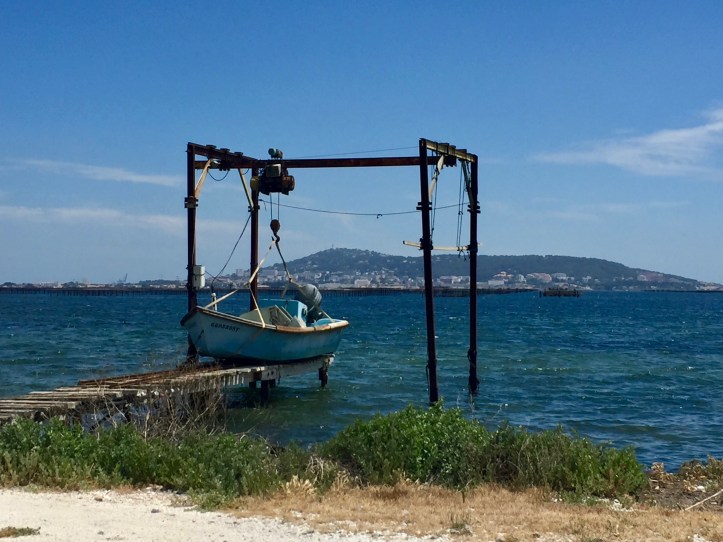
Our tour group of seven plus out guide, was taken to a small oyster farm in the Étang de Thau – run single-handedly by a young woman. This photo is looking across the étang (basin / bay) towards the city of Sète. It does not show clearly the timber structures that fill the bay, all neatly lined up in rows – but we could see them very clearly. The timber structures are called ‘tables’, and in this bay there are 2000 tables. The woman we visited owned three tables. Each table has 1000 strings of oysters growing on them.
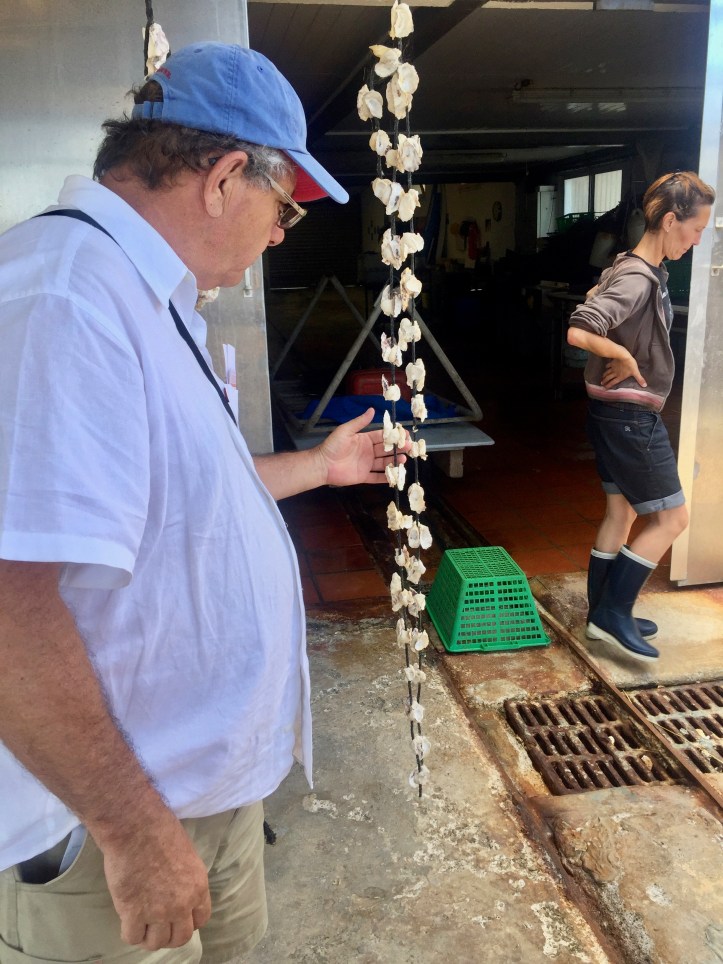 Mick gave the ‘string’ are close examination to see how the baby oysters were cemented into place in groups of three before they are then placed back into the water to grow. Once they get bigger, they are brought out again and separated and placed on the string in separate positions.
What we did find out was the baby oysters are grown in Arcachon, and sent across to here when they are about 28 days old – so our information from 2014 was correct. We were told that it takes about 2 years for the oysters to fully mature here compared with about 3 years around Arcachon. The shorter period required was explained by the tidal variations. Arcachon experiences quite large tidal differences, while this bay does not experience any.
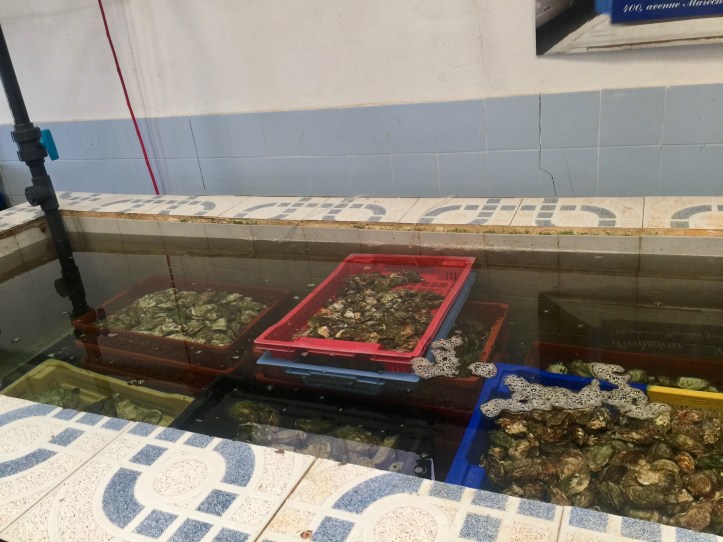 We were shown the process required to clean the oysters in preparation for sale and consumption, and it is long and gruelling and, I would imagine, quite cold in the cooler months.
Part of the tour included tasting her oysters, harvested that morning and chilled for us on ice. She told us they were size 2 or 3, where 0 is the largest. Normally Mick and I choose the smaller oysters, around 5, because in Australia we both prefer the Sydney Rock Oysters to the larger Pacific Oysters. But, we might change our minds after tasting these.
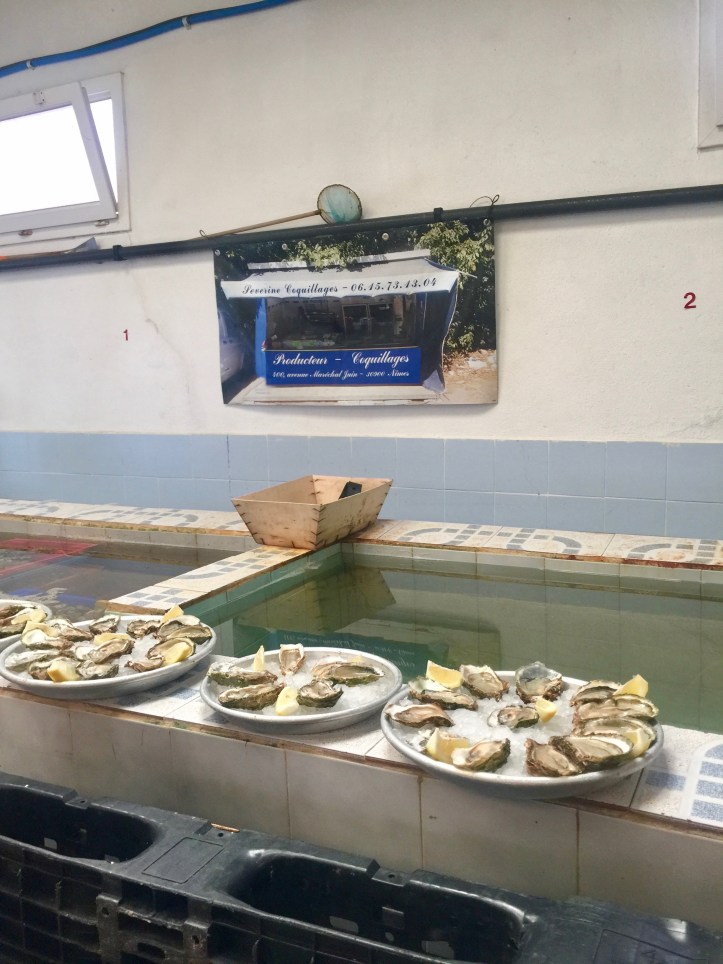
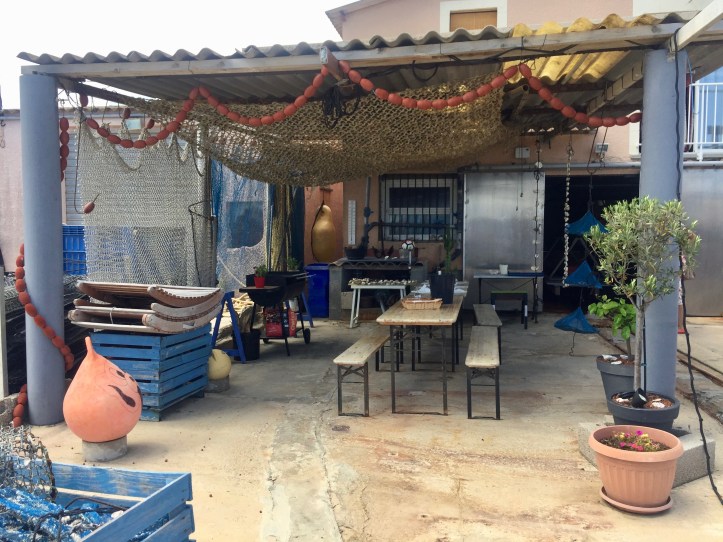
We sat around these small tables and were offered either fresh lemon juice or a very popular local vinaigrette made from very finely diced shallots and vinegar – which I really enjoyed.
 They were delicious and each person had about 5 or 6 large oysters, more if you were a bit quicker. One Danish woman on the tour who was in her late 50s had never eaten an oyster before, and Mick was hopeful she might not like them – but not so. She took them like she’d been eating them for years.
To accompany the oysters we were given a glass of the local white wine – made from a single grape variety neither Mick nor I had heard of before – called Picpoul de Pinet.
 Picpoul de Pinet is both the name of the wine and of the grape.
It is usually bottled into this specific shaped and coloured bottle with an embossed logo, and I think we were told that it is the only AOC wine in this appellation that can be made from a single grape variety. It is quite acidic, and the name is a translation from Occitan meaning ‘lip stinger”. It went very well with the oysters.
We have booked up further tours that will take us around some of the vineyards and châteaux around Montpellier. Needless to say, we are looking forward to them.
 Jane and Mick's Holiday Adventures