And not only because I was bitten by a dog.
Shocking I know, and even though Mick was walking by my side when it happened, the dog was too quick for him. He did not even realise I had been bitten. Luckily I was wearing long sleeves and the dog was only ‘playing’. But it did hurt, and it did shock me. Actually, it didn’t even break my skin, only wet my sleeve. But, that is not the point. Its owner had just got the dog excited by meowing like a cat and inciting it into a frenzy, showing off in front of some other friends of his, and the dog became over excited and I copped it!
We have seen an increasing number of people who ask passersby for money, sitting with one and sometimes two dogs. I have rationalised this as being for company and sometimes for warmth, for those who do sleep rough, but there is also the “tug” factor. Lots of animal lovers can’t walk past a sad looking dog, particularly one where its owner may not have the means to feed and care for it properly, so they give the person some money…. for the dog/s.
As we walked from Avignon Gare to the main part of town, Mick actually started to count the number of people sitting on the pavements asking for money. Only because it was such a shocking number – more than we had seen in any city so far this holiday. We assumed because Avignon is a tourist town and it is summertime. Certainly there were loads of tourists; we had spotted one large river cruise boat moored on the edge of the Rhône, disgorging hundreds of people into the city, along with dozens of empty coaches parked in a purpose-built parking lot just outside the main part of the city.
But we were here to see this. 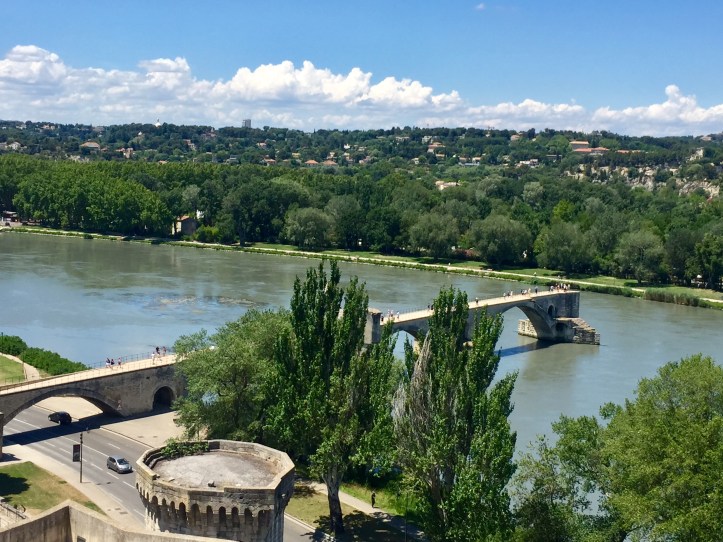 However, there was no dancing, because you have to pay to walk on it.
I felt pretty ignorant during our tour of the city to find out that the bridge was not even called the Pont d’Avignon, and that it looked like this – only part of a bridge.
The bridge, made famous by the song, Sur Le Pont d’Avignon, is actually called Pont Saint Bénézet, after Bénézet – a shepherd who was given a sign from God in 1177 to go down from the mountains, where he was tending his flocks, and to tell the people of Avignon that they had to build a bridge.
Of course it took a lot of convincing, but eventually a bridge was built across the Rhône, but not this half-surviving bridge shown in my photo. The one built back then was made of wood. It was finished in 1185, and forty years later was destroyed in a crusade.
Starting in 1234 (now that is a good date – easy to remember), a new bridge was commenced consisting of 22 stone arches. Sadly, the powerful waters of the Rhône in flood, eventually destroyed quite a few of the arches and the bridge was abandoned in the mid 17th Century.
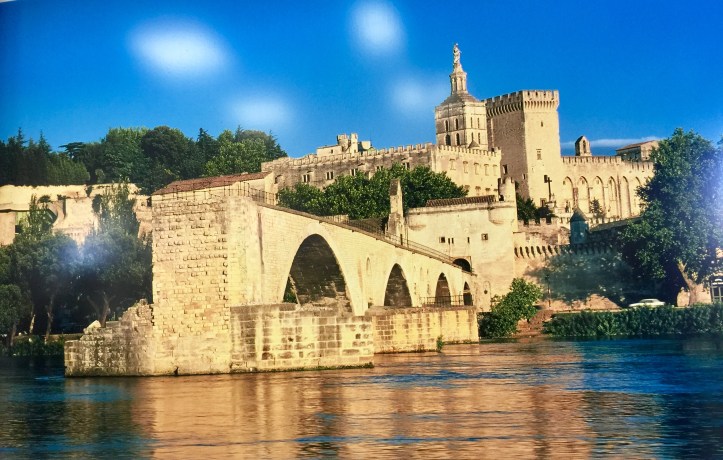 I did take this picture – I promise – of a poster at the Avignon railway station – miles better than any aspect I could get.
Our train trip of just over one hour from Montpellier, took us from the region of Occitanie to that of Provence-Alpes-Côte d’Azur, and we could tell.
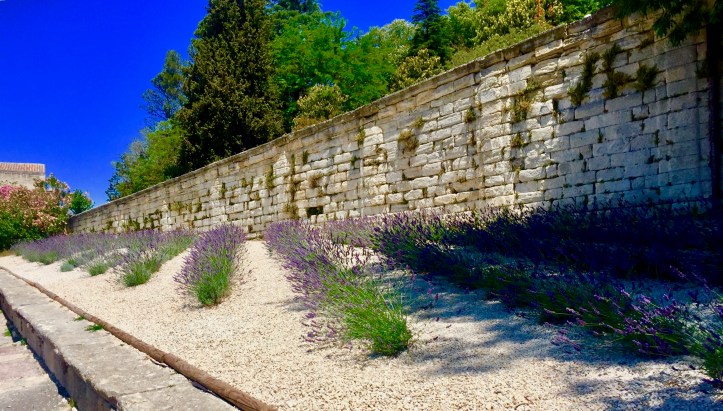 There was plenty of lavender growing in pots and in gardens, and loads of shops were selling lavender products, which I have to run past as I find the smell over-powering. But, I love the look of it.
This city has some amazing buildings, many of them thanks to several Popes. The most impressive and well-known site is the Papal Palace – Palais des Papes. It is the impressive structure in the photo I took of the photo. None of my photos did it any justice.
One of Mick’s favourite books is called Saints and Sinners: A History of the Popes written by Eamon Duffy. He read it a few years ago now, but while he was reading it he would often quote passages from it about different popes. Mick was fascinated by some of the things he read, and it was he who had told me about Avignon being the headquarters of the Papacy during the 14th Century (from 1309-1377) and not Rome.
Avignon became the Pontifical residence under Pope Clement V in 1309. His successor, John XXII, a former bishop of the diocese, made it the capital of Christianity and transformed his former episcopal palace into the primary Palace of the Popes. It was Benedict XII who built the Old Palace and his successor Clement VI the New Palace. He bought the town on 9 June 1348 from Joanna I of Naples, the Queen of Naples and Countess of Provence for 80,000 florins. Innocent VI endowed the ramparts.

There are 4.3 kilometres of the walls built mostly by Pope Innocent VI that still surround Avignon, plus a few remaining gate houses. However, there has been one recent “break” in the wall – and Mick and I drove through it on the tourist train. We think we heard through our headphones during our ride that the opening was made in the 1970s to improve access into the city. We hoped it wasn’t only for the tourist train.
We did enjoy our day in Avignon, along with hundreds of other people. It is certainly worth a visit, but we were happy to get back on the train and head back to Montpellier.


 Jane and Mick's Holiday Adventures