Mick and I are going to have loads to explore while we are house sitting here on the edge of the Fontainebleau Forêt. The town we are in is shown by the blue dot on the map below. It also gives you an idea of how close to Paris we are.
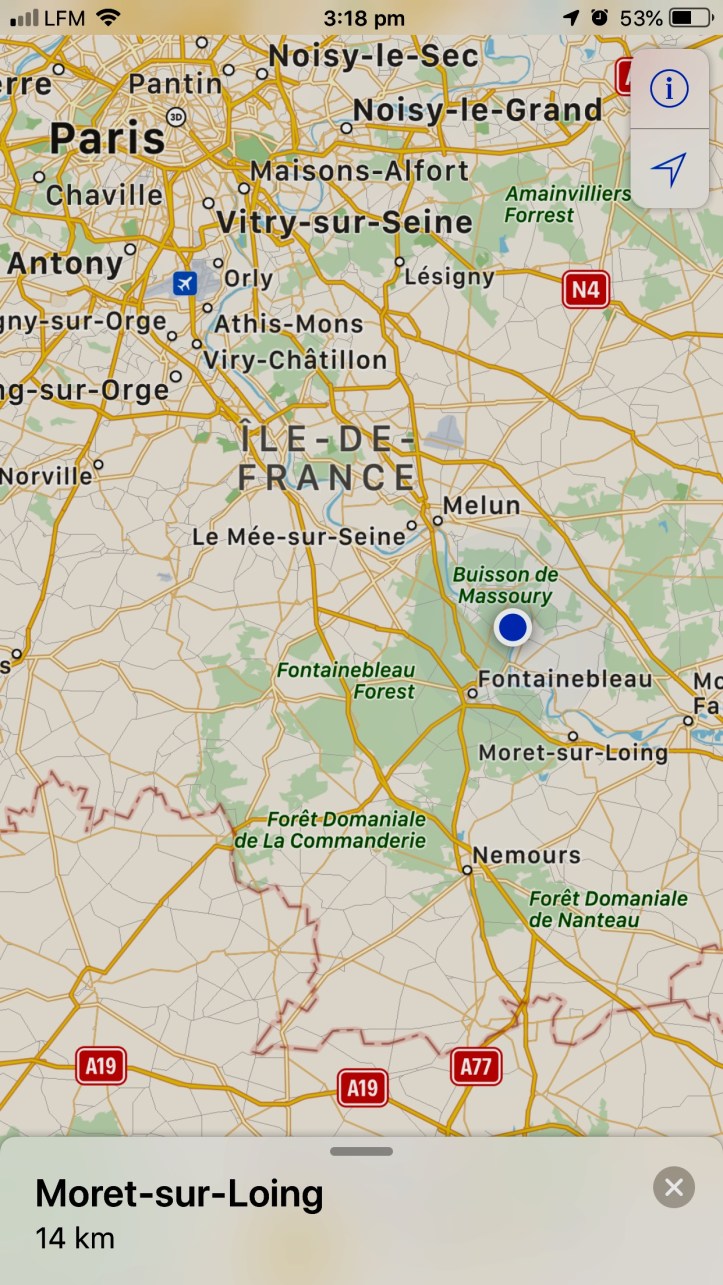
Yesterday for example, we drove south less than 15 km to visit a town on the Loing River, hence its name ‘sur-Loing‘. And it was beautiful. It is famous for being the town that Alfred Sisley, impressionist and contemporary and friend of Monet, Manet and Renoir, lived and worked until his death in 1899. He apparently died in poverty, and it wasn’t until after his death that his paintings appreciated in value. You will notice in the photo below a large copy of one his paintings is on show. We saw quite a few of these during our stroll through the town.
 This is a gate at the end of Rue Grande called the Porte de Samois. There is another similar one at the other end of the street that is still intact as well – they are they only two of the twenty original gates (or portes) that that were used to protect the village in the Middle Ages.
But it was the charm of the river bank that interested us and our dog the most.

There were two weirs that created small waterfalls and also the remnants of mills that were once operated by the running water.
 We spotted some young boys swimming, or paddling, in the river. The weather was perfect.
Of course there was a very large church, Notre Dame, which stood out above all the other buildings in the village.

At the time of our visit, the sun was streaming through the stained glass windows behind the alter. Apart from the stained glass, the church was very simple inside. But, you and Mick are going to have to believe me. He couldn’t come in because of the dog.
 Another thing that Moret-sur-Loing is famous for, (and I doubt you’d ever guess) is for barley sugar. This building here is the Sucre d’Orge shop, and at a separate location in the town there is also a museum (click on the link to read a bit more about it) dedicated to the history of making barley sugar. Mick and I decided not to go to either – we cannot afford to break a tooth while we are away.
Back in the 17th Century, some nuns loving in Moret-sur-Loing developed the (secret) recipe for the boiled sweet which became very popular.
I found it interesting to think that these nuns were developing sweets at the same time as monks were developing bubbly wines like champagne and crémant. I know what I’d prefer!!
Mick and I also stopped in an even smaller village on the way to Moret, at the confluence of the Seine and Loing rivers. We hope to go back there when it holds its weekly market on the banks of the (Seine) river. The village was called Saint-Mammès, and I have tried to find out who Saint Mammès was without success.
Mick was hoping to chat to the fisherman at the end of the wharf, but not only could he not get through because it was chained off, the man was made of concrete!!
 Jane and Mick's Holiday Adventures