This is one of the two other châteaux on my ‘must visit’ list before we leave this house sit. The first two images in this post are borrowed from the internet. I had no chance of getting such good shots, and it is not that green at the moment..
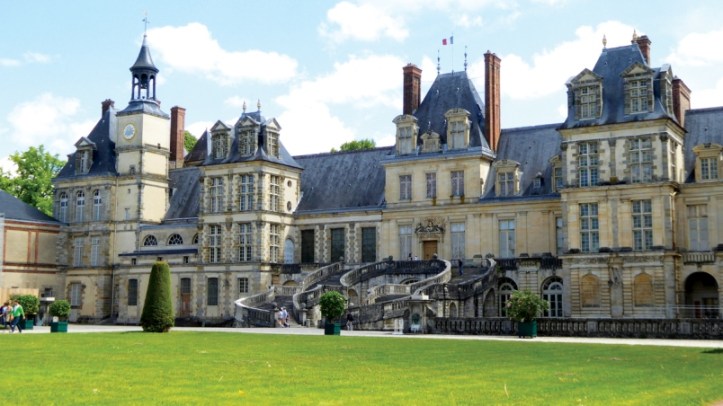 After the Palace of Versaille, this château is probably the best known palace in France, and it is now a national museum. The Château de Fontainebleau is located 7km from where we are staying in Samois-sur-Seine. It boasts 1500 rooms and is set in 130 acres of parkland and manicured gardens.
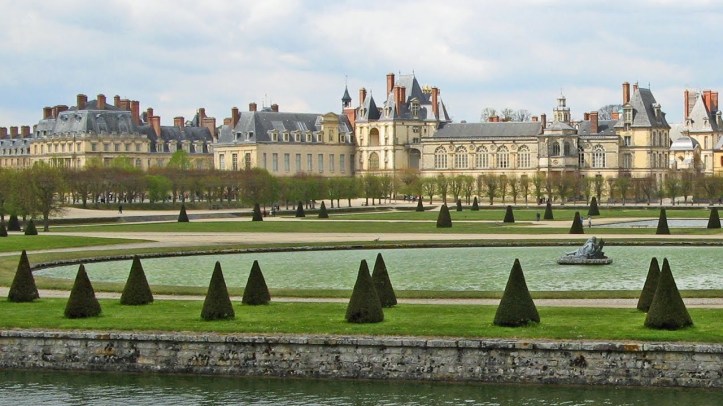 This originally was a medieval castle (12th Century) and subsequently a palace which served as a residence for the French monarchs. Francis I (1528-1547) and Napoleon (1804-1814) were the ‘owners’ who had the most influence on the château, and this was obvious during our tour.
 If Mick has one regret about what he packed for our year plus holiday abroad, it is that he packed too many red shirts – five in total. In this photo he is almost impossible to see – he blends in so well. He worries that in all the photos it looks as though he never changes his shirt!
The château was dripping with portraits of the monarchs and royals who lived here or who were related in some way to Napoleon I.
 We read that it is the only French palace to have had continuous habitation for 700 years. Even following the French Revolution, the palace remained relatively undamaged, however the contents of the palace were sold off at auction. And once Napoleon was made Emperor, he set about gathering contents for his palace. However, he actually did not get to spend too much time here as he was off fighting in military campaigns.
Napoleon had special rooms decorated for Pope Pius VII who agreed to crown him as the Emperor (in 1804). Although it is said that Napoleon took the crown from the Pope and crowned himself. This was a big step for Pope Pius VII to agree to considering his predecessor Pope Pius VI died as a prisoner of Napoleon in 1799.
The ten years following the crowning of Napoleon were very divisive, and Pope Pius VII excommunicated Napoleon in 1809. Napoleon reacted by arresting the Pope and imprisoning him in Savona. Their disagreement was over the men Napoleon had selected to become bishops. The Pope did not agree and refused to invest them until a deal was brokered. And in 1812, the Pope was moved back to the luxury of Château de Fontainebleau.


Pope Pius VII was kept in exile in some of these rooms from 1812-1814, and possibly the exact rooms that had been decorated for him when his and Napoleon’s relationship was a little happier.
All the rooms were lavishly decorated and there were many tapestries used to decorate the walls. Some of the tapestries dated back to the 15th Century.

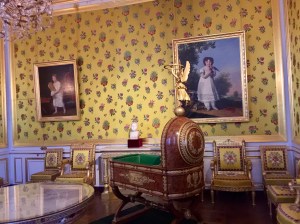 Check out the cradle that was made especially for Napoleon I’s son. Before he was born, the baby – Napoleon II – had been declared the King of Rome. He died of tuberculosis when he was 21.
The furniture was exquisite. I was surprised to see the bright colours in many of the materials used for the bedspreads and chair upholstery, still looking very bright.
The wooden door on the left of these two photos shows very well how no detail was too small. We saw loads of doors that were individually carved and decorated like this one.
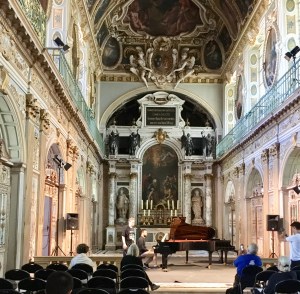 A real treat for us during our visit was our attendance at a ‘master class’ in the chapel. We could hear the music before we knew where it was coming from and then as we got closer we saw an open door that indicated that a master class was in progress and that we could enter. So we did. It worked perfectly because our feet had had enough, and the music and commentary from the American ‘Master’ were very interesting.
Hopefully the video clip will work and you can enjoy some of the music being demonstrated to the student by the Master – 11 seconds only!!
Finally, a favourite photo of mine from our visit to Château de Fontainebleau.
 This French couple found a seat to rest their weary feet while they enjoyed the masterpieces
 Jane and Mick's Holiday Adventures