It was easy to twist Mick’s arm for this château visit, because it included wine tasting. Luckily, Mick did not find out he had to climb 195 steps to get to the top of a tower before he could taste the wine.
Château de Sancerre is actually a wine cooperative that produces excellent wines of the Sancerre appellation. It consists of 55 hectares of vineyards spread across different-sized parcels of land all around the village of Sancerre – 50 hectares of sauvignon blanc and 5 hectares of pinot noir. And, the Château itself is surrounded by two hectares of gardens. It is located right in the centre of Sancerre on what is the highest part of the village.
We decided to pay for a tour of the Château and a wine tasting for €12 each, and as it turned out, Mick and I were the only guests – so it was a private tour. I asked our guide when was the busiest time for tourists and she said it was usually now, but the tourist numbers were down everywhere, and no-one seemed to know why. On our earlier walk around the medieval village of Sancerre, we noticed that although there were some tourists, many of them American, the restaurants and caves were far from full.
 This photo shows the Loire River on the left and the Loire Canal on the right. In France at the moment it is very dry and hot, and the Loire is at less than half its normal volume. We could see lots of exposed sections of the river bed from this spot.
The first part of the tour took us up to the Château, which is currently under renovation. Regardless, it is never open to the public, as it is privately owned by the Marnier-Lapostolle family, from Grand Marnier fame. Our guide told us that the well-known liqueur Grand Marnier was created in Sancerre in 1880 by Alexandre Marnier-Lapostolle. Although, it is no longer made in the region.
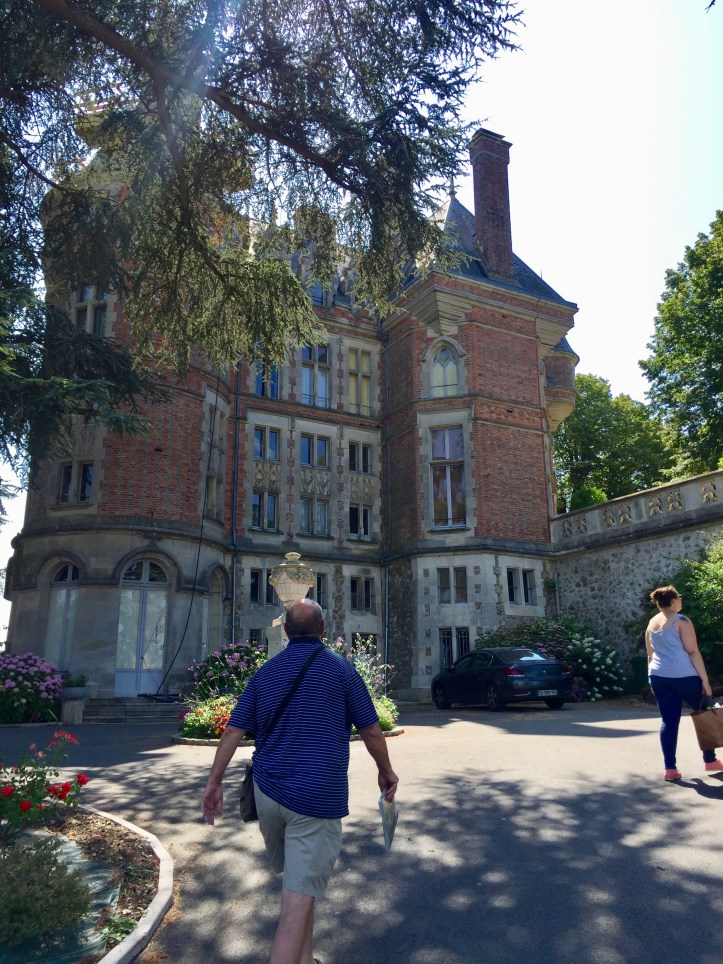 This building is relatively new, having been constructed during the late 19th Century (1874), after the great French wine blight that destroyed many of the vineyards in France, including in this area. The owner of the land decided to employ the workers from the then-defunct vineyards to build her this Louis XII style château.
It is built on the remains of what was once the strongest castles in France of the Middle Ages, but obviously not strong enough. Because, the very-Catholic French King of the time decided he wasn’t happy with the essentially protestant community holding this useful military position. He ordered that it be destroyed. The fighting lasted for more than 200 days and the Sancerre villagers endured almost 6000 cannonballs launched at them over that time, before the King’s men won out in the end. The King either ran out of interest or money, because the story goes that only remaining tower – La Tour des Fiefs – is here because he would grant no further money towards the cost of explosives to destroy it. He had already had the other towers destroyed, but the records are not clear as to whether there were 5 or 6 towers.
And this is what we got to climb up and explore.
 The tower consists of two sections. The original section is on the right, which surprised us because it looks stronger, despite being built 400 years earlier than the second part on the left. Apparently, the same woman who built the château had the extension added to house a wooden staircase, and had insisted it be built quickly, and perhaps cheaply.
We found out that this tower houses an eclectic mix of artefacts. There is a dungeon on the lower level, but we were not permitted into there. On the ground floor there was a collection of armour and some of the cannonballs that had demolished the place back in the 16th Century. Some of them were very heavy!!
 After climbing to the next level we were surprised to find a very-dusty chapel. We were told it was an 18th Century Chapel that a previous owner had had brought to the empty tower from a second château he owned somewhere else in France. As you do!!
The stones used to construct the towers were a conglomeration of different sorts of rocks from the area, including a lot of flint.
 Once at the top, the views were amazing and so were the wines we tasted.
 The village at the bottom of the château in this photo is Saint-Satur, where Mick and I are staying.
We had a 360 degree view from here while we tasted the local wine and the local cheese called Crottin de Chavignol. We learnt that there are three major soil types in Sancerre and that the appellation of Sancerre can only make single-grape wines – sauvignon blanc or pinto noir or rosé made from pinto noir. Our guide explained that one major way the local winemakers create wines of ‘difference’ is by blending the grapes grown on the different soil types.
 We also tasted Le Croquet de Sancerre – a sweet meringue-based biscuit with almonds that was ‘apparently’ developed around the time of the wine blight when the wine was so bad someone had the idea to make this biscuit so they could drink the pretty awful wine of the time, as the biscuit helped to make it more palatable. Nowadays the biscuits are consumed with coffee.


 Jane and Mick's Holiday Adventures