Limoges is the capital of the Haute Vienne Department with a population of just under 140,000. Mick and I have just spent two nights here, and that was enough. While the city has some beautiful areas, it wasn’t really to our liking. If you are visiting the Nouvelle-Aquitaine Region and your time is limited, my advice is to spend it in Poitiers.
Limoges is famous for its porcelain. I actually own a piece (a small plate) that was given to me as a gift when I finished teaching at a school in Dubbo in the late ’80’s. I remember my mother was very impressed that I could actually afford a piece of Limoges back then and she wondered if it was in fact genuine. Mum only believed me when I told her it had been a gift and I showed her the name on the back!!
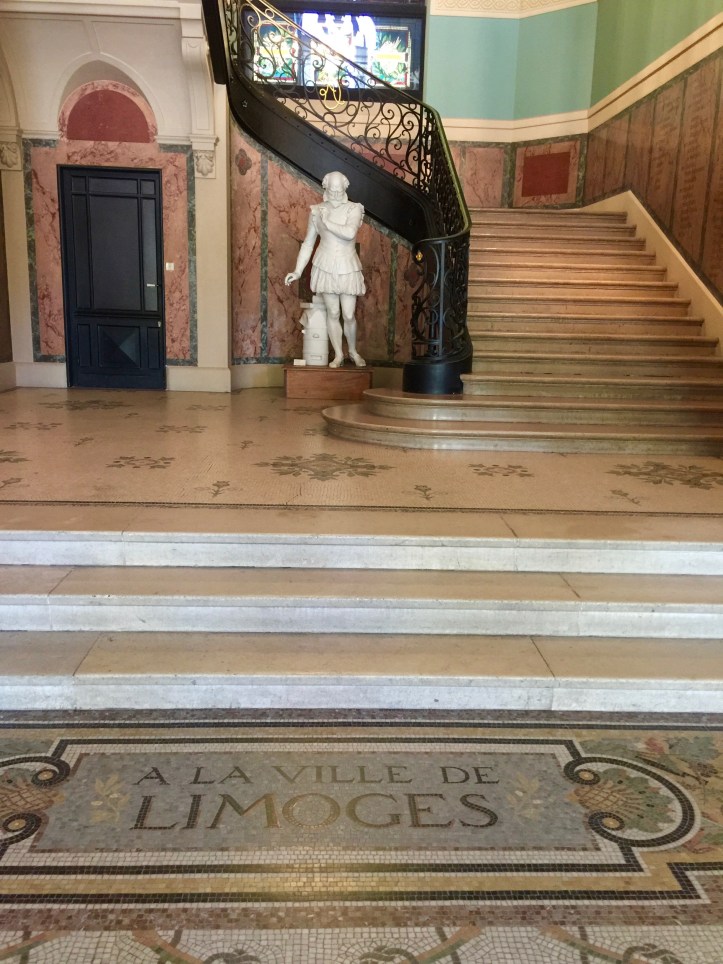
Mick and I spent just over an hour wandering through the museum (Adrien Dubouché National Musée) devoted to porcelain and pottery once we worked out how to get in.


We tried the door in the middle of this face of the museum (left hand side photo), which obviously had been the front door at one stage as per the historical photograph dating back to the early 20th Century.
 But we soon found out we were wrong.
This jolly wall decorated in colourful pots stands just outside the new entry to the museum. After we paid €7 each, we were able to explore the displays which showed the techniques used in making and decorating porcelain, as well as comprehensive examples of specimens produced in Limoges.
There were two additional areas provided for samples of pottery and porcelain from all of the world dating back to some primitive pots made and used 200 years BC.


The museum closed at 12.30pm for lunch – of course, but we were told we could use our ticket later in the day if we had not seen enough. But funnily enough – we had.
The discovery of kaolin outside Limoges in 1768 gave birth to the porcelain industry. It provided huge employment to the city, with 1200 people employed in 1900.
 After we visited the Tourist Office on our first day, we were given a booklet with several options for walking tours. We chose to follow the itinerary that took us through the ‘high town’.
We cheated to explore the outer reaches of the city by buying tickets on this train.
We got a very good view of the Pont Saint Etienne which crosses the Vienne River and leads towards the city’s cathedral (see below). Many pilgrims cross this bridge on their way to Santiago de Compostela as part of their camino.


Wherever you find an old bridge such as Pont Saint Etienne, which was finished in 1203, you will usually find a new one, invariably called Pont Neuf.
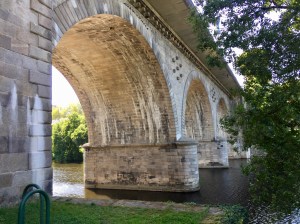
Voila!
Not the best view, but the little train took us underneath it. It was built between 1832 and 1838 and has five arches, three of which span the Vienne.
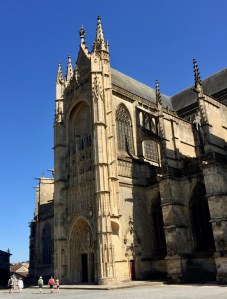 The little train also took us around the Cathedral Saint Etienne, but we did not stop to peak inside.
The cathedral was commenced in 1273 and completed in 1888. Now that is a slow building program.
Our walking tour of the town led us to the markets and through cute little streets with interesting shops and some surprises too.
This private courtyard called Cour du Temple is located down a small walkway and the homes and buildings here have beautiful granite stairways and columns.
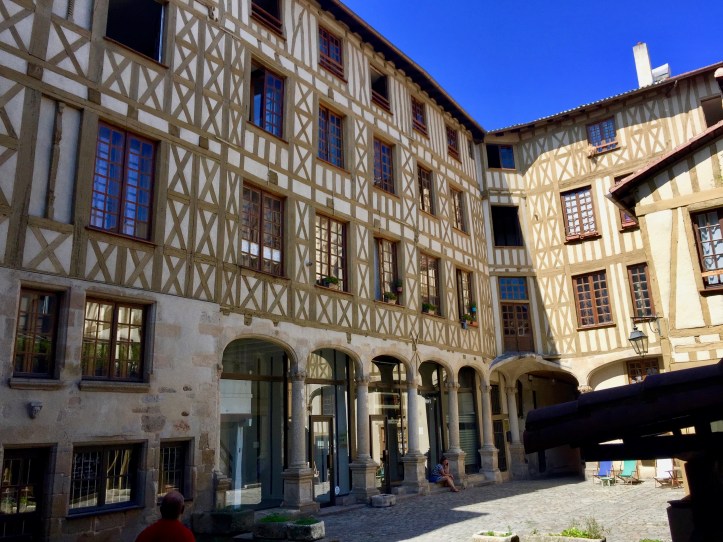 We’d almost given up any hope of finding it, when we stumbled across it on our way home. It was so cool in there.


The markets were doing a reasonable trade, but this small charcuterie had a long line of people waiting his or her turn to enter to buy something. It must be good.


Limoges has its share of art deco buildings too. These examples were found in and around the Rue Jean Jaurès.
La Fontaine des Barres stands in the centre of a small triangular medieval square. Yes that is correct – triangular square.
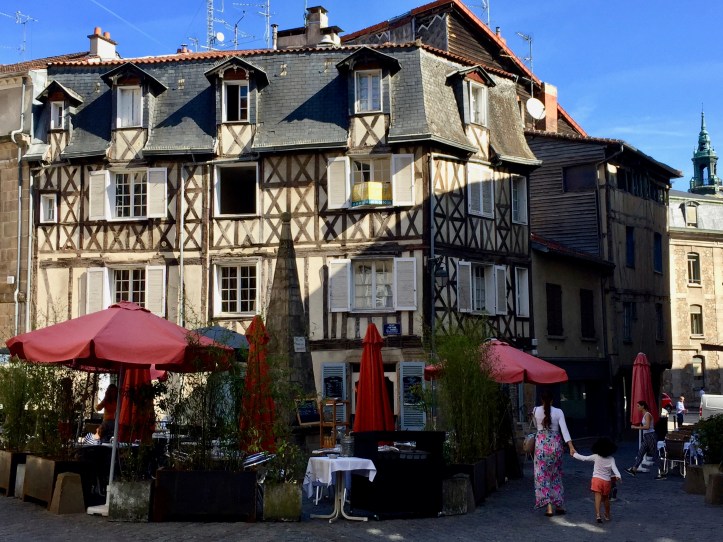 There were quite a few restaurants in this area serving mostly seafood. Limoges is about 220km from the coast, which I guess is not too far to ensure the seafood is very fresh. The fountain has a pyramid top which was added in the 18th Century.
 There are quite a few of the half-timbered houses and buildings in the centre ville of old Limoges.
I confess to being a bit awe-struck with these buildings as I find them fascinating.
In order for us to get into the old part of the town, we had to walk through a park called Champ de Juliett and then the Place Jordan.
In and around these parks were some large sculptures and monuments. Many of them were now homes or perches for pigeons.


One of the most well-known landmarks in Limoges is apparently the Gare. Mick and I arrived here two days ago, and we will leave from here later today for our next house sit. It was impressive.
 I took this photo of the Gare de Limoges – Bénédictins from the Champ de Juliett.
The gare is named after a Benedictine monastery that existed nearby before it was closed during the French Revolution.
On the advice of the owner of our accommodation, an ex-restauranteur from Limoges, she suggested we walk into town to eat at a tapas bar. It has only been opened for a few months and everything on offer is home made. The street was filled with restaurants and people were starting to fill the tables. Can you guess which plate belongs to whom??


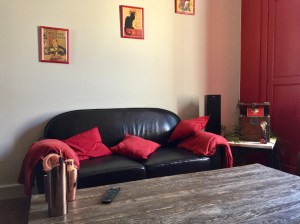 Mick and I stayed at a chambres d’hôtes in Limoges, less than 500 metres from the gare. The room was comfortable enough, but small. However, what was lost in bedroom space was made up with the massive breakfast on offer, a comfortable lounge room, and a nice outside space where we could enjoy a glass of French wine in the evenings.

Mick was happy. But not as half as happy as he was when he found out they had Heineken beer on tap and he could serve himself. He actually said, had he known that before, he would have had one for breakfast.

A new adventure begins later today when we meet our next hosts and their four dogs.
Yes four.
I said last time when we sat three dogs just outside of Cambridge last year that we’d never care for three dogs again – too many. So this is not three I guess. We’ll soon find out if we are able to cope.
 Jane and Mick's Holiday Adventures