Mick and I visited Mortemart today after we dropped one of the dogs at the vet to have her dressing changed. We were advised she would have to go under an anaesthetic because it could be painful. That meant this morning’s feeding routine was a challenge because she was not allowed any food or water. But, we managed. Our skills in managing animals are increasing. Thank goodness is all I can say, as we have to repeat that process again next week when she will have the stitches removed.
I was very keen to visit the small commune of Mortemart with 115 inhabitants and a 9-hole golf course that boasts views of the Massif Central. An added challenge is that the course is set amongst hundred+ year old trees. My sister Robyn recently got a hole in one on a course back in Australia. I reckon she would love to play a round or two here.
Mortemart holds two titles.
Not only is it the smallest village in the department, it is also the only village in the department that can claim the status of being a “most beautiful village of France”, (une plus belle village). It is set in the Blond Mountains, which are the first to make up the Massif Central, coming from the direction of the Atlantic.
 Once we arrived we could see why it had this classification. It was small and very cute.
I ‘borrowed’ this image to the left because….
I don’t have a drone!
And, it helps show how the village is built around a castle and its moat.
Actually, there is not much left of the original château that was built in 995AD by the Duc de Mortemart. He was given permission to build it because he helped defend Bellac (only 12 km away) from William de Poitiers.
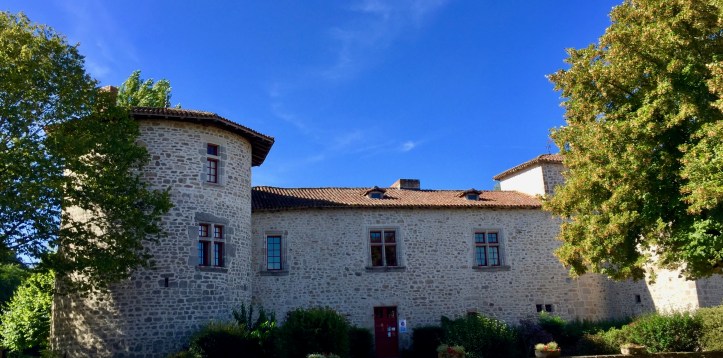 The sign on the door advertised the Office de Tourisme, but it was closed. I believe it is also used as a public space for exhibitions and the like.
Looking across from the château, we could see the covered market which dates back to the late 17th Century and early 18th Century. It is built directly on top of the soil using materials that were local to the region.
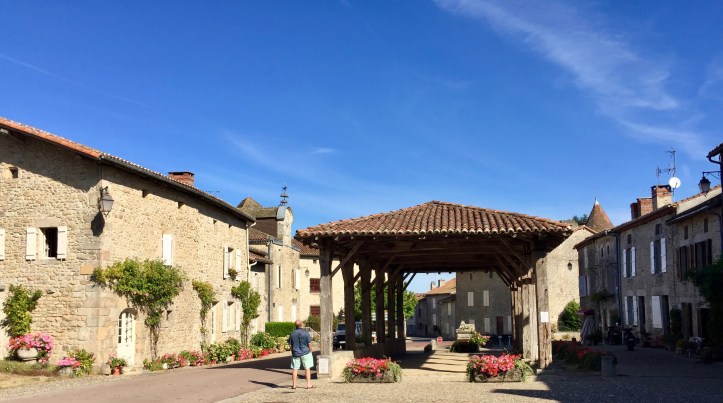
The buildings in this village all appear to be built in a similar style, and all using granite for all or most of their construction. This gave a very neat appearance to the cluster of buildings surrounding the hall.

Mortemart is also the home to two former convents and the former chapel of the Augustine Convent which became the village’s church in the 17th Century. Inside contains wooden (oak) carved stalls dating from the 15th Century. I read that the now plain wooden ceiling once displayed beautiful frescos which were sold off in the mid 19th Century to pay for some much-needed upkeep.


There were three convents, once upon a time, established in the 14th Century. They must have been huge as the buildings, some of them three stories, are very grand. It was good to see many of them had been converted into accommodation (chambre d’hôtes) and artist studios. The Augustine Convent has been converted into the mairie, and another large building is privately owned by one family whose members live in various wings of the sprawling convent.


The photo on the top left is the old Carmelite Convent that once also housed a hospital as well as a convent. For such a little place, Mortemart had its fair share of large buildings. It would have been a very busy place 400-700 years ago.
 There were quite a few signs around the village explaining the buildings and their history. Mick and I also noticed a few signs targeting tourists. For example, tourists could take a slow ride with Clementine around the village.
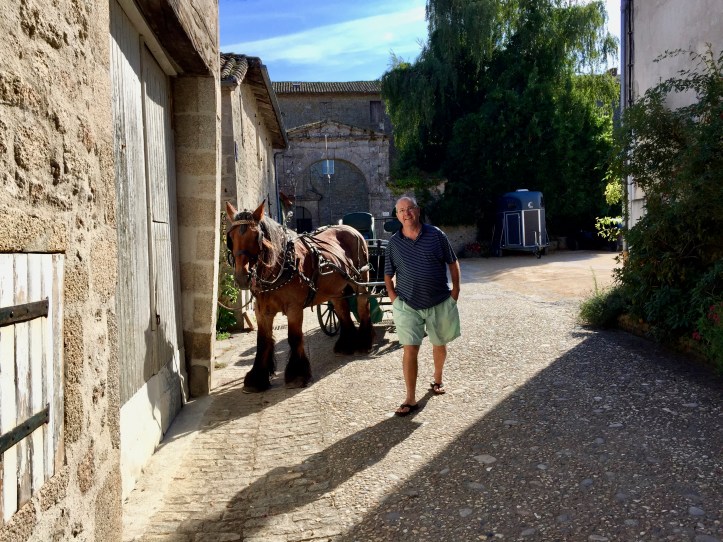
And no, that is not Mick in one of his red shirts.
We spotted this man preparing Clementine for a group of four tourists who we later spotted heading towards the neighbouring commune of Montrol-Sénard, less than 2km away.
Mick was game enough though to get up close to Clementine while she was waiting.
Mick and I also went to Montrol-Sénard and enjoyed seeing the great display around the local lavoir. Even though the water was now green, we could see the inlet drain that once would have channeled clean water into the pool, where purpose-built scrubbing panels had been installed.
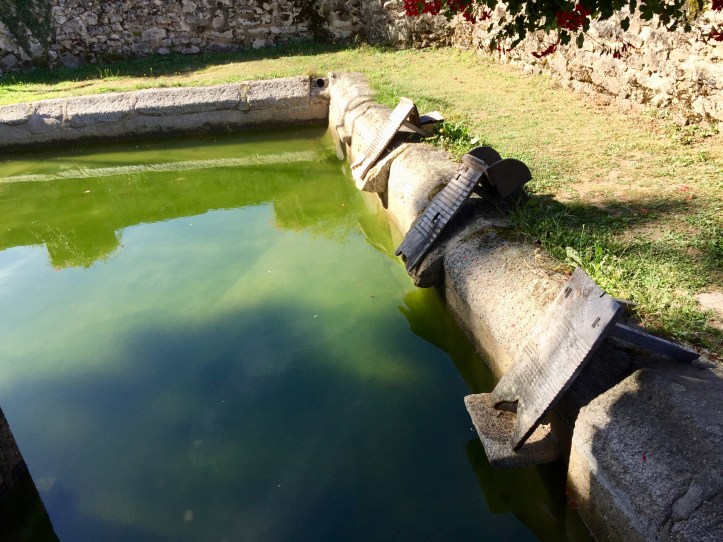
There were old boilers and utensils for stirring the clothes and removing them from the boiling water. It would have been terribly hard work.


Seeing this made me even more grateful for having an automatic washing machine.
 Jane and Mick's Holiday Adventures