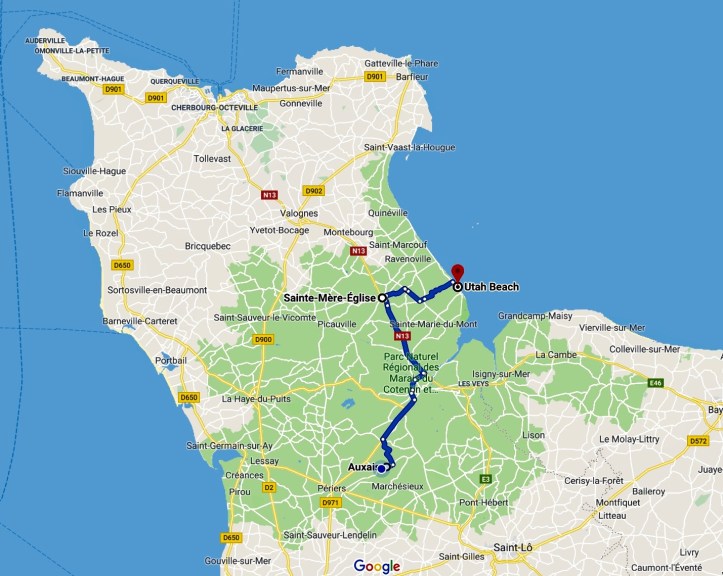
Our first day trip was to Sainte-Mère-Église, a small village close to Utah Beach that was a very important village for the Allied Forces to ‘take’ in the early hours of 6 June 1944. Paratroopers landed in the centre of the village, and because there were some buildings on fire, it meant they were easily spotted and many were killed before they even landed.
One of the most famous incidents of this event involved a private – John Steele – who had his parachute hooked on part of the church spire. From that height, he got a good look at the carnage taking place beneath him. He pretended he was dead for two hours and eventually was cut down by the Germans and taken as prisoner. (He later escaped and re-joined the combat).
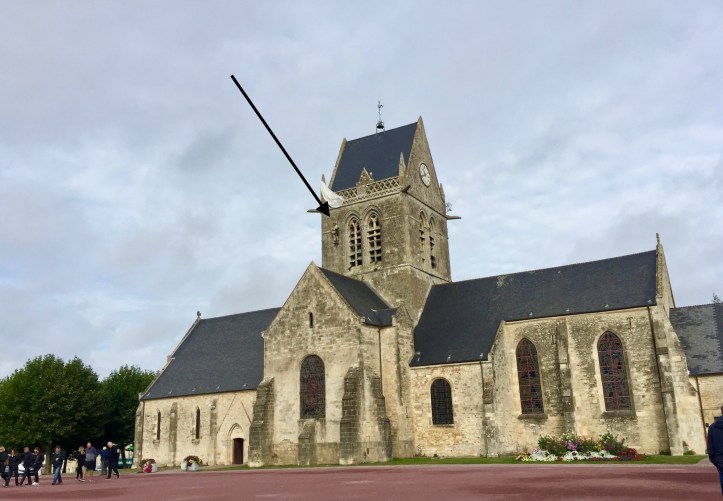 The arrow in my photo is pointing to a model of a parachutist, representing John Steele.
There were a number of museums in the small village toasting the success and bravery of the parachutists. One of the arrows is pointing to a parachute-shaped building that houses one of the museums.
 The other arrow is pointing to a soldier – but this photo doesn’t show it that well.
One novel item that this town produces to both remember this event on D-Day, (and to make some money), are parachute-shaped biscuits. We chose not to buy any of those.
Mick and I headed a further 12 Km on to Utah Beach. There were lots of buses and tours parked near the beach, with people viewing the information boards and the monuments displaying the names of the men who lost their lives there. An amazing site.
We travelled a little further on and found a factory selling oysters direct to the public.
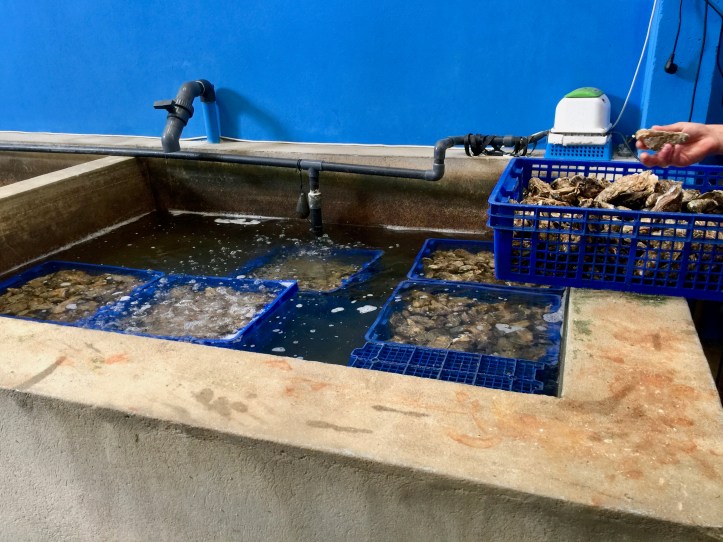
These were so fresh they were selected from the rinsing tanks where they had been placed only a few hours beforehand.
On our way back to our cats, we stopped at a market and bought some cider – Normandy is famous for its cider which has been made here since the Middle Ages. We were told that these bottles were made in the traditional way.
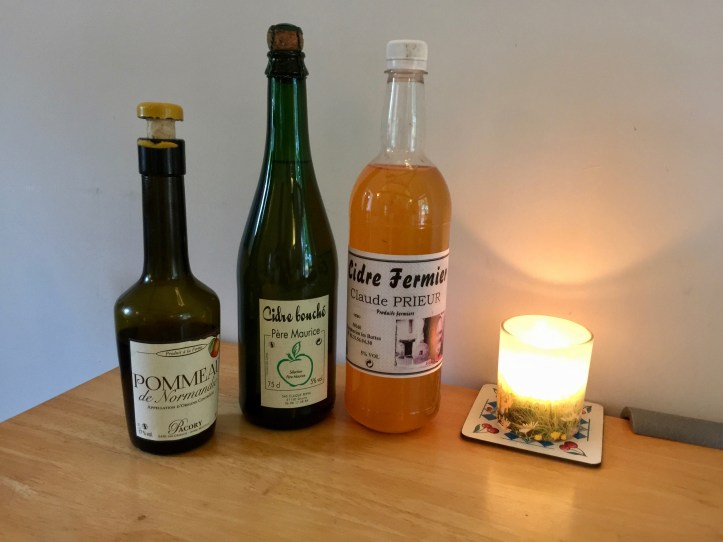 Apples are gathered and stored for a short while before being emptied into a circular stone trough where they are crushed by a big millstone. The crushed apples are then transferred to a press where they are laid in between layers of straw to extract the juice. The mats and pulp are then soaked before a second press, and this time the juice is a weaker brew. The one in the plastic bottle is (possibly) the second press (€2.50) and the bottle with a cork – cidre en bouché is the first press (€3.50).
Another famous (alcoholic) product if Normandy is Calvados, or cider brandy. It is distilled twice and matured in casks for up to 10 years. It is quite expensive and I do not really like it. But, Mick does.
Then there is Pommeau – an apéritif made using apple juice (2/3rd) and Calvados (1/3rd). It too is aged in casks for about 18 months. I’m not a fan of it either.


The glass on the left is from the corked bottle and the other cloudier one was from the plastic bottle. Mick thought dinner last night was superb.
 Jane and Mick's Holiday Adventures