I mentioned in a previous post that when we first arrived in Fenouillet earlier this month (1 October) there was a lot of activity with regards the grape harvest (vendange). It was almost over, with only a few vineyards holding onto the ripening grapes. The harvesting finishes a bit earlier down in the south of France (in the Languedoc-Roussillon) because the grapes have had plenty of sunshine throughout the summer.
In fact, we almost missed it.
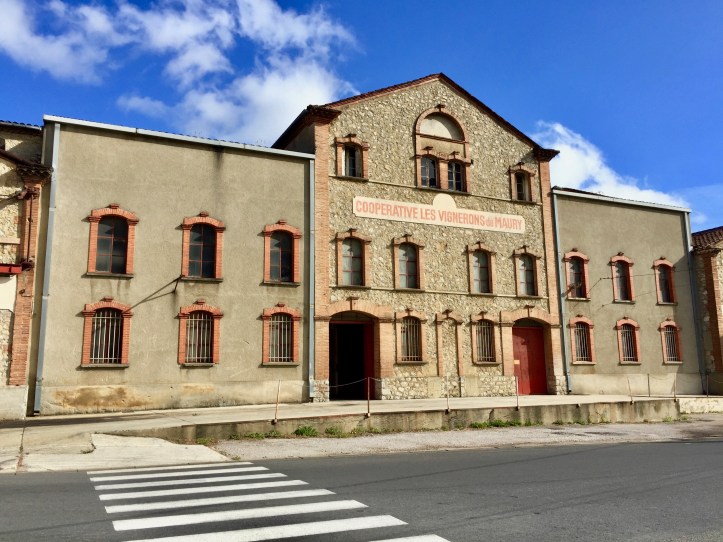
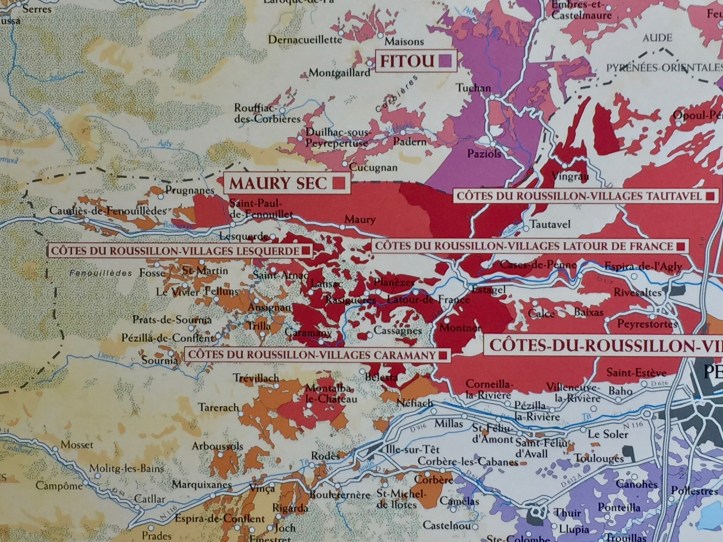
The town of Maury is about 20 minutes from our house sit, and this is where there is a very large cooperative that many of the (smaller) local winemakers use to crush their grapes. I took this photo of a poster at a wine tasting we went to in mid June at Chateau Saint Martin. I thought it might come in handy

Maury is also boasts lots of winemakers, offering free tastings of their wines, including the local fortified wine named after the town – Maury. This close up shows (or tries to) how thick the area is with winemakers.
So it won’t come as a surprise that Mick and I actually had quite a few visits to this little town during our stay in this area, but more so during October – our final month here. We decided as we liked the wines from this region the best of all we had tasted in France, that we would only buy wine directly from the growers or through their cooperatives, and not through the supermarkets.
During one of our visits to Maury, we spotted a workman emptying some of the crushed grape skins into huge containers beneath him. (If you look closely, he is enjoying a cigarette at the same time). There were several of these containers loaded with old skins and small branches that we later saw dumped onto parcels of land where they were used as compost.


What we also saw, but I was unable to get photos of because I was driving, were groups of people harvesting the grapes, mostly by hand. Well, at least all the older vines anyway, as they have not been planted far enough apart to allow the mechanical picking machines to operate.
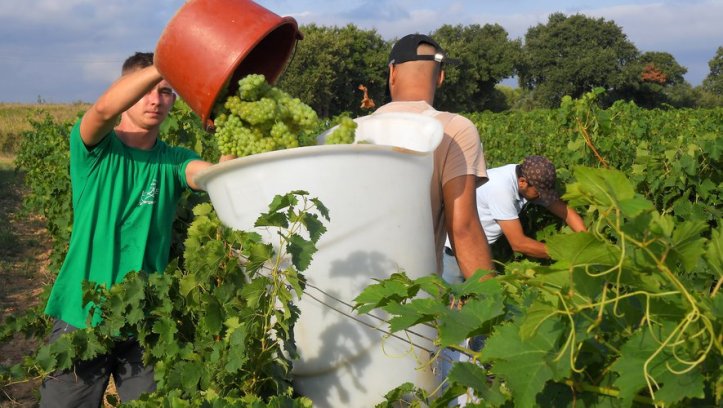
I borrowed this image (above) from a winemaker in this area, closer to Perpignan, where you can see how one person has a larger container all the pickers help fill, before it is later dumped into a trailer or the back of a small truck. Mick and I definitely saw that happening.
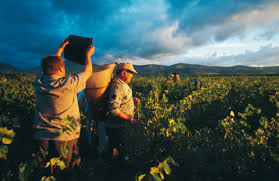 This second borrowed photo (to the left) is stunning – one from an advertisement for the town of Maury.
While there are many different types of grapes used to make the thousands of different types of wines in France, the grape (and hence the wines) that Mick and I really enjoy is (are) Carignan (a grape variety of Spanish origin).
I found this article about wine growing, and its history, in France very interesting.
After the decline of the Roman empire and the rise of Catholicism, wine in France grew in importance. Medieval religious orders began to hold a strong influence over the production of wine and perfected techniques to create the perfect taste. In the Middle Ages, the region of Bordeaux with its handy seaports became the wine capital of the world and was the purveyor of wines to most of Europe’s monarchs.
So, it would seem that the rise of religion actually helped wine growing to flourish.

I took this photo a few days before we left, just outside Saint Paul-de-Fenouillet heading towards Maury. The low clouds hanging over the Corbières highlights the changing colours of the vineyards below (in the centre-right of the photo).
During this trip of our ‘one year in France’, Mick and I have spent all winter in this area . (Fenouillet), one week in summer (August), and now finally one month in autumn, and we have found that the local winemakers are very happy to give us a free taste of their wines in the hope we will buy some. We were told that during the harvest that might not be the case, however as wine making is more often than not a family business, while the main wine growers were busy with the harvest and getting the juice pressed ready for the wine making process, there was always a wife, child, mother, grandfather or grandmother, who were happy to accommodate us.
I have mentioned some of our wine tasting experiences before in this post, and this one.
Now to Our Conclusions and Recommendations – Our Favourites
- Domaine Serrelongue – for three reasons – (a) an amazing wine tasting experience where we were made to feel at home tasting the wines in the family lounge room using beautiful glasses filled with sizeable portions, and where we engaged socially with the winemaker’s father; (b) the 100% Carignan wine (called Carigno) was our favourite – for taste, bold, strong and dangerous (it is so black that after one glass Mick’s teeth and lips always turned black – mine not so much!!); and (c) the price. At €6 per bottle (although I notice that the new online price is €6.50), and usually with a free bottle of wine included, it makes for one of the cheapest wines in the region.) Another plus was that each time we returned, sometimes with family or visitors, the winemakers father always remembered us (the AUstralians from Fenouillet).
- Mas de Lavail – a close second. We only discovered this winery later in our stay, but visited it a few times. Our host had told us it was one of her favourites. The (a) tasting experience was held in a very pleasant location and we were able to taste all wines on offer; (b) their white wine (Ballade) was the best Mick tasted and their other cheaper wines (at €7 per bottle) in the Ballade range (Carignan and Rosé) were very good too. When we bought more than 12 bottles we were given a bottle for free. (So not as generous as Serrelongue, but still a nice touch). Mick was very disappointed on a return visit to find out that the 2017 Ballade Blanc was sold out and the 2018 had not yet become available.
- Marc Majoral – an independent winemaker we visited many times, but never did he give a hint that he remembered who we were. We liked some of his wines, but the tasting was certainly nothing too fancy – standing in a garage-type room with a small number of wines to taste from very small glasses. The cheapest was €8 per bottle. One of the reasons we liked it though was because it was very easy to get to – it had a large pull off area right alongside the main road between Saint Paul and Maury, and because the sign always said “ouvert“.
- Thunevin-Clavet – a modern, large winery where the tasting experience was brilliant – with so many wines to taste and where the staff were always very welcoming. The prices though were more expensive, but the quality of the wine was very good. Definitely a place worth a visit.
And finally, possibly the best-ever wine tasting experience in this area was at Château de Jau, where we enjoyed lunch with our neighbours and friends Derek and Helen, and our host, in August while tasting all their wines. The only issue was there was no restrictions to how much you could ‘try’, and a couple in the ‘party’ ended up a little worse for wear. The only reason this does not get the number #1 position is because it is only open during the summer months for these tasting luncheons, but I would highly recommend booking yourself into one if you are in the area during summer.
 I’m certainly no expert with regards French wine, but Mick and I have had quite a lot of experience this year throughout many different wine growing regions in France, and by far the area of Languedoc-Roussillon is our favourite.
I just wish we could buy it so readily back in Australia.
FOOTNOTE: If you are shy about going to small wineries in fear of being forced to buy something you don’t want or like (as can happen in some places), another great option around this area are the Wine Cooperatives. We have visited many of these too – the best ones we have found are in Saint Paul, Maury and even a small one in Caudiès. At these you can taste many local wines and buy some at very reasonable prices, including a great selection of wine sold as ‘Bag-In-A-Box (as 4, 6 or 10 litres casks). Plus, you can even buy wine en vrac (in bulk), usually the less alcoholic table wine, but not always, where your plastic container can be filled with x number of litres at about €1.30/L.
 Jane and Mick's Holiday Adventures