As with many French towns (I’d venture to say almost all), the local Office de Tourisme provides maps of their town with suggested walking trails to ensure visitors don’t miss out on anything important. I am sometimes fascinated by what is important to one city or town – as they can seem quite minor or obscure – and we were to find that out here in Argentan. The written guide provided for the walking tour of Argentan was a bonus because we were able to obtain one written in English.
Now, Mick and I only had three jobs for today (our second and last day in Argentan).
The first was to explore the key sites of Argentan by following the guide we picked up the previous day; second – was to collect the hire car from E Leclerc; and third – was to buy some groceries to take with us tomorrow to our next house sitting assignment. While we will have a car, we have arranged to spend two nights and one full day with our next hosts, and we are unsure what they might have planned. We do not want to arrive empty-handed.
The good news was the collection of the hire car and the grocery shopping went without a hitch. The car was there waiting for us, and it will be perfect for us for the next almost two weeks, when we must return it to the same location – E. Leclerc in Argentan.
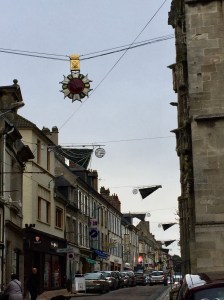 Our walking tour looked like it might be rained out, but we were lucky.
The first stop for us was the Lérot Clock (left). (As I alluded before, places and objects of note for a city come in all shapes and sizes.) This clock was a gift to the town of Argentan in 1854 from the watchmaker Lérot. Its shape was inspired by the Legion of Honour. It is suspended from one end of the church I photographed yesterday (Saint Germain) – and Mick and I had completely missed it when we last walked down this street. (Thank you Guide).
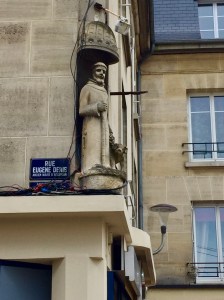 From the same spot, but looking upwards in the opposite direction, on the corner of the building that now houses a bank, is the statue of Saint Antoine and his pig. He is the patron saint of butchers (and obviously not of pigs who I am sure would not give him their vote of support).
One of the things that Argentan is most famous for is it lace making industry. There is even a lace stitch named after the town, which is different from the lace stitch named after Alençon, the neighbouring rival lace-making town. Mick was not too keen to visit the museum of lace, and as our time was limited, a trip there was scrapped.
A famous (now deceased) resident of Argentan is remembered in a number of ways along the walking tour. André Mare (1885-1932) was born here, and we walked past the house where he was born. Further along there was a fabulous mural in his honour painted on a building adjoining The Keep. Mare was a painter and also a designer of colourful textiles. During WWI he led the development of camouflage for military purposes using Cubism techniques.


The wall is a remnant of a fortress that was built here in 1123 by Henri I, the then Duke of Normandy and King of England. The fortress was originally surrounded by a moat, however 500+ years later, an abbot had the moats filled in to provide work for the poor. (Perhaps as a deliberate ‘economic stimulus package’ – possibly the first in recorded history aimed at curbing both inflation and unemployment. Perhaps even a model for ‘trickle-up’ economics.)
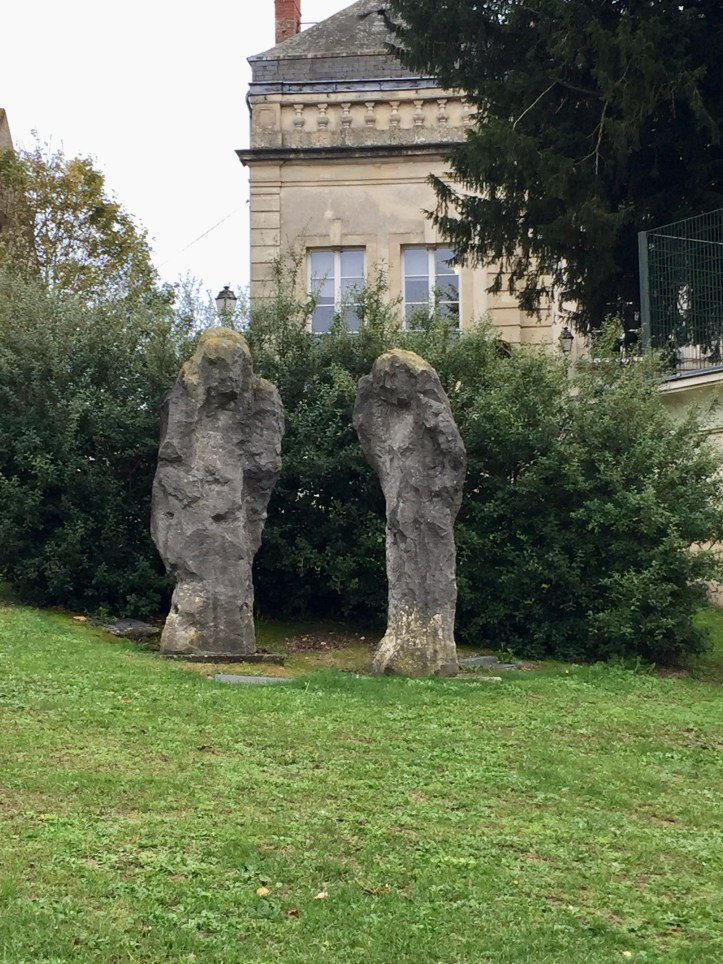 These statues, named Le Couple, are made from black granite and were erected in 1993. They stand more than 2m high and weigh almost 2 tons (I think each, but again, I can’t be sure).
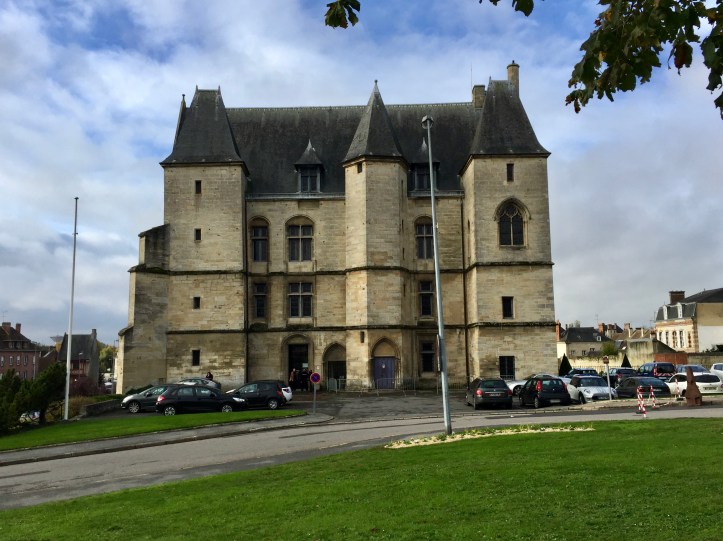
The Palais de Justice, pictured above, was once the Old Duke’s Palace. The Château was restored in the 14th Century, and has been housing the law courts since 1827. It is located very near the market square behind the large church of Saint Germain. It was a good thing I took the photo of that church yesterday because today there were dozens of stall holders selling lots of things we have seen before in French markets, with lines of well-organised and patient French people waiting their turn to be served.
But this was a first for us.

This stall holder was selling live rabbits for €12 per kilogram. Mick and I are not 100% sure, but we think they were being sold for food. We had spotted a cleaned, dressed rabbit at one of the butcher’s stalls for €8.90 / kilo – a much easier, and less messy way to prepare dinner.

This tower, called La Tour Marguerite, was less than 100m from where we were staying. It comprises four levels and was previously used to lock up debauched women. I am guessing it was men who decided the women needed to be locked away.
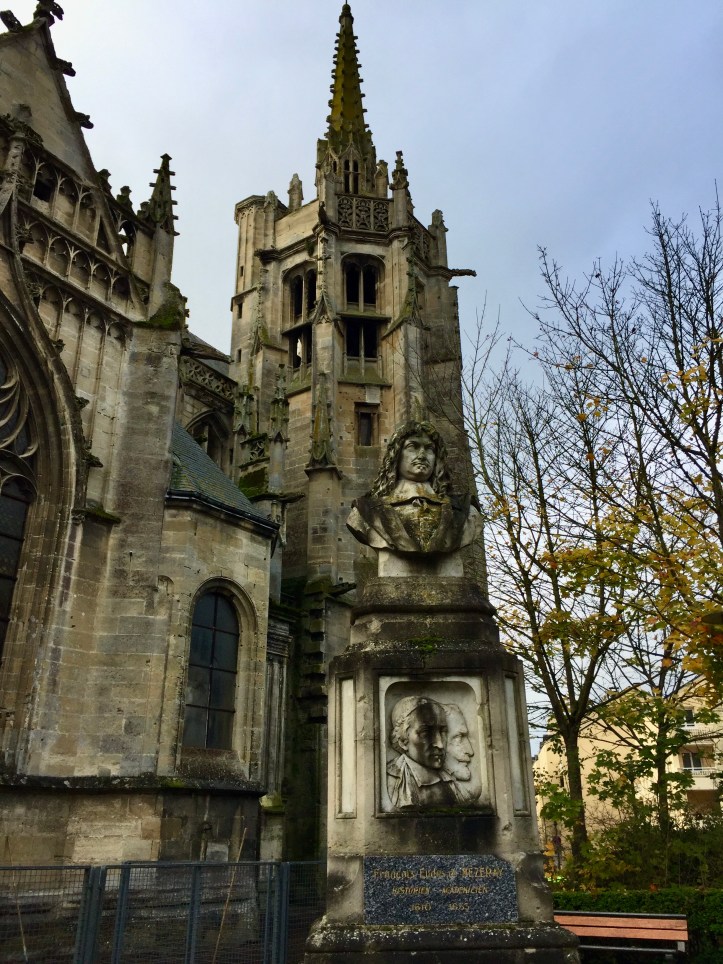
Finally, this bust is of François Eudes de Mézeray, who is considered the first French historian, and it stands in front of the church of Saint-Martin, which is just around the corner from where we stayed.
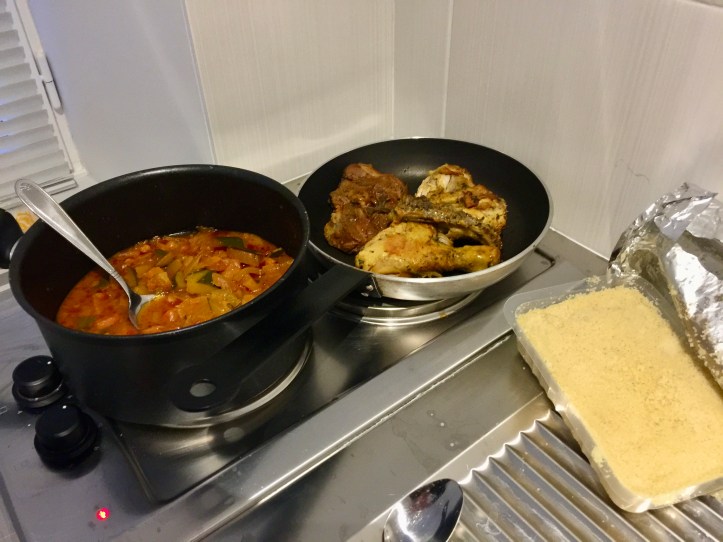
Dinner on our last night cost €7 – we bought it at the markets – pre-cooked Moroccan cuisine comprising two types of meat with vegetable sauce and couscous. We also paid €1 extra for some very spicy chilli sauce. We could not believe how much food we got for our money. No wonder there was a line up of locals buying their dinner and lunch for the next few days.
 Jane and Mick's Holiday Adventures