
Today Mick and I travelled firstly to the tourist village of Portmeirion. And to our great surprise, we found out that today was the start of a three-day food and craft festival that was being held in the little village, and hundreds of other people had decided to visit there as well.
We only had limited time because we were booked on a guided tour at 11.30am at our next destination, but we decided to pay the (reduced for the festival) entrance fee of £7 each and take a look.
What we had really gone to Portmeirion for was to look at the village that was designed and built between 1925 and 1975 by the architect Sir Clough Williams-Ellis.
In its hey day, Portmeirion was used as a setting for films and TV series (most well known – The Prisoner – 1967/68). I was more interested to read that George Harrison had spent his 50th birthday here in 1993. Maybe it was a bit more exciting back then.
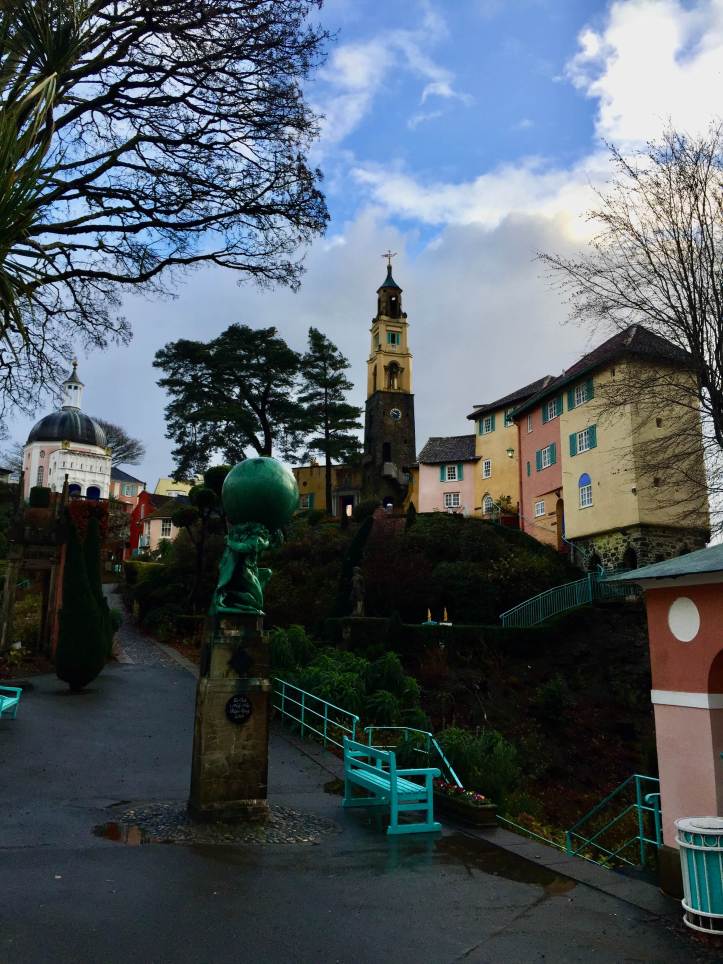
The style chosen by Sir Clough Williams-Ellis was aimed at giving the visitor a feel of the Mediterranean. But, he denied that the village was modelled on the Italian Riviera town of Portofino. I’m unsure why that would bother him.
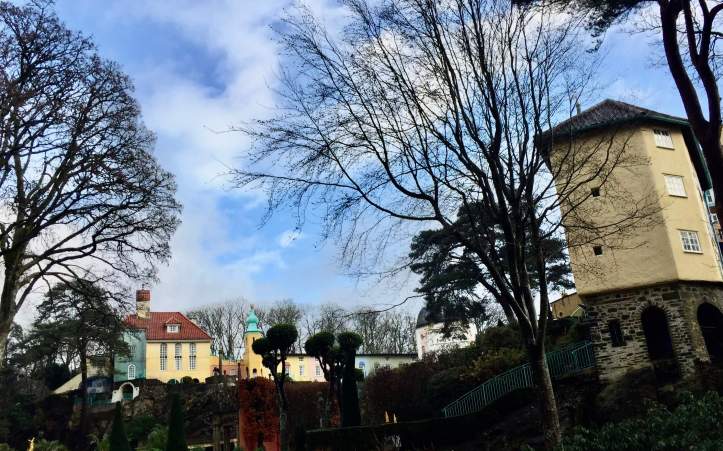
And. I guess it did have a Mediterranean feel, but most of the buildings needed a fresh coat of paint. Pretty much all of the buildings are guest accommodation, with a few shops to cater for the needs of visitors. All the buildings are registered as historic buildings.
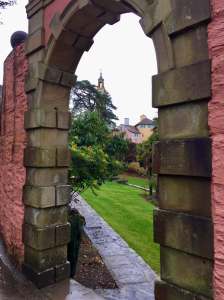 Portmeirion was certainly ‘quirky’, and many of the hundreds of visitors there today were taken by its beauty (as overheard by their comments as we passed by). One lady was taking a video of the place while she provided a commentary of what she was seeing – complete with lots of positive adjectives and “it’s gorgeous”.
Sadly, Mick and I could not fully appreciate what they were seeing as ‘gorgeous’.
The village is built on the estuary of the River Dwyryd, and when we were there the tide looked very low.
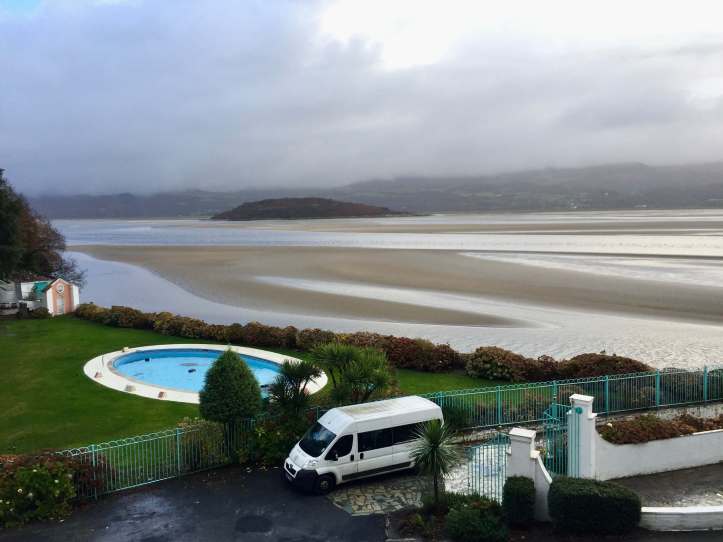
 Today though, there were loads of marquees and stalls as well, and initially I was disappointed as they hindered the view of the buildings. I tried hard to get photos minus the tents.
Mick and I wandered through some of the stalls, and bought ourselves a cup of coffee for morning tea.
Then Mick spotted a couple of stalls he was interested in – one selling gin, another whiskey, but finally it was the award-winning Welsh cider maker who successfully had him part with some money after he tasted some of her ciders – £3.50 for a pint.
We could see the rain clouds heading our way, and decided we had better head to our next destination – Llechwedd Slate Mine.


Mick and I were booked on a 90 minute underground tour of the disused slate caverns. We read that the town of Blaenau Ffestiniog where the mine is located, is the wettest town in Wales. And right on cue, the rain started to fall.
We were told to assemble in the area shown above 15 minutes before the tour commenced for the ‘safety briefing’. The briefing included being told to take a hard helmet and to be careful to check it was not filled with water before putting it on, and to make sure we kept the helmet on for the duration of the tour.
That was it!
Rob, a retired slate miner who commenced working in this mine when he was fifteen, was our guide.
Mick and I, and the four other visitors, were then led to the train carriage that was to take us below the ground. We had been told we would go 500 feet beneath the ground on the steepest narrow gauge railway in the UK.
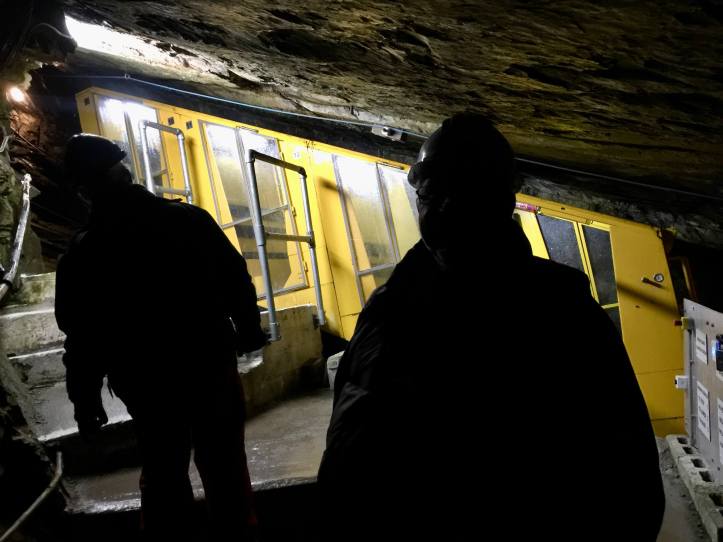
But, when we stopped only after seconds and told to get out, I asked if this was 500 feet below the ground and was told ‘no’. We were on Level A, where Level J was previously the lowest level (before the mine was closed and flooded).
Rob then took us to different parts of the underground mine on foot and used clever technology to control the lights and audio visual presentations projected onto the rock faces. Meanwhile, we all were ducking the dripping water that was seeping through the layers of rock above us.
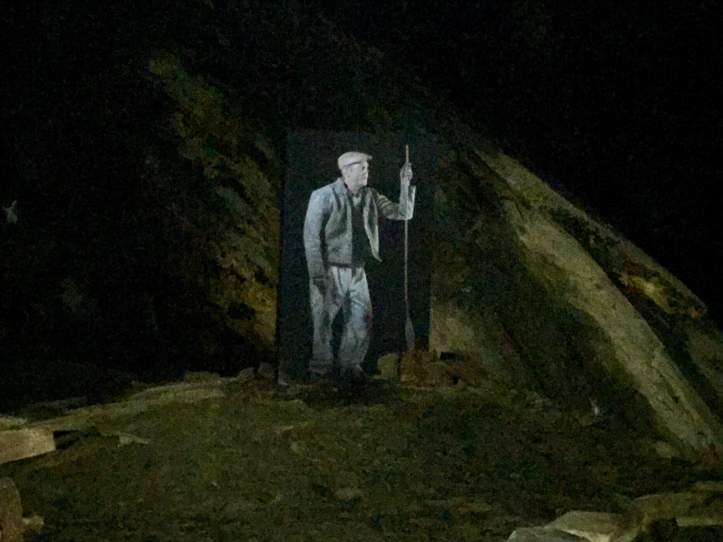
These animations told the story of men and boys who worked in these mines when they were originally opened in the mid 19th Century. A tough life indeed.
We eventually wound our way through tunnels, closely following Rob and listening for his safety warning of “duck your head”, and ended up on Level C, which was 500 feet below the ground. And, there was our train. Phew.
Back on ground level, Rob took us to a workshop where he demonstrated how the slate was split to make the tiles that were in such high demand for roof tiles all around the world back in the 18th, 19th and 20th centuries (before China came into the market). Rob explained that as much as 90% of the slate was wasted, and Mick and I could see tons of it piled up on the hillside, discarded because it had not split correctly or it was imperfect. To think of a 10% success rate does make it sound like a very risky business.
Mick chose some back roads to get us home, and they took us through some wonderful countryside. One thing that will always symbolise Wales for me are these rock walls – they are used along almost every small road and on farms to divide paddocks for stock.


One thing is for sure – Wales has lots of rock.
Mick did make an interesting comparison after our visit to the Llechwedd Mines that …..
……Saudi Arabia has huge deposits of oil, Australia – gold, Africa – diamonds
…….and Wales….
……….SLATE.
 Jane and Mick's Holiday Adventures