 Saint Fagans National Museum of History is an open air museum consisting of re-erected buildings from all around Wales. The buildings, some dating back to the 13th Century, are set inside the grounds of Saint Fagans Castle, which is located in a nearby suburb called….Saint Fagans. (There is a theme here I know.)
The museum allows visitors to examine the history of the culture and lifestyle of the Welsh people, while observing differing architecture.
Mick and I had to wait for the rain to stop so we could get more out of our visit. We had been told by our hosts that it was an interesting place to visit because many of the buildings are actually in use by artisans from bakers to ironmongers. And, when we arrived, on Bus 32A, we were blown away by some of the buildings that had been totally rebuilt on this new site.
The museum holds displays of traditional crafts with a working blacksmith forge, a pottery, a weaver, miller, and clog maker. It also includes two working water mills: one flour mill and one wool mill. Part of the site includes a small working farm which concentrates on preserving local Welsh native breeds of livestock. Produce from the museum’s bakery and flour mill is available for sale.
The first time I heard a story about a building being torn or pulled down and totally re-built was when my mother told me about when she was a little girl, living in outback, remote north-western New South Wales with her parents and three younger siblings. Sadly, I cannot recall all the specific details, but she said that her father bought a new property some distance from where they were living, however there was no home on the new property. So, her father, who was an engineer, pulled the house down and transported the timber to the new property. While they waited for the house to be re-built, her family lived in a tent. I have no idea how long it took but it seemed incredulous to me.
Anyway, back to this museum.
The museum started just after WWII when the Earl of Plymouth donated the castle and its grounds. Some of the forty+ buildings were reconstructed in the 1950s and 60s. But, the museum is still growing – at the moment there is a complete pub (ex Cardiff, 1853) being re-built on the site. However, everything is not old – the bus stops at the front door of a very modern centre comprising a restaurant and meeting rooms, and of course – a gift shop. Mick said this visit was his favourite ‘thing’ in Cardiff (so far).
 This (1610) farmhouse was originally located on the Gower Peninsula and it was re-built here in 1955. The red colour of the walls is thought to have protected the house and its occupants from evil spirits.
Can you guess what this is?
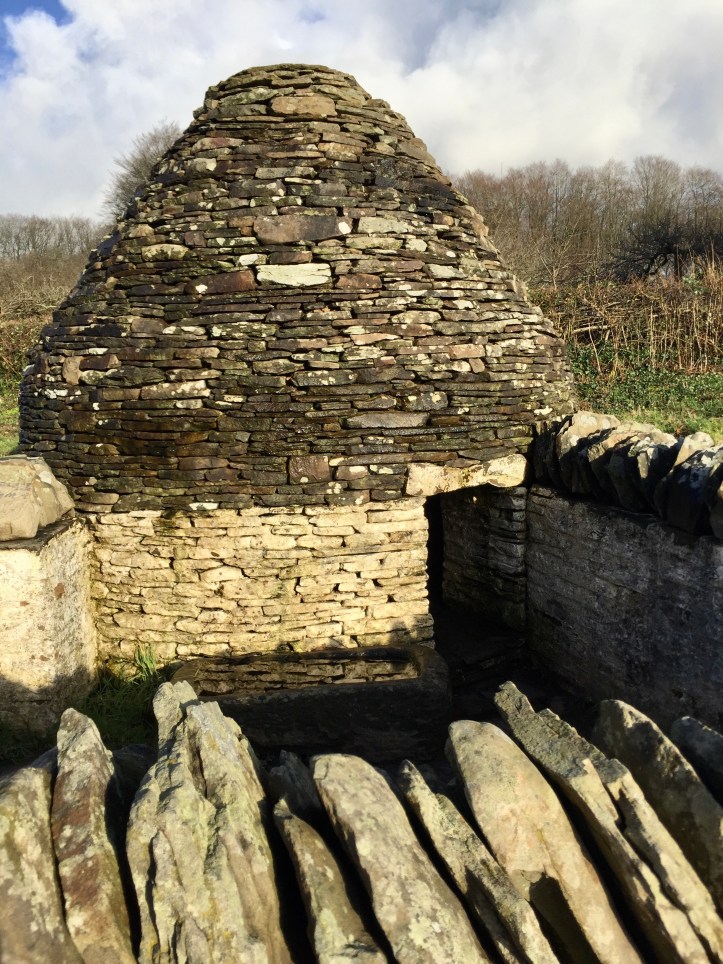 Correct!! A pigsty – obvious isn’t it?
This style of pigsty was common because the circular shape prevented the pigs from digging their way out – as there are no corners. It was originally built in 1800 and relocated to Saint Fagans in 1977.


Inside every house that was open for visitors on the day of our visit was a museum employee keeping a fire burning, to keep him or herself warm, and to give visitors an idea of how the home was organised. This house was built in 1672 and reconstructed here three hundred years later. It was a single story home with a little loft above the two small bedrooms. In 1761 a family of six children, a maid and a lodger lived in this house. “How?” I asked the museum employee. The six children slept in the mezzanine level, the parents slept in one of the bedrooms beneath and the lodger slept in the other room, separated by a curtain. And the maid, she slept either on the floor in front of the fire or on the table. The tables were not nailed to their legs so they could be ‘flipped’ for use as a bed. (Mick and I started to feel guilty when we learnt this – as we are finding our current (town)house sit’s three-bedrooms and two toilets a little small for us.)
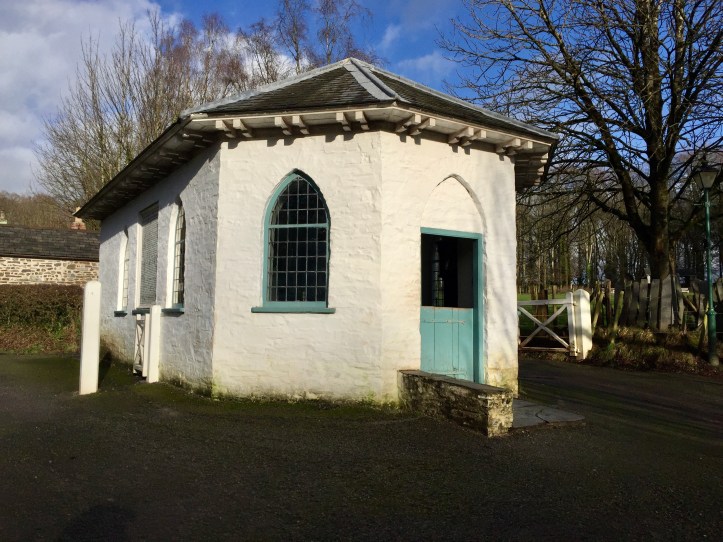 This building (built in 1771) is a tollhouse. It was relocated here in 1968. They used to be located on busy roads and often poor farmers were charged several times per day. Take a look at the sign advertising the prices and the exemptions.
 Mick and I were very interested to read that there were protests about the unfairness of these charges during the period between 1839 to 1844. The main group of men who led these protests went by the name of “The Daughters of Rebecca”. They would dress like women so they could not be recognised. Obviously that did not work as well as they’d hope, because some of them ended up being sent to Australia as convicts for their trouble.
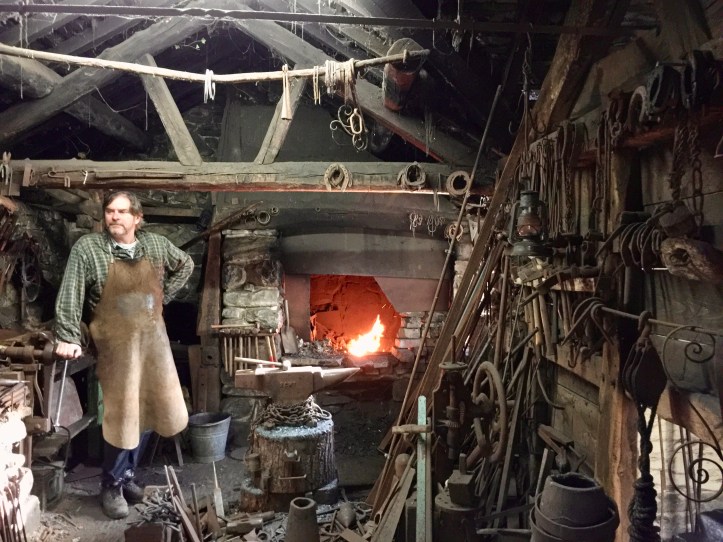 The ironmonger or ‘smithy’ was one place Mick really wanted to see. His grandfather had been a blacksmith in a small community called Attunga, outside of Tamworth in NSW. While Mick’s grandfather passed away before Mick could meet him, his grandmother kept the workshop and her husband’s tools for many years, and Mick has fond memories of visiting the workshop.


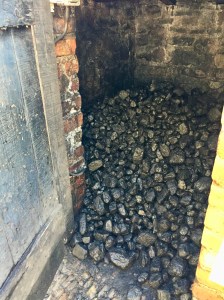 Mick chatted to the smithy for quite awhile – reminiscing about his grandfather’s workshop and tools. We both found it almost unbelievable that the coal he used for his blacksmith fire came from Columbia. These following comments are my attempt to summarise what he told us.
He explained that since Margaret Thatcher’s time, no more coal was able to be mined in the UK. During 1984-85, miners went on strike protesting against the changes PM Thatcher wanted to introduce. She was unhappy about the tax payers’ money that was being used to prop up the coal mining industry while there were cheaper fuel alternatives available. He also said it was because the coal that was being mined and used in the UK had a high sulphur content which later formed acid rain that impacted Norway; and Norway was not happy.
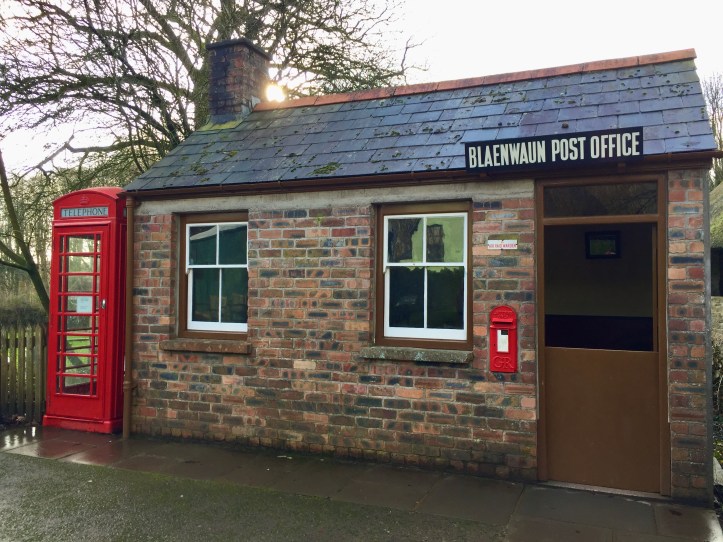
The interior of this 1936 post office reminded Mick of the old post office in Attunga – the small community where his grandparents had lived.
Time for another quiz. What is this?
HINT: It was built in 1660 and was located in the yard of a pub.


If you guessed a cockpit you were correct.
The Prevention of Cruelty to Animals Act of 1849 brought an end to the cock fights, but the building adapted its use to something very different – a slaughterhouse.
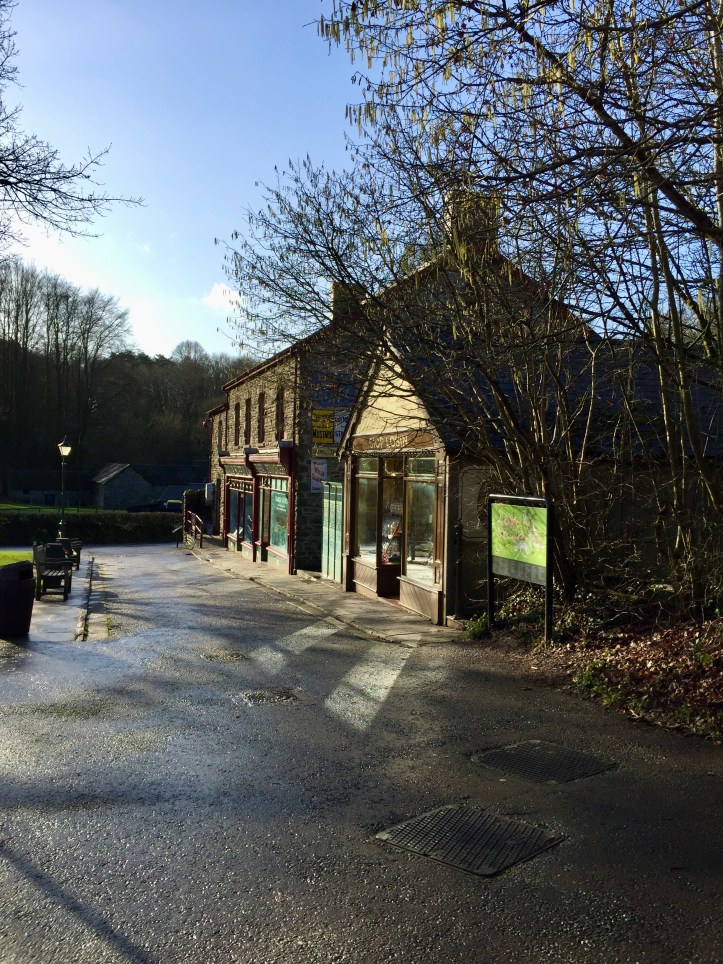
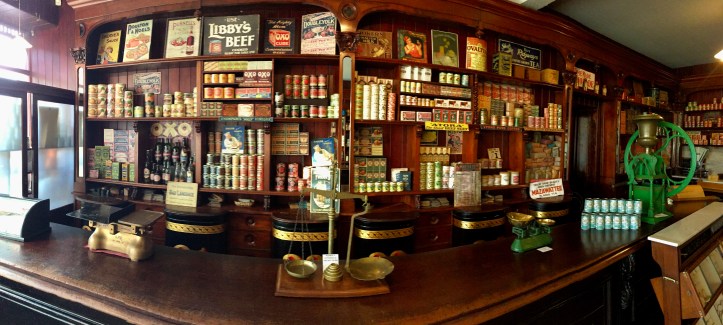
The newer buildings included some shops where Mick and I enjoyed recalling items from our childhood memories. The stores were originally opened in 1880 in Ogmore Vale and only closed in 1973. The first picture for this post shows the inside of the store as it would have looked in the 1920s.


Mick could remember many of the varieties of cigarettes in lefthand display cabinet. His mum used to smoke the cork tips Craven As because she liked the little black cat on the box. A good a reason as any I guess.
Another quiz?? HINT – read the wording “Please adjust your dress before leaving”.


It is a urinal from a railway station originally built between 1901-1910.
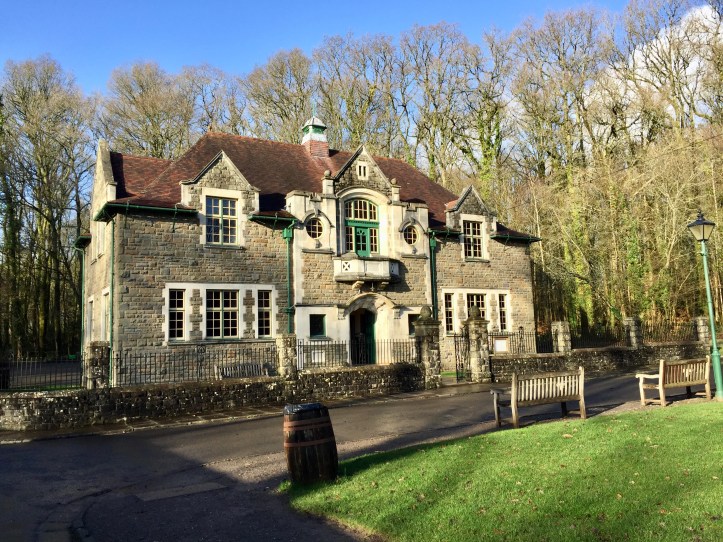
This next building was originally constructed in 1916 – it is the Oakdale Workers’ Institute. You have to remember that this building, like almost all of them at this museum, was totally deconstructed, then transported to here and re-built (in 1995).
The Institutes were important for the social and cultural life of the mining communities. This one housed meeting rooms and a library, and upstairs there was a very impressive meeting hall.
 There was no way Mick and I got to see everything at this (free) museum. It is a place that is worth spending a few visits, but we had to get home to let Mitzi out for a wee walk. But before I finish this post I want to share a few of our favourite places at this museum.
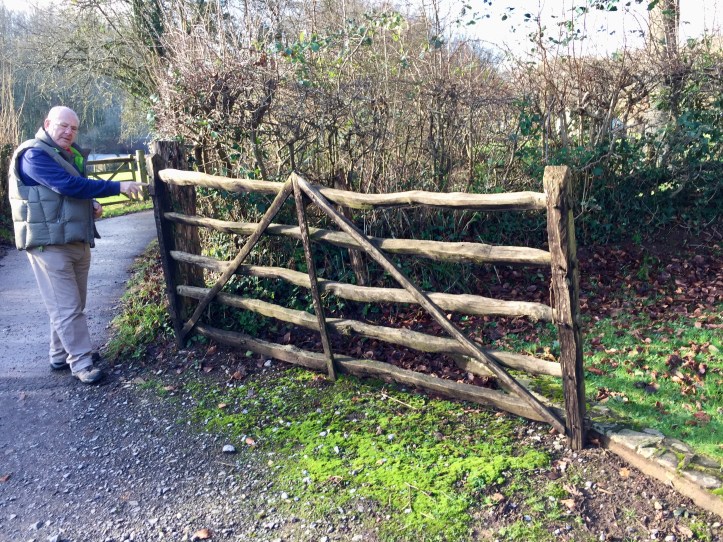 Mick loved the workmanship in this gate.
But I enjoyed visiting a row of iron workers cottages originally built in 1800. They each had the same floor plan, but had been done up showing how furniture and ‘possessions’ had changed from that time up to the 1970s.
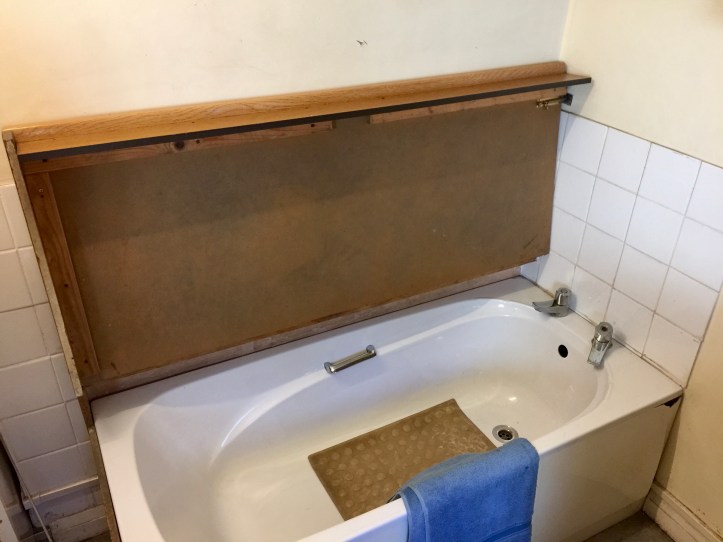
This bathtub in the 1970s house was in the same (very small) room as the kitchen / laundry. I’d never seen a lid for a bath tub before, but I could see how useful it made the space.
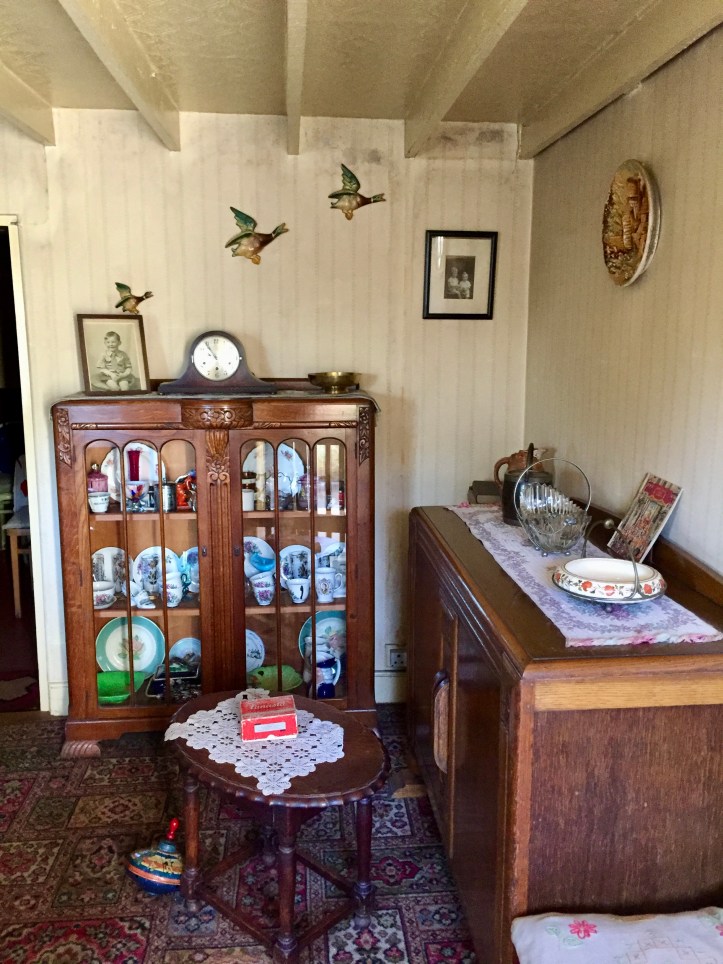
The house beside it was from the 1960s and I loved the flying ducks on the wall – we’d had some of those in one of our homes in Dubbo many years ago.
 I reminded Mick as we were rushing to the bus stop that we had been to another town in Wales that had an interesting ‘take’ on the construction of the houses within it – Portmeirion. While Saint Fagans Museum had a range of buildings from different locations in Wales and from different periods in history, Portmerion had been built to look like an Italian village.
We both agreed – Saint Fagans was miles better, and that is well worth a visit if you are ever in Cardiff. Perhaps several visits!!
AN ASIDE
Mick knows something about pulling down a building and re-building it somewhere else. When he was Principal of a school in central New South Wales (NSW), he found out there was an abandoned shed on a property about 20 kilometres from the school.
The school was in need of a shed because Mick’s Science teacher (me) wanted to set up a community recycling program that would be run by the students. So, after discussion with his general assistant, a veritable procurer of all things weird and wonderful in the community, Mick and a few others headed out to pull the shed down. Mick could not stay long but had a clever idea to have each panel of the shed numbered as it was dismantled so the reconstruction would be easier.
Once all the pieces were transported to the school, a team of volunteers assembled to re-assemble the (soon-to-be-recycling) shed.
Things were going very well until they got to Piece #8. It was missing. So were pieces 18, 28, 38, 48, etc. Mick immediately ‘clicked’ to the pattern here. There were no Number 8s. He raised this with his general assistant, asking why there were no pieces with the number ‘8’, and was told “I always have trouble with 8s!”. The general assistant had not spent much time in school when he was a boy, and as a result he could not read or write. He was a much loved member of the community, who ironically spent more years at the local school than any other local we knew. He had learned ta few tricks so he could get by without the need for reading and writing. Most people did not know.
Once that piece of the puzzle (excuse the pun) was sorted, the shed went up in hours. And, Mick’s Science teacher was happy.
 Jane and Mick's Holiday Adventures