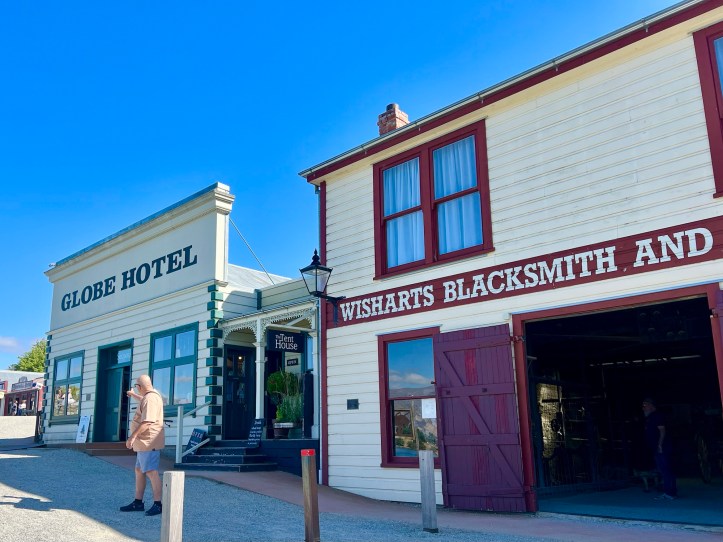
Mick and I headed into Cromwell, New Zealand’s farthest inland town, to explore a little piece of the town’s history and to sample the coffee. The town is very proud of its historical buildings lining the edge of Lake Dunstan as they help tell the story of the early days of this settlement.
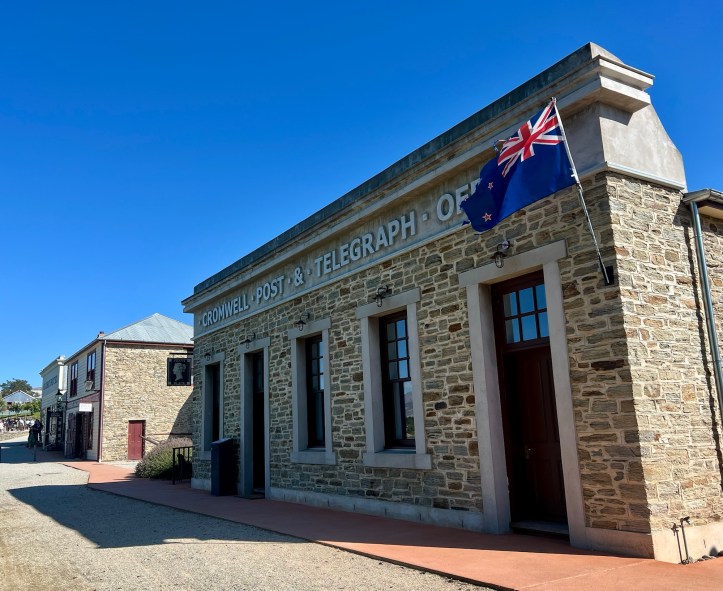
Some of the old buildings now house gift shops and cafés, while others are set up as displays of old professions like blacksmiths. Mick cannot walk past a blacksmith’s shop as his grandfather was the local blacksmith in Attunga for years.
I commented to Mick that I thought it odd that the early settlers had built all these different businesses in a row along the edge of the lake, only to discover that they have only recently been placed here.
When the Clyde dam was completed in 1990, Cromwell’s main street disappeared under Lake Dunstan. Some of the historic buildings dating back to the gold rush of the 1860’s were saved or lovingly rebuilt on higher ground, creating the Cromwell Heritage Precinct.
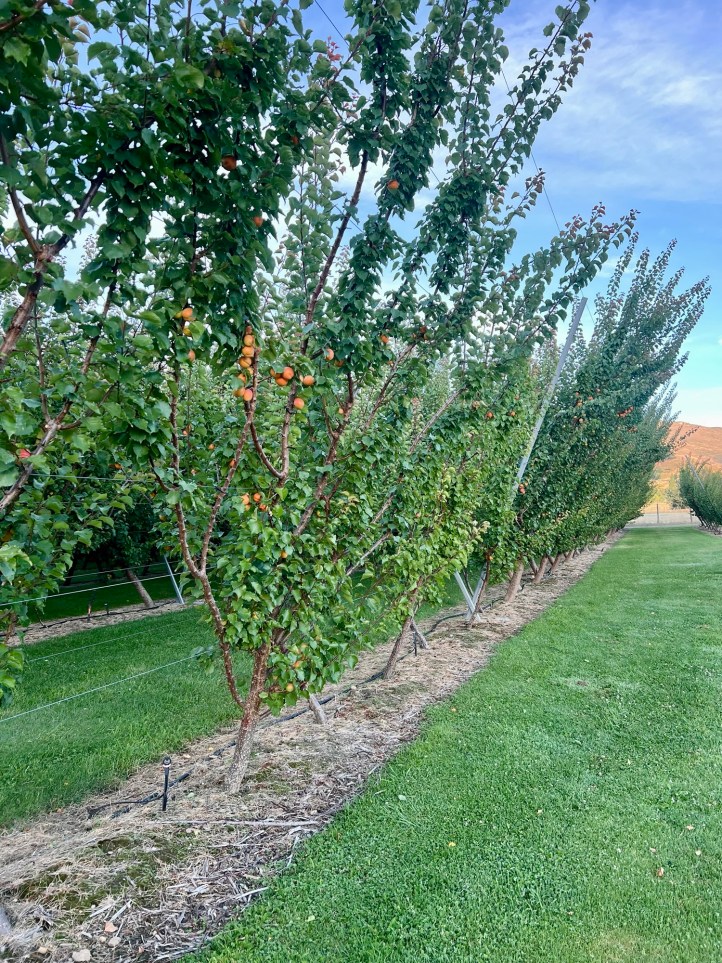
Cromwell does have vineyards here. Of course it does because that is why we are here. But it is also home to large orchards growing stone fruits, including cherries, as well as apples and pears.
And the town is very proud of that. So much so that it has one of those giant sculptures many locations are fond of – such as The Big Banana back home.

Nearly half of New Zealand’s export cherries are produced in the Cromwell Basin, prized internationally for their intense flavour and distinctively bold, complex sweetness.
We bought some cherries from a very large orchard nearby to where we are staying – it is definitely the greenest orchard we’ve ever seen – they even water the lawn between the rows.
During the afternoon we headed off to visit Quartz Reef Wines’ cellar door, which is actually located in the industrial estate of Cromwell. As we drove to the cellar door, we passed a very large wine bottling facility and a large wine storage area, both obviously used by a number of producers from around here.
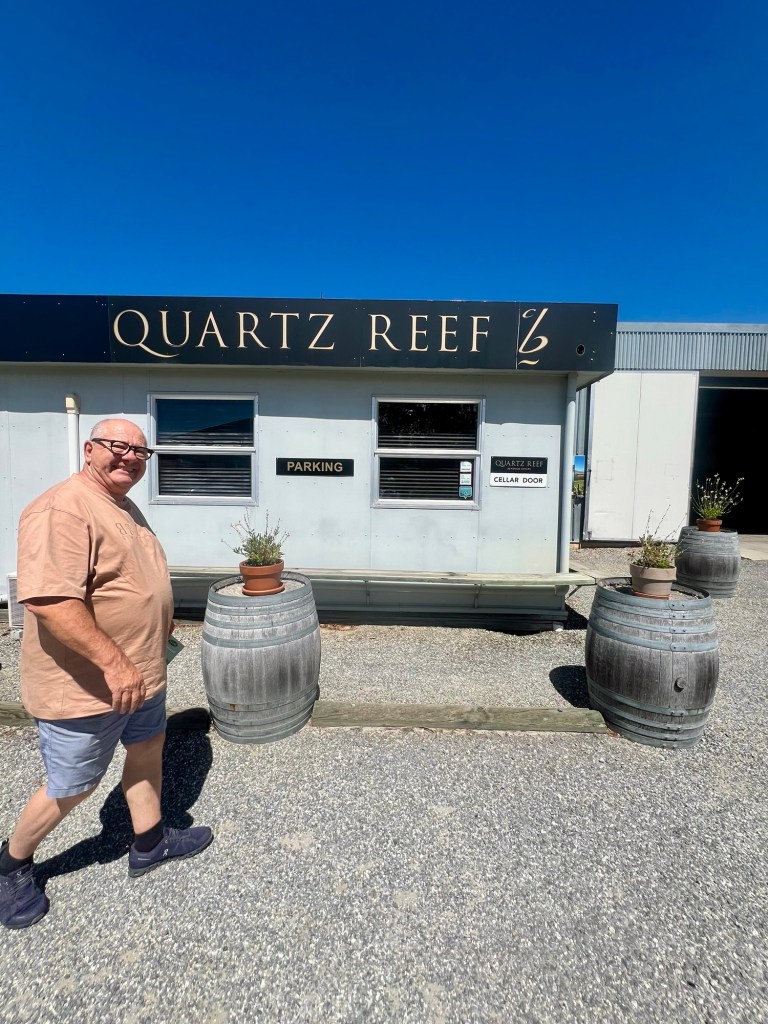
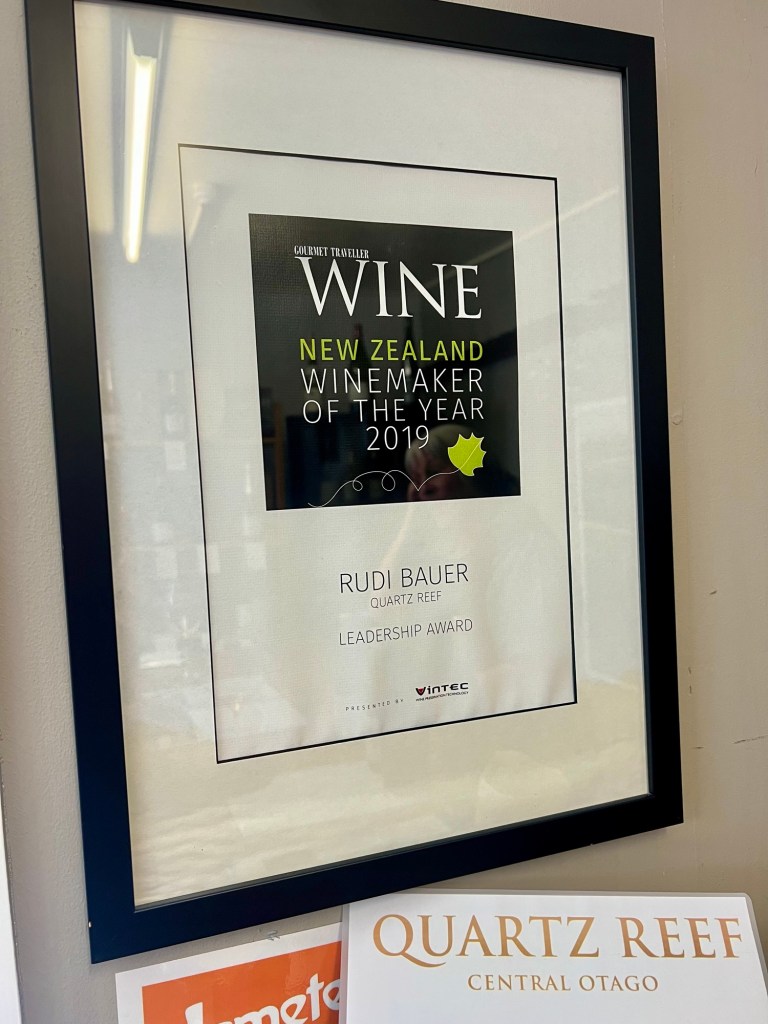
The Quartz Reef vineyard is located in the Bendigo sub-region, and was founded in 1996 by three partners, one of whom is Rudi Bauer, an Austrian winemaker. It was a few years later before vines were planted on what was once Bendigo Station. The land produces intense flavoured wines due to the closely planted vines that yield relatively small amounts of fruit. The winemaker uses biodynamic practices.
We were guided through our tasting by Elaine who has worked with the company for 25 years, and she knew a lot. She took us into the shed next door to the tasting room to show us how the current vintage of méthode traditionelle wines were being ‘riddled’ – put into racks so the lees would sink to the bottom, which is actually the neck of the bottle, before it is disgorged.
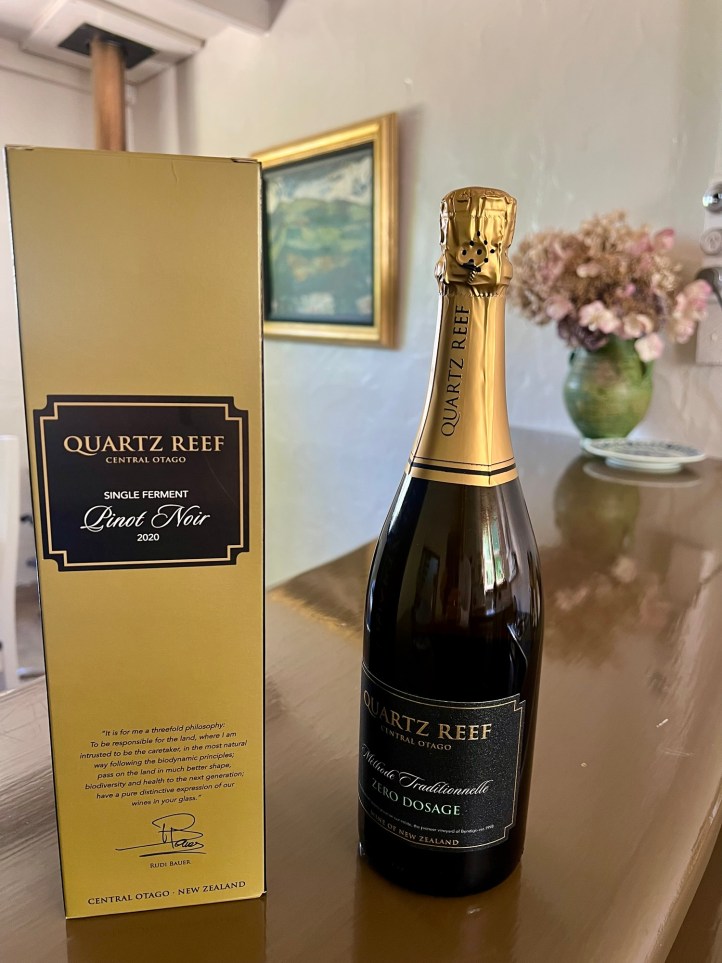
We left here with two bottles of wine. Mick and I chose the ‘bubbles’ that had zero dosage, which means that no extra sugar was added to it before it was corked. And, a bottle of the 2020 Single Ferment Pinot Noir.
When we returned to our accommodation we noticed that Lucie the winemaker had some people visiting her small winery for a sample of her organic wines. The next thing we know, there is a knock at our door and Lucie invited us to try her wines.
Lucie is French and her husband is from New Zealand. They are both winemakers. Lucie started her career around Dijon in the Burgundy Region and then went to Alsace Lorraine to learn more about making wines, such as Riesling, that are suited to the Central Otago.
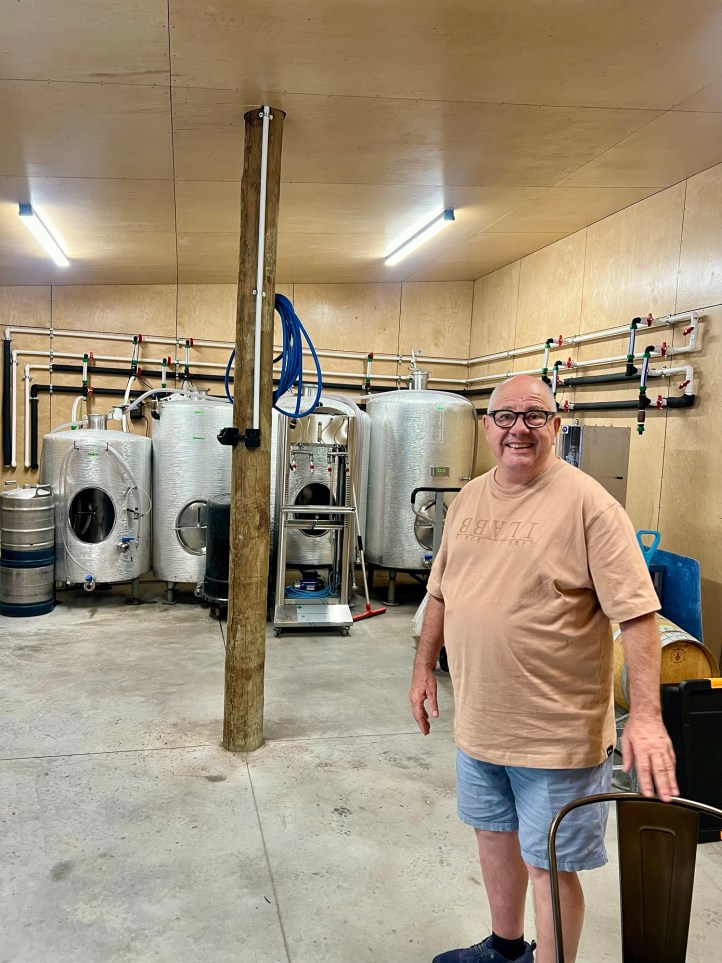
Their operation is very small and the two of them do everything, including disgorging the bottles of wine by hand when they are making their méthode traditionelle wines.
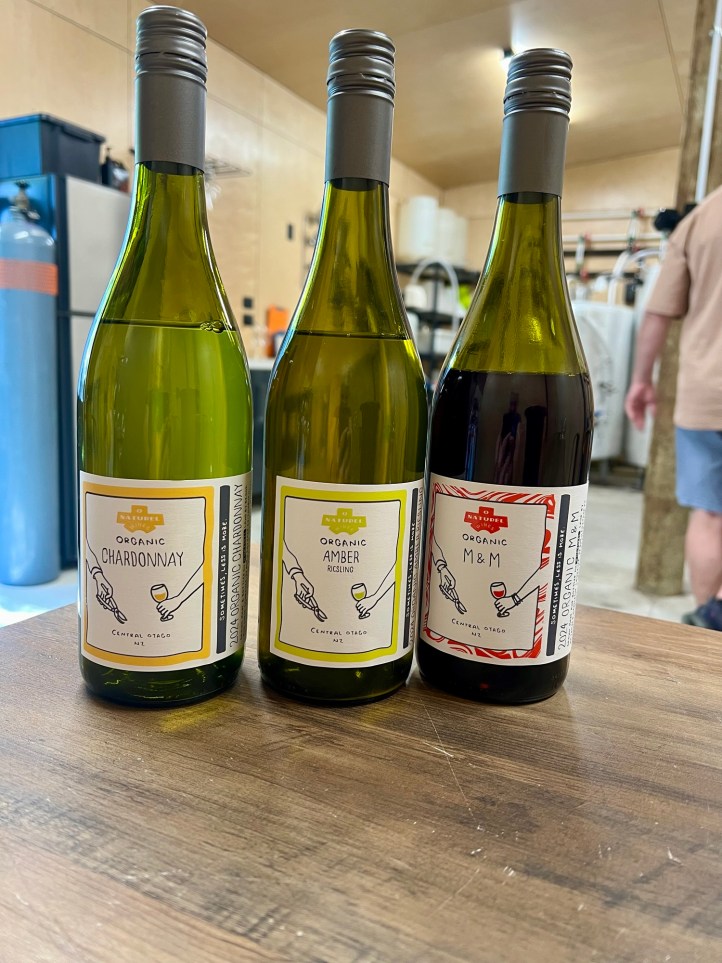
Lucie gave us a taste of her Amber Riesling, as she had given us a bottle of her Dry Riesling as a welcome gift, which we had enjoyed. The Amber Riseling might be called an ‘orange wine’ by some and she made it by leaving the skins on the grapes when making it. Her chardonnay had a very floral nose. They do not use oak as they are committed to making as small a footprint on the environment as possible. Lucie explained that getting a wine barrel from France does not make sense to them. She uses steel tanks, and most of their wines are made to drink now. They do not have any place to store them even if she would like to keep some vintages. And finally we tried her mixed field blend – named M & M, after her two daughters. The wine is made to be consumed as a chilled red wine. She uses the grapes they grow Riesling, Chardonnay and Pinot Noir and the grapes are co-fermented. It was very interesting and I am sure it would be great with a BBQ.
We however bought a bottle of her Chardonnay, her bubbles and a very unusual wine that I had not heard of before – a Sous Voile Chardonnay. Even though we could not taste it.
Sous voile means “under a veil”, in this case, the veil is the flor yeast that forms a film over the surface of the wine in the barrel.
If you look closely in the photo of the winery, just behind Mick there is one small oak barrel. So when I said they don’t use oak for aging their wines, that is correct, but they use this barrel to make the sous voile.
That bottle might be coming home with us for a more serious tasting event. We will see.
 Jane and Mick's Holiday Adventures