This was our last day in Cromwell. And to start the day we headed into town so I could go for a walk along the edge of Lake Dunstan. There are loads of different walking and biking tracks in the area, but I was just happy walking along the lake’s edge near the Old Cromwell Precinct. Where we have been staying on the winery is on the edge of a busy road, and I have not really enjoyed my walks along there so far.
But the main item on our agenda for today was a tasting at Felton Road winery.
A dear friend of ours had recommended to us that we should try a Felton Road Pinot Noir, as it was one of his all time favourites. Now that was high recommendation. And, on doing some research about the wines, our friend is not alone.
Considered by many as New Zealand’s benchmark Pinot Noir, Felton Road is renowned throughout the world for unblemished quality. Their philosophy is driven by sustainability and the wines are produced by way of biodynamic viticultural practices in harmony with their land, the stars and the moon.
The Bannockburn area must be perfect for Pinot Noir.
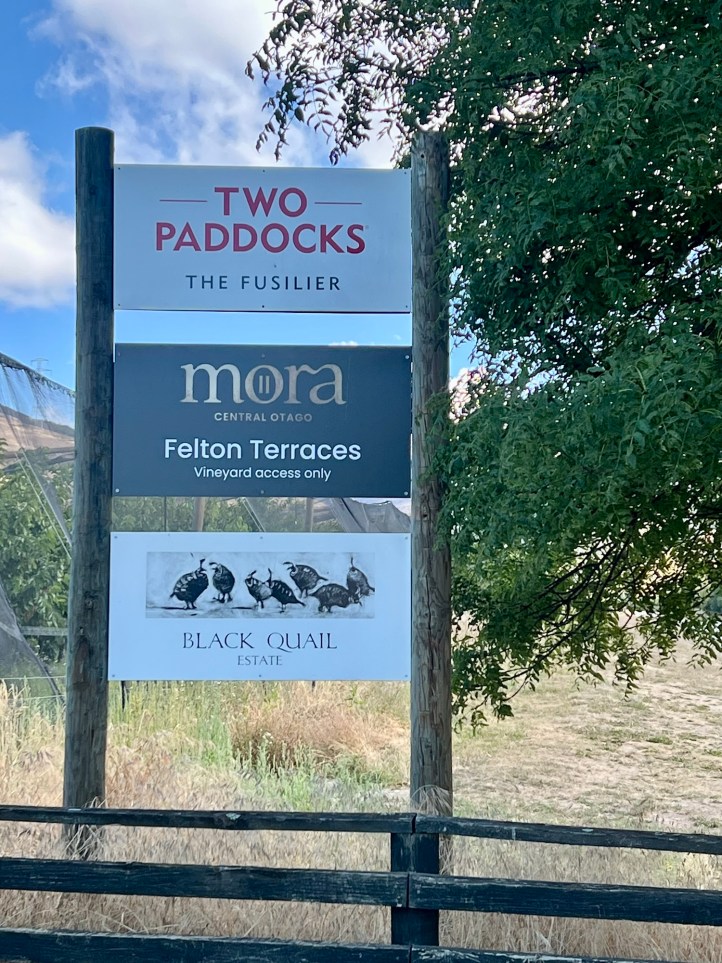
The only way to visit this winery is by appointment. And I was able to secure a time today at 1.30pm. I was emailed the code for the gate to enter the winery, and as we drove to almost the very end of Felton Road, we spotted the winery, as well as signs to a few other wineries including Sam Neill’s Two Paddocks.
I was relieved to see that we were not the only ones punching in the secret code to enter the winery. There were 12 of us in total, from different parts of the world. We were the only Aussies, but there were people for the UK and the US as well.
On entering the cellar door, we were met by Ros who asked each of us several unusual questions. She wanted to know how far we had travelled today, where we planned to go to next and what type of car we were driving. It is all part of data they gather to determine their carbon footprint. She commenced the tour outside overlooking the north-facing slopes.
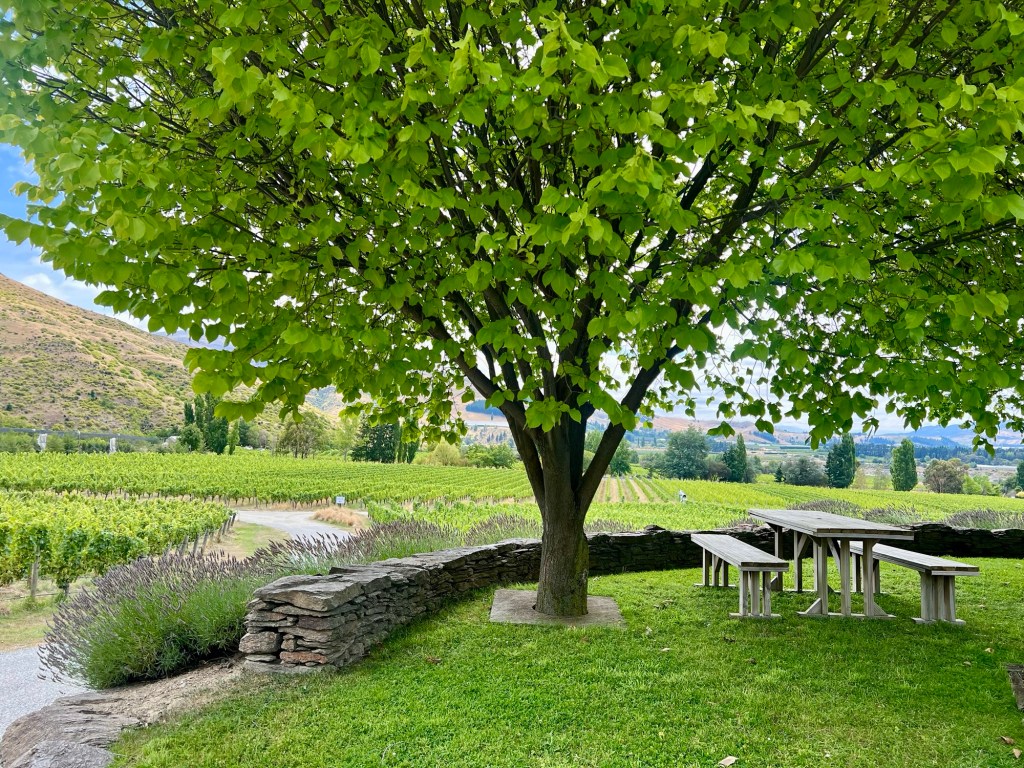

Ros gave a great history of the vineyard, explaining that the original vines were planted in 1992, and that now there are four different plots, the last one takes the truck filled with ripe grapes 25 minutes to get to the winery (carbon footprint again). All up, there are 45 hectares of vineyards, making it a relatively small producer in comparison to other parts of the country. The first vintage under this label was in 1997.
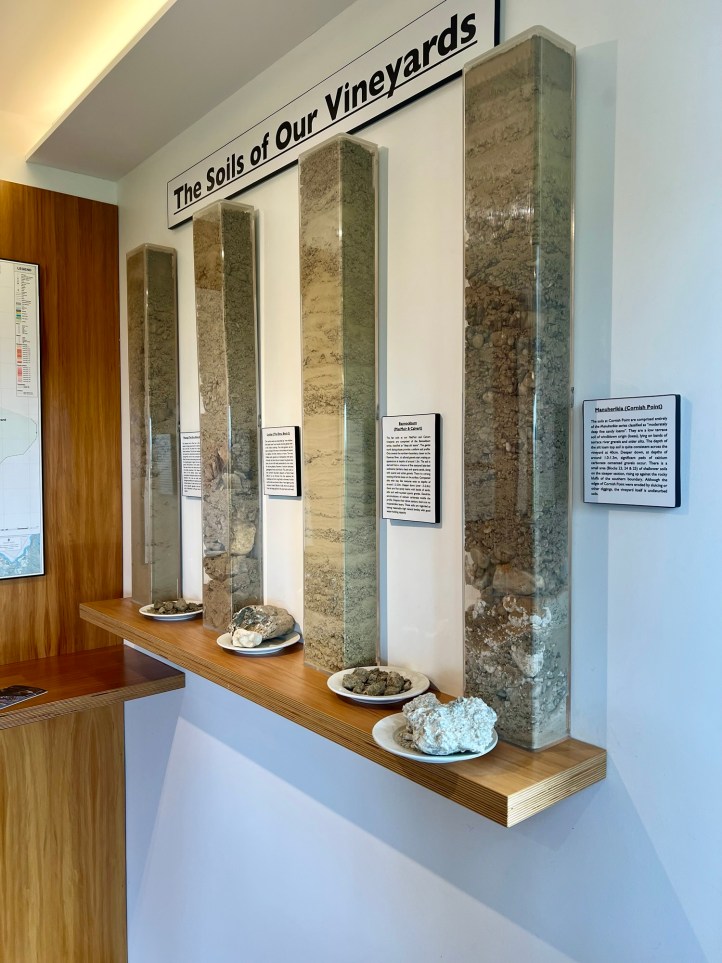
As with most vineyards, the climate and the soil types are most important to the wine quality. This display showed the variations between the four blocks that make up Felton Road. But, essentially, all blocks have free-draining soil which is perfect for growing Pinot Noir, Chardonnay and Riesling.
Since 2002, their vineyards have been managed organically and biodynamically. Mick and I have noticed during our trip to Central Otago that this is a common characteristic of the wineries here. Or at least, many are striving for this classification.
Ros then took us on a tour through the winery and explained that they use a clever three-tier gravity feeding system to move the grapes from the crusher to the vats and then to the barrels. This ensures minimal human intervention during the winemaking process. She also explained that where it was previously common for the grapes to be plunged up to three times a day during the early fermentation process, now it is only plunged once per day. All yeast used is naturally occuring – nothing extra is added. You could tell that Ros was very proud of the procedures this winery has in place to make its world famous wines.
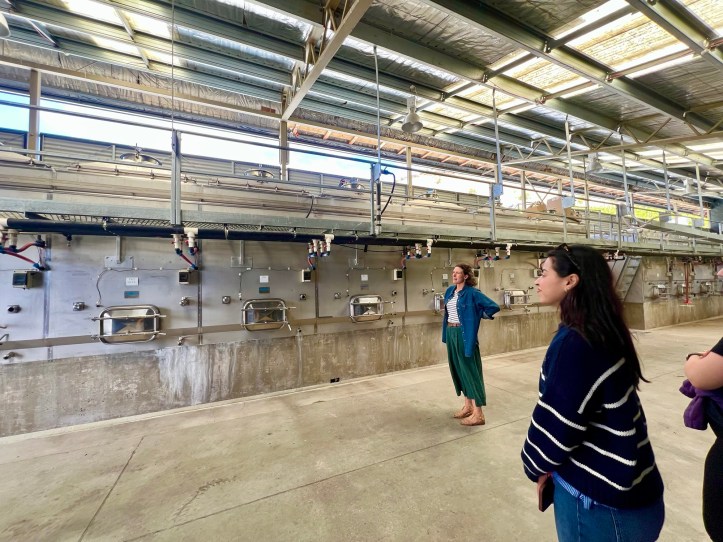
Mick and I had not seen vats like this before – there were two stands of 8 stainless steel vats, side by side, as well as some round, smaller ones in the middle of the floor. The fruit for the 2025 vintage will not be ready to be picked until the end of March, and one block of the Pinot won’t be picked until April. The picking usually takes about 3 weeks and they use between 50 and 70 people to do this. Everything is done by hand.
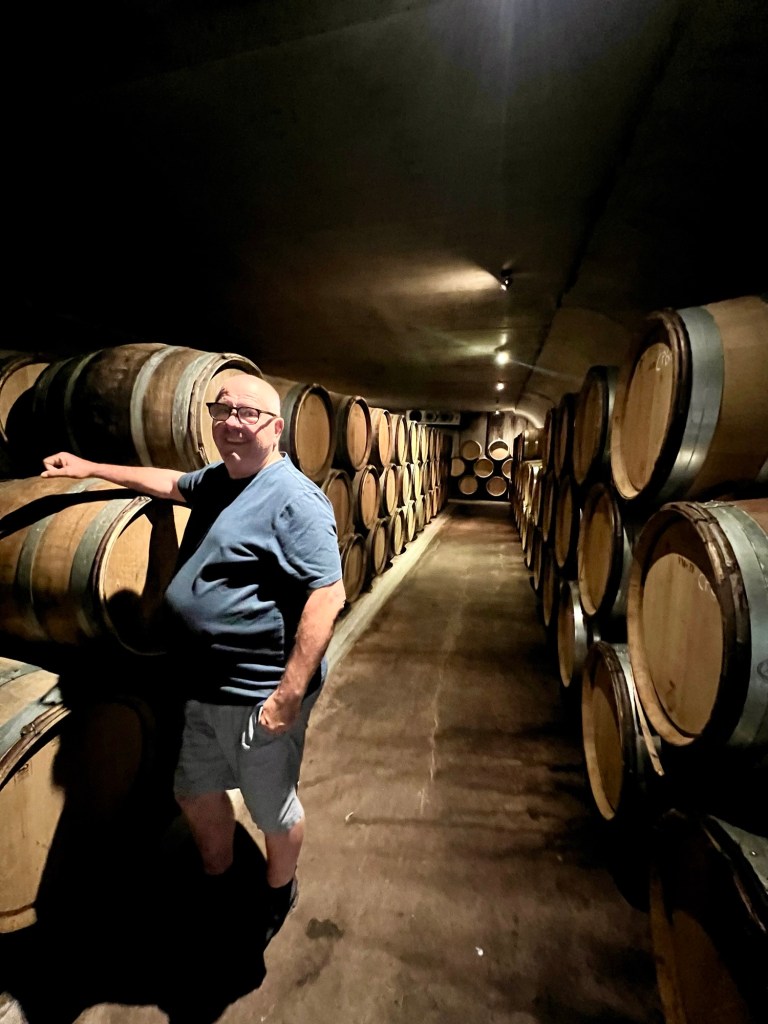
The tour also included a visit to the cellar rooms. We visited two of the four they have. Air conditioning is used to maintain the optimal temperatures. Around 400 oak barrels are used each vintage, with 100 of those being new. Ros explained that there is enough cellar space to hold two vinatges.

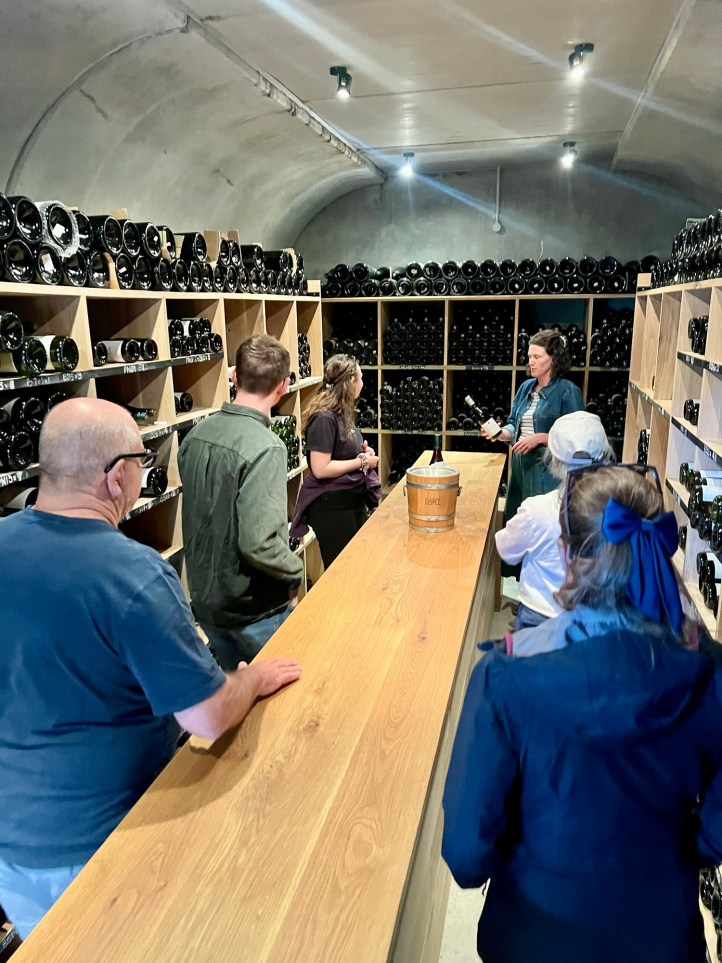
Ros then showed us one of the rooms used to house their library wines. Which she quickly explained were not for sale. They use the bottles for events and special occasions.
The final stop of the tour, before we got to taste some of the wines, was in the room where boxes were packed onto pallets ready for shipment to countries all over the world. We spotted labels for Canada, Belgium and Qatar. But there were others.
By now, we had spent almost one hour with Ros and we were all keen to try the famous wines. Well at least, their latest vintages that were for sale.
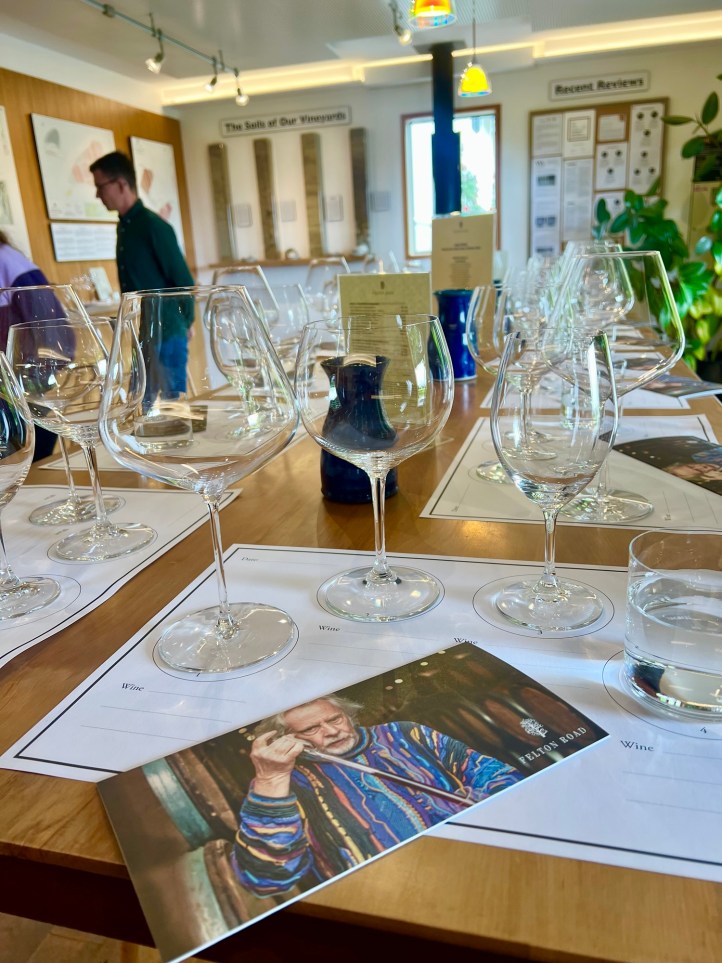
We started by tasting three different Pinot Noirs; the 2023 Bannockburn (which is made from a blend of the Pinot grapes from their 4 sites, and which is the most well known – it retails @ $67NZ), followed by the 2023 Calvert Pinot (from the plot of the same name which retails @ $83NZ) and then a very special taste of the 2023 Block 5 (from that block on the original site and which is not availble for sale except by visiting the winery or if you’re a club member. It retails @ $109NZ).
All three were outstanding, possibly made more so by the beautiful Plumm glasses we used to let the wine open up. But my favourite Pinot of the day was the first one, followed by Block 5. We bought a bottle of the 2023 Bannockburn Pinot before we left.
Then we tasted the 2023 Bannockburn Chardonnay($52NZ) again, this is a blend of the grapes from across the different plots. And it was really good. But it was our lucky day, as Ros had an open bottle of the 2015 Block 2 Chardonnay which is not available for purchase. It was still very fruit forward but with stronger evidence of some of the wine making techniques. I have no idea what a bottle of that would be worth.
The final wine we tasted was the 2024 Dry Riesling (@ $38NZ). It was very acidic – sharp and crisp. It was slightly sweeter than Rieslings Mick usually enjoys – but he still gave it a big thumbs up.
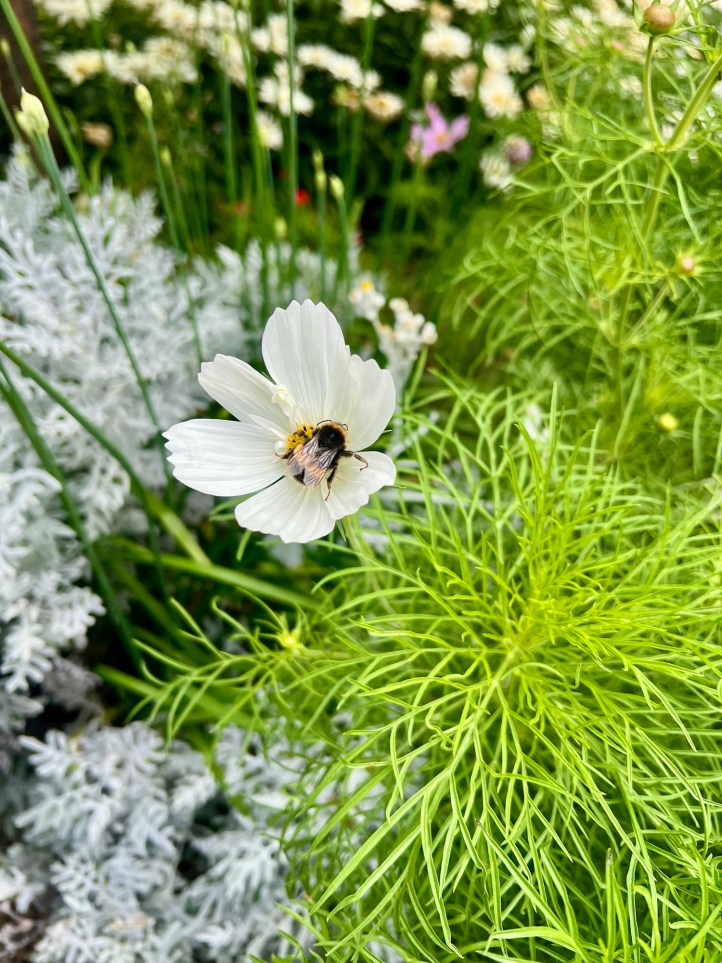
Mick spotted several of these large bees while we were outside listening to Ros – and he is fascinataed by them.
At the end of our tasting and tour, almost 2 hours after we arrived at the winery, we were surprised to find that there was no fee. We would have happily paid for the experience.
But, we did place an order for a mixed case of 15 to be delivered to our home address through the Wine Collective – a special deal was on offer for those of us who had had the tour. We won’t get it until May, as they like to ship all the orders in one go so they can reduce their carbon footprint. I am sure we can wait until then.
So – did we save the best to last?
Yes. Thank you David.
 Jane and Mick's Holiday Adventures
thrilled!! 👏🏻👏🏻👏🏻