Our main activity today was to drive just outside Aranda de Duero to a winery I’d read about while researching for our holiday. I had been able to book a tour and tasting directly with the winery, and when Mick and I turned up (after taking a few wrong turns) the place was in a little bit of chaos. There is no photo to include here of the grand cellar door, because there wasn’t one – only a massive concrete shed which we learnt was built in 2018.
We were met by Christina (Alonso) – one of the co-owners of the boutique winery who took a few minutes getting ready, as harvest was in full swing and she needed to give instructions to some of her staff. She explained that they had started about 6 days ago and that they would be pressing the grapes and making the wine over the next week or two. A much shorter time than usual – so the pressure was on.
Christina explained that she and her partner, Fernando Ortiz (the winemaker), started the winery in 2008 and chose the name of Luthier for the winery. The name refers to the craftsman who builds stringed instruments, and that she and Fernando like to think of themselves as craftsmen of fine wines (my words – not hers).
We toured the facility – stepping over hoses and puddles of water where equipment had been washed out, trying to avoid the workers who I am sure were not really thrilled that we were there at that time.
The grapes are grown by viticulturists in the nearby area of Ribera and the winery only buys fruit from vines with a minimum age of 40 years, but many are much older.


We got a real sense of Christina’s passion for making the wines here – they use minimal intervention, adding nothing to the wine with the exception of a small amount of sulphites to assist with ageing.
The wines start fermentation in large concrete vats and then they are transferred to oak barrels for differing lengths of time before being returned to the concrete vats to settle before bottling.

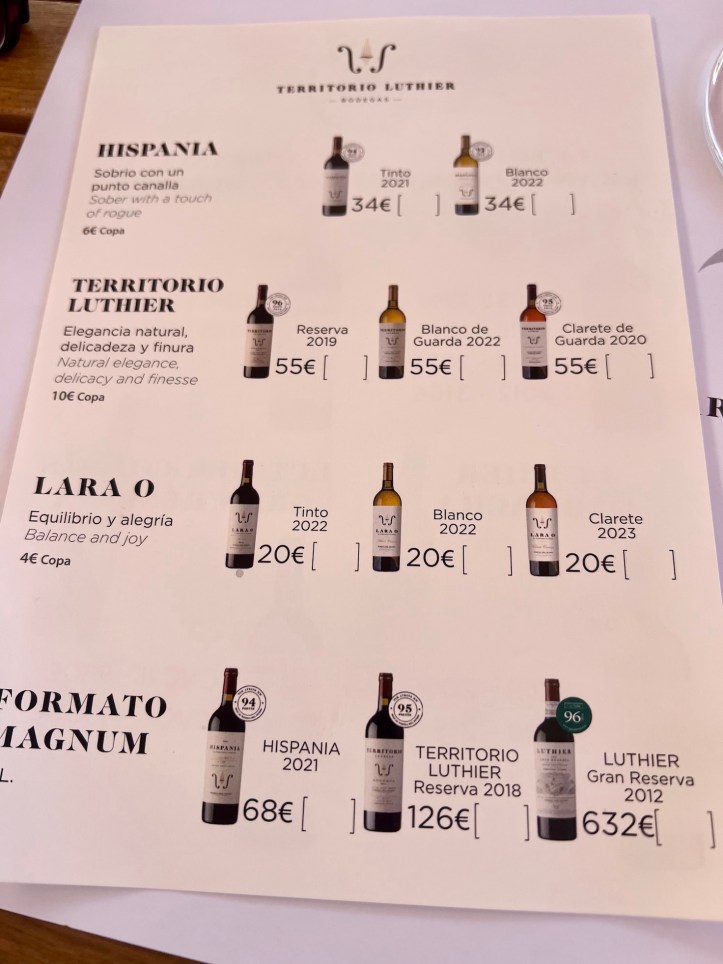
We tasted 6 different wines – and this one here called “Hispania” – is one of their iconic wines at it matured in Spanish oak. Very few wineries use Spanish oak as it is very hard to come by. This wine, like many that we tried have all been recognised by wine writers and judges as being of outstanding quality. Mick and I both liked it, but it was not our favourite.
Most of the red wines they make here are of courses at least 75% Tempranillo, then some Granache and often a few percent of the white wine (Albillo Mayor) to adjust the acidity. Legally, it is the only white grape that can be used in wines made in Ribera de Duero, EXCEPT (Christina explained) if the white grapes come from very old vines, making them ‘historically significant’. Christina named some of them – Bobal (aka Valenciana), Viura, and Malvasía. And they use most of these.
For many years, Ribera del Duero only encouraged the production of red wine – Tempranillo. This resulted in many of the white grape vines being destroyed. But now, Albillo Mayor is being planted more extensively as it now has the nod to be labelled Ribera del Duero.
We tried a fabulous white wine – their 2022 Blanco de Guarda, which had undergone malolactic conversion in barrels, and which was made of a ‘field blend’ – all different types of white grapes, but mostly Albillo Mayor. It was fantastic, and apparently it has been voted the best white wine in Ribera. Even though we both loved it, we did not buy a bottle. Instead we bought the 2019 Reserva and a bottle of Clarete. But not any Clarete – pronounced clar-ET-tay. We had not heard of this before yesterday during our tour with Daniel, and here today we tasted two different wines.

Clarete is a traditional wine style of Ribera del Duero that had gone out of favour, but is now undergoing a revival by certain brave winemakers, and Luthier has taken it one step further by ageing the wine in oak barrels. Both red and white grapes are co-fermented, which is very different to how rosé is made. So, this is definitely not a rosé.
Our tour took 90 minutes and then Christina said that we were no longer ‘tasting’, we were ‘drinking’. Sitting outside under large umbrellas while nibbling on some chorizo and cheese made for a very pleasant afternoon – but I pulled up stumps as I was the driver.
We headed home for some lunch and a siesta before venturing out for more fun and frivolity.
Before we went for our wine tour, we had walked into town for a coffee and had to get out of the way of one for the Peñas, who were marching across the bridge in the same direction as the group I saw yesterday.


As we wandered back from our coffee, we discovered a few narrow streets with interesting architecture. Part of the building on the right was derelict, but surprisingly the side in front of Mick was obviously inhabited.


Dinner was not as good as the previous evening’s meal, but we were lucky to get a table as the streets were still full with people enjoying the fiesta. As we left the restaurant, different groups of people in their uniforms, each with their own bands, were marching along the street, one after the other. There were hundreds of people in the procession and we walked along beside them for the length of the street. We recognised some bands as those we had see marching about 12 hours earlier in the day. We have no idea how they can keep it up.
 Jane and Mick's Holiday Adventures