Staying right in the centre of a city has its pros and cons.
Mick and I usually prefer to base ourselves centrally so we can walk to most places or use the public transport. Travelling with Mick’s 90 year old (very fit) mother though, did mean we had to re-think a few of the options we’d normally take on such a holiday, but only a few.
A negative of course can be the noise. And, our accommodation in Palermo did get its fair share of that. The streets at night were filled with the noises from party goers, locals returning from work, police sirens, and cars and bikes echoing through the almost empty streets in the very early hours. But the one that got to me, was that of the Tom cats fighting. They sounded as though they were in my bedroom. 😬
Thankfully, there were also the periods of absolute silence which helped you return to sleep.
I knew that Palermo is the capital of Sicily, but I was really surprised to read that it is Italy’s fifth largest city with around 700,000 people. Although another source had Genoa as fifth. So don’t bet on my information here. Nevertheless it is a very significant Italian city. Our tour guide actually said the total population was closer to two million and that the 700,000 were only those living in the city centre. He also mentioned that in high season there can be up to 8 cruise ships moored in the port and between 30,000-50,000 tourists descend on the city for a few hours.
As with most European cities, Palermo is full of contrast. Brand new shops and restaurants, sometimes built inside hundred + year old buildings, next door to the ruins of brick and plaster buildings crumbling under the city grime.
Sadly, I got the sense that the city’s leaders have given up on preserving or improving Palermo. It seems too hard, and perhaps it is.
When we asked our host where the recycling could be taken, we were told that you need a car and that Palermo does not have easily accessible locations.
Our tour guide told us that Sicilians insist on driving everywhere and will park as close as they can to wherever they’re going. Even if the parking is illegal. This explained why we did see some collection points on our walks, but for our host, this was too far to be bothered.
We had seen the common recycling bins in Cefalù but in the central part of Palermo where we were staying we really only saw mounting rubbish.
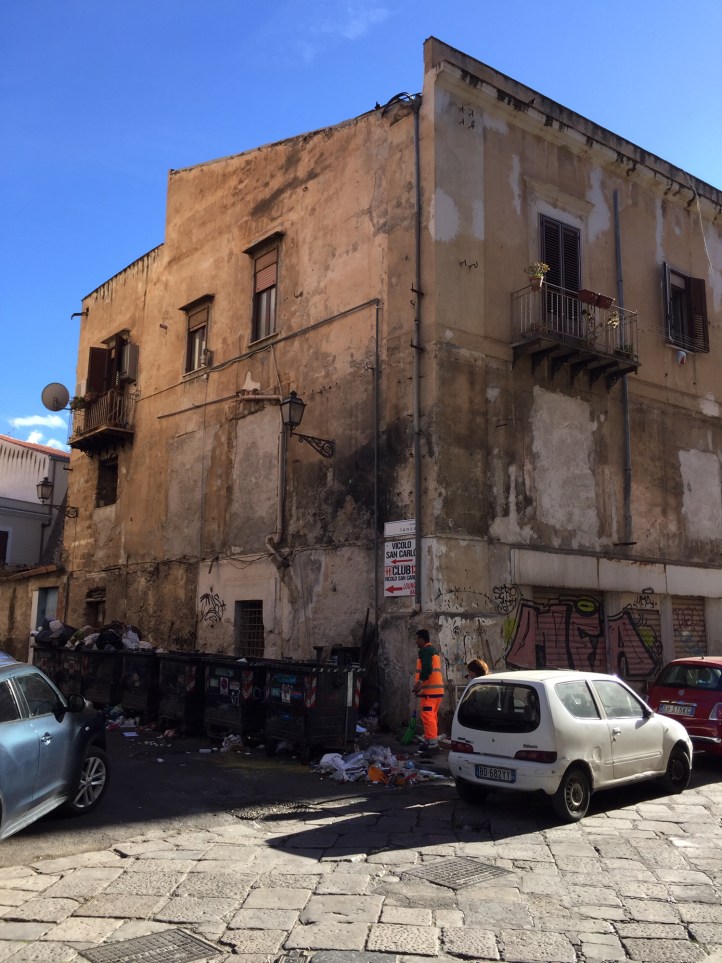
I found an article by Seamus Murphy written a few years ago which accurately, and in a less clumsy way than my writing, describes my observations of this city too. He received some negative comments from people upset that he had pointed out the ‘negative side’ of the city and for including photos of rubbish and chaos.
But, it’s the truth.
Today I did see a council worker taking great care with cleaning the streets near the Piazza Pretoria, which did give me some hope and make me re-think my views on the city.

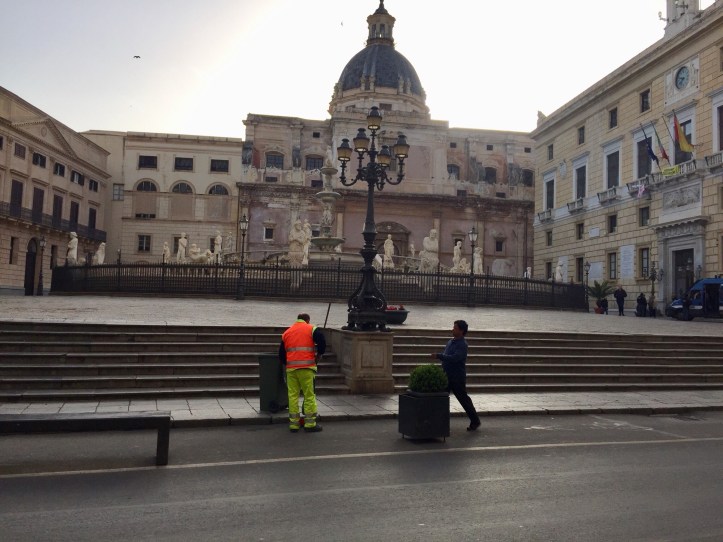
A few days earlier though, we’d noticed a council worker manoeuvring a large vacuum cleaner along a street beside the edge of the narrow path we were negotiating. She was vacuuming up cigarette butts, well most of them, but walking blindly by empty beer bottles, food scraps, paper wrappings and plastic bags. She definitely did not do as good a job as this man.
This to me highlights the depth of the problem.
What of the future for Palermo if it doesn’t address this single problem of rubbish management?
Obviously tourism is an important source of income for this city. But, how long can it cope with the rubbish tourists generate and the resources they consume?
As a tourist I do reflect on my impact on the places I visit. Mick and I have been fortunate to visit quite a few places in many parts of the world in the past ten years, and there are many places where leaders are trying to balance the pros and cons of tourism.
Palermo leaders must re-think their approach to garbage at least.
 Jane and Mick's Holiday Adventures
I wonder if they have had trash dumps over the years/millennia or if they — as NYC used to do — once hauled their trash out to sea and dumped it in the depths? Certainly all human beings need to be increasingly aware of our ecological footprints if we would like to leave any semblance of functioning ecosystems here on planet earth to the care of our children, grandchildren, and great-grandchildren…
Very philosophical indeed, Mum. 🤔