PROVISO:
As I have admitted before, I am no student of history. But, what I learnt during a visit to Saint Dié I feel is worth sharing. These are my interpretations and my comments of what I read and saw. And, I must point out that with us being in France we are reading this country’s interpretation of what happened.
Mick and I visited the Musée de Pierre Noël in Saint Dié the other day. It is both an art gallery and a museum, combined. It houses an eclectic collection of taxidermy, hundreds of specimens of mostly birds, and alongside that were displays of memorabilia of WWI and WWII, plus loads more collections of art and memorabilia. Jules Ferry, also featured prominently, having been born in Saint Dié, and because he was a very famous French politician. But, what interested us most, was the display about the town itself, about its destruction in November 1944, and its subsequent reconstruction.
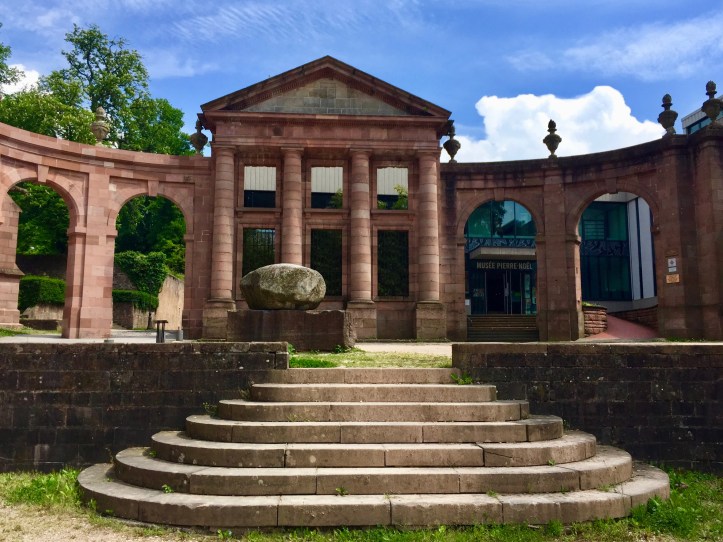
The photo below show a partially standing facade in front of the very modern building that houses the museum. It is located in the same square as the Cathedral of Saint Dié.
Mick and I were both amazed to read about the city’s history.
On 26 August 1944, General Leclerc set Paris free from the control of the Germans who had ruled the city since 22 June 1940. French army tanks drove into Paris to joyous celebrations that the city, and its people were finally free.
Sadly, this was not the case in the Vosges. Just over 300Km away, the war was still very much in progress.
German soldiers were fleeing Paris, and the western and south-western parts of France. They descended on the Vosges (remember that it had previously been their territory). One historian described the collection of Germans in the Vosges at this time as the worst of the worst. They included members of the Gestapo and the militia, as well as soldiers. And, they were not going to give up lightly.
In early September 1944, these Germans waged a very violent war in the Vosges and killed every leader of the resistance groups (marquis) in the area.
The Allied forces were coming. But not quickly enough to prevent the deaths of hundreds of locals.
It took almost two months to get to Saint-Dié-des-Vosges.
One of the reasons given for the delay by the Allied forces was that necessary supplies for the soldiers, as well as ammunition and fuel, were still in Marseille.
This delay gave the Germans plenty of time to develop a plan they hoped would allow them to hold Saint Dié. They forced locals to help dig trenches and shelters on the right side of the river bank, as the Allied forces would approach from the left. But, the Germans soon realised that this was not going to be enough.
 Commencing on 7 November, the Germans started to ‘torch’ the surrounding villages, by using fire and dynamite to destroy as much as they could. They also forced around 900 local Saint Dié men to go to Germany to work in German factories. That left mostly the elderly, women and children in Saint-Dié.
The Germans then come up with another strategy, and that was to cause as much destruction as they could to the city of Saint Dié in the hope that the ruins delayed the progress of the Allied tanks.
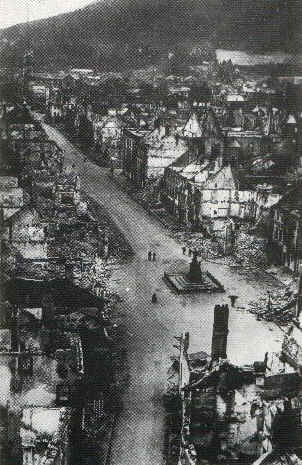
So, on 14 November, the Germans started three days of devastation – they burned and destroyed buildings and factories. On November 16 and 17 the four bridges over the river and three railway bridges were destroyed.
More than 1,300 buildings are destroyed, 400 businesses affected, public buildings are demolished: sub-prefecture, city hall, cathedral, colleges, schools, court, museum, hospitals, hospice, orphanage … Saint-Dié is no longer of value in the eyes of the Germans, the important thing is to join the ridges to postpone their front line.
In the end, there was no fight necessary to free what was left of Saint Dié, as the Germans had fled. But, the Allies had dropped bombs during the period the Germans held Saint-Dié. And, civilian lives were lost (or wounded) as a result of both actions. The Germans shot 34 people during this occupation, and more than 2000 people were forced to work for the Germans or were taken as prisoners.
What the museum also highlighted was the process of reconstruction of the city.
It showed how the locals lived for quite some time in timber huts, temporary accommodation, while the process to rebuild the city was underway.
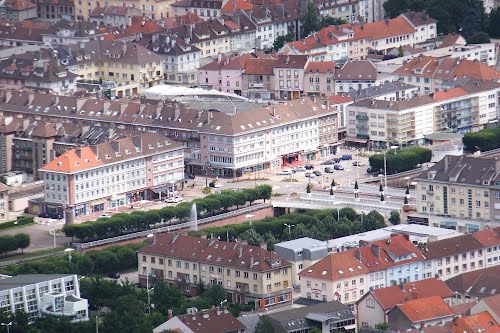
This museum helped me to understand why some of these French towns, Saint Dié in particular, do not look like what I’d call ‘traditional French towns’. I know many were badly damaged during WWII, but I have been surprised that the reconstruction of them looks so stark and different.
Apparently the French Government wanted to rebuild the cities and towns destroyed in WWII mostly as they were before. However, some architects, one in particular for Saint Dié, wanted to design new modern cities. The architects took the opportunity to test out their ideas.
The museum had a large display (a whole floor) concerning the work of an architect known as Le Corbusier (not his real name), who was a world famous, modernist architect in 1945. It showed how Le Corbusier developed his ideas for the new Saint Dié, how consultations occurred with the residents and how the new areas of the city would include lots of green spaces and tall apartment blocks, some with shops on the ground floor.
Anyway, as a result of the consultations, Le Corbusier’s dream for Saint Dié, was roundly rejected.
I’ll leave you to decide how they did.