BAKGROUND – We are in the Côte d’Or Department of the Bourgogne-Franche-Comté Region, and our wine tour was inside the appellation of Côte de Nuits (one of 84 in the Bourgogne Region).
We spent over three hours with a couple from Brazil and a young French man called Christopher, who took us on a tour of two vineyards just outside of Dijon. At one of the vineyards, we matched wines with some local cheeses.
Boy, did we learn a lot about the Bourgogne Region’s wines. Including, that this is the region where the most expensive wine in the world is produced. No wonder Mick and I had never heard of it before, but interestingly the couple from Brazil knew all about it.


Mick does not look his happy self in this photo – he was putting on a brave face, because only an hour before this he had hurt his knee rather badly as he was getting out of the tour van, which was higher off the ground than he thought, and he reefed his knee. And this was even before he had tasted a single wine. Fingers crossed ibuprofen and some light massaging can get him back into shape for our next house sit which starts in two days.
We were able to taste four wines at our first stop.
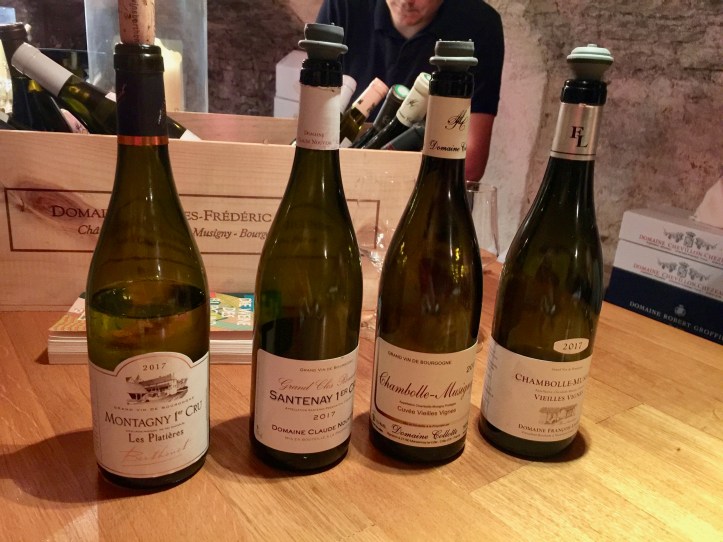 The Burgundy Region, now called Bourgogne is famous for single grape variety wines of Chardonnay and Pinot Noir. And both these wines are often referred to as ‘Burgundies’.
This is very different from the last few locations we have been to that produce (mostly) blended wines. The rules of those other AOP’s (Appellation d’Origine Protégée), like the one we visited at Pic Saint Loup dictate the framework for the blends.
There are actually four types of grapes grown in Bourgogne – Chardonnay and Aligoté (used to make white wines), and Pinot Noir and Gamay (used to make red wines). But way back in 1441, as part of the ducal powers of Bourgogne, Phillipe the Bold prohibited winegrowers from growing the inferior Gamay in favour of Pinot Noir. The Dukes from this part of France were very serious about making excellent wines even before that, and the monks before the dukes.


Following that experience we were then taken to our next stop – which was a much bigger entity – called Caveau Moillard. Here we were supposed to taste six wines, but we ended up trying seven.


The extra wine we got to taste was the Crémant de Bourgogne, another ‘methode traditionale‘ wine for us to try. We tasted it both with and without Crème de Cassis (a sweet alcoholic beverage made from blackcurrants).
 Christopher, our guide, told us that the very popular cocktail called Kir, was developed in Dijon by the then mayor of the city when he mixed the inferior local white wine Aliganté with crème de cassis. (If the cassis is mixed with bubbles it is called a Grand Kir.) Some other facts Christopher told us as he took us on our tour, and I have not confirmed all of them, but you might be interested to know include the following.
The Bourgogne Region:
- produces only 4% of France’s wines production.
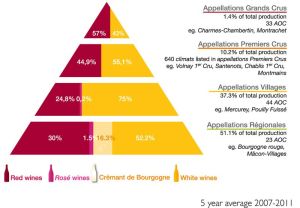
- there are four classifications of wines in Bourgogne which must be identified on every label of wine from the region. In order from the best these are:
- Grand Cru which makes up only 1% of the Bourgogne wine – therefore 0.4% of French wine, and the labels state this very clearly along with the name of the winemaker and the vineyard from where the grapes are grown.
- Premier Cru – about 10% of production and these wines bear the name of the domaine.
- Village – about 38% of production and these wines show the name of the village in biggest print.
- Regional – about 50% of production and the bottles are labelled as Bourgogne wine.
- different classifications arise from the ‘terroirs’, but the age of the vines is also important. Usually the regional wines are those grown on flatter land and the higher up the hill you go, the thinner the soil and the harder the vines have to work to produce fruit. Here the quantity is less, but the quality is superior.
- has 33 Grand Cru producers only and there will be no more.
- 9 of 33 Grand Cru producers are found in and around a village we visited called Gevrey-Chambertin. (Must be great terroir!!)
- small (work) huts found in vineyards are called ‘cabot‘, unlike the ones we’ve seen near Caudiès which are called ‘casot‘.
- vineyards are shared between producers, e.g in Côte de Nuit there are 50 hectares of Grand Cru vines shared between 85 producers. Often the cabot is a marker for the winemaker who may have 3-4 rows of vines.
We also learned what the term ‘clos‘ means if seen on a wine label. It means that the vineyard is enclosed, usually with a rock / stone wall, used to help prevent erosion of the vineyard.
Mick and I found the wines of this region rather expensive, but perhaps that is because Bourgogne takes its wine growing very seriously and controls the quailty very closely. It has a higher number of AOPs than any other French region, and is often seen as the most terroir-conscious of the French wine regions. The practice of delineating vineyards by their terroir here goes back to medieval times, when various monasteries played a key role in developing the wine industry.
FOOTNOTE – Chablis (made from mostly Chardonnay) and Beaujolais (made from mostly Gamay) were formally part of the Burgundy wine region, but wines from those subregions are now referred to by their own names.
 Jane and Mick's Holiday Adventures
And more to the point, what did you think of them/ Did they knock your socks off? (Mick looks like recovery took about as long as the first drink, although that may be way harsh.)
A good question!! And, one I had deliberately avoided to answer. Because, we didn’t really like them.
The Pinot Noirs were over-priced and ‘thin’ to quote a friend of mine!! My palate certainly prefers the bigger reds.
As for the whites, Mick thought some of them were ‘soapy’. Don’t ask me what that means, but again many were over-priced.
We did however enjoy a glass or two of the whites and the rosés while we were there.
But our hearts weren’t in it!!
We are looking forward to returning to the South of France in a couple of weeks where their wines are a better match for our tastes.