New Caledonia, here we come!!
Mick and I were looking for a short getaway that would provide us with the chance to experience a different culture, that was not too far to travel, that did not cost an arm and a leg to get to, and where we could get the chance to practise our French.
Et voilá.
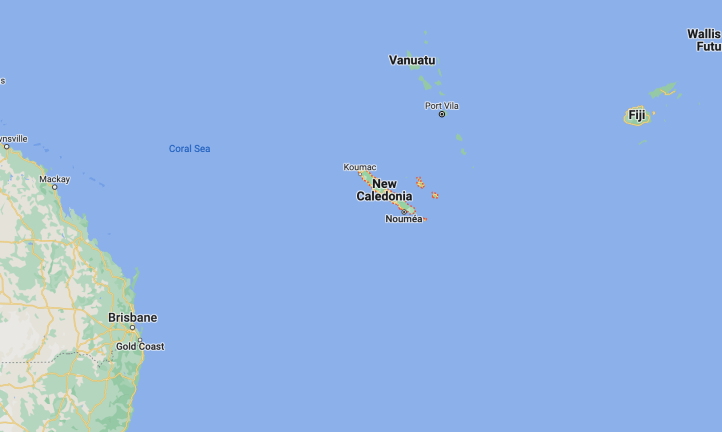
We were both very surprised to discover that the flight time from Brisbane to Noumea, was only 2 hours and 5 minutes (although it is sightly longer on the return leg). That makes it quicker to fly there from Brisbane than it is for us to fly to Melbourne, and certainly less than half the time it took us to fly to Perth – our last holiday destination.
We are heading off not knowing a great deal about the French territory, except that it comprises dozens of islands, with many beautiful beaches and lagoons. We have decided not to stay in Nouméa, the capital, rather we have chosen a suburb 4km to the south of the city centre where we are hoping there will still be many French-influenced restaurants and cafes for us to explore.
Once I had booked our flights, I spent a few hours most days revising my knowledge of French, and learning a little more about our destination.
- The main island, known as La Grande Terre is approximately 400 km in length and is 40 km wide.
- New Caledonian citizens have French nationality and can vote for the president of France, and as well, they have the right to vote in elections to the European Parliament.
- Indigenous New Caledonians, Kanak people, are very keen (and that is an understatement) to separate from France.
- There have been 3 referenda undertaken in recent years about the support for independence: in 2018 – 57% of New Caledonians voted NO to Independence; in 2020 – 53% voted NO, and then the final referendum in December 2021 showed a massive increase to 96.5% voting NO. However in the last referendum, fewer than 44% of people voted – the Kanak people mostly abstained or boycotted the vote, as many were in mourning due to deaths from COVID-19, and had wanted an extension to the timeline. The link: Referendum background provides for some interesting reading.
- The long-term agreements that have kept the peace between the pro- and anti-independence sides have expired and there is no agreed governance after early 2024, when the local congress mandate ceases. Concern over possible unrest in this group of islands is growing. (Perhaps now is a good time to visit!)
So, what of the population of New Caledonia and its makeup?
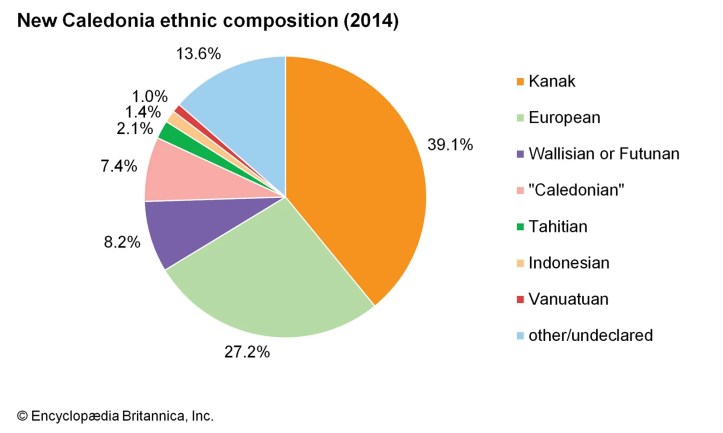
While this graph is almost 10 years old, it shows that in 2014 almost 40% of the population were Kanak or of Melanesian descent, compared with 27.2% being European.
I had to look up the term Wallisian or Futunan and discovered that the Territory of the Wallis and Futuna Islands is another French island collectivity in the South Pacific. It (or they) are situated between Tuvalu to the northwest, Fiji to the southwest, and Tonga to the southeast. In part of the history of Wallis and Futuna, prior to 1961, it was administered by New Caledonia.
So it would appear that the French do have a ‘footprint’ in the Pacific that it apparently is keen to maintain.
The latest figures show that the total population of New Caledonia is 293,000, similar in size to Geelong or Wollongong. The data also shows that the birthrate of the Kanak / Melanesian population is increasing at a greater pace than other ethnic groups. Added to this is an increase in the number of non-indigenous people leaving the territory each year, resulting in a shift in the balance of cultures. It would be interesting to see what today’s figures show of the ethnic composition.
While New Caledonia contains around 10% of the world’s nickel supply, which provides a source of income for the territory, it relies heavily on financial support from France, with almost 20% of its GDP (gross domestic product) being paid for by France.
The currency in New Caledonia is the Pacific Franc or CPF – (with those letters originally coming from Colonies Françaises du Pacifique). Just before our departure, the exchange rate was around 72 CFP francs to $1AUD.
The CFP franc (XPF) is the official currency of four French overseas island collectivities: French Polynesia, New Caledonia, Wallis, and Futuna. The currency was introduced in 1945 to protect the colonies from the post-Second World War devaluation of the French franc and is subdivided into 100 centimes.
Investopedia
We have received mixed comments from people when we mention we are heading to New Caledonia. There are definitely strong views about our destination – some people love it, while others say it is “boring”.
Well, Mick and I are about to find out as we head for La Toutouta International Airport in New Caledonia tomorrow. The airport is more than 45 Km to the north of the capital, so I have organised an airport transfer to take us to our accommodation.
I’ll keep you posted as to how we go.
 Jane and Mick's Holiday Adventures
Fascinating!